
The Ultimate Guide to Ukulele Chord Chart: Learn the Basics and Beyond
When you’re starting with the ukulele or looking to improve your playing skills, understanding how to use a ukulele chord chart is one of the most important aspects of learning the instrument. A chord chart is essentially a visual guide that helps you play different chords on your ukulele by showing you where to place your fingers on the fretboard. Whether you’re a complete beginner or someone looking to expand your chord vocabulary, having a solid grasp of chord charts is key to becoming a proficient player.
In this comprehensive guide, we’ll explore what a ukulele chord chart is, how to read it, the most commonly used chords for beginners, and how to practice efficiently using the chart. By the end of this article, you’ll have a better understanding of how to navigate chord charts, which will help you improve your playing skills and confidence.
What is a Ukulele Chord Chart?
A ukulele chord chart is a diagram that shows the string and fret positions for playing a chord on the ukulele. These charts represent the strings and frets visually to help you understand which fingers to place where. The chart consists of a grid of vertical lines that represent the strings and horizontal lines that represent the frets. The dots or circles placed at the intersections of these lines indicate where you need to press the strings.
READ THIS ALSO: The Ultimate Guide to easy ukulele songs
The ukulele typically has four strings, which are represented by the four vertical lines on the chord chart. The horizontal lines represent the frets, which are divided by spaces. A number or dot inside the grid will show you which fret to press for each string. Open circles indicate strings that should be played without pressing any fret, while an “X” indicates strings you should avoid playing.
Understanding How to Read a Ukulele Chord Chart
Reading a chord chart is straightforward once you understand the basic components. Here’s a breakdown of how to read a typical ukulele chord chart:
- Vertical lines: Represent the four strings of the ukulele, from left to right: G (top string), C, E, and A (bottom string).
- Horizontal lines: Represent the frets on the ukulele’s neck. The first line represents the nut (the starting point of the fretboard), and each subsequent line represents a fret.
- Dots or circles: Indicate where you should place your fingers. A filled circle means you press that string on that specific fret, while an open circle means the string is played open (no pressing of the fret).
- X: Indicates that the string should be muted and not played.
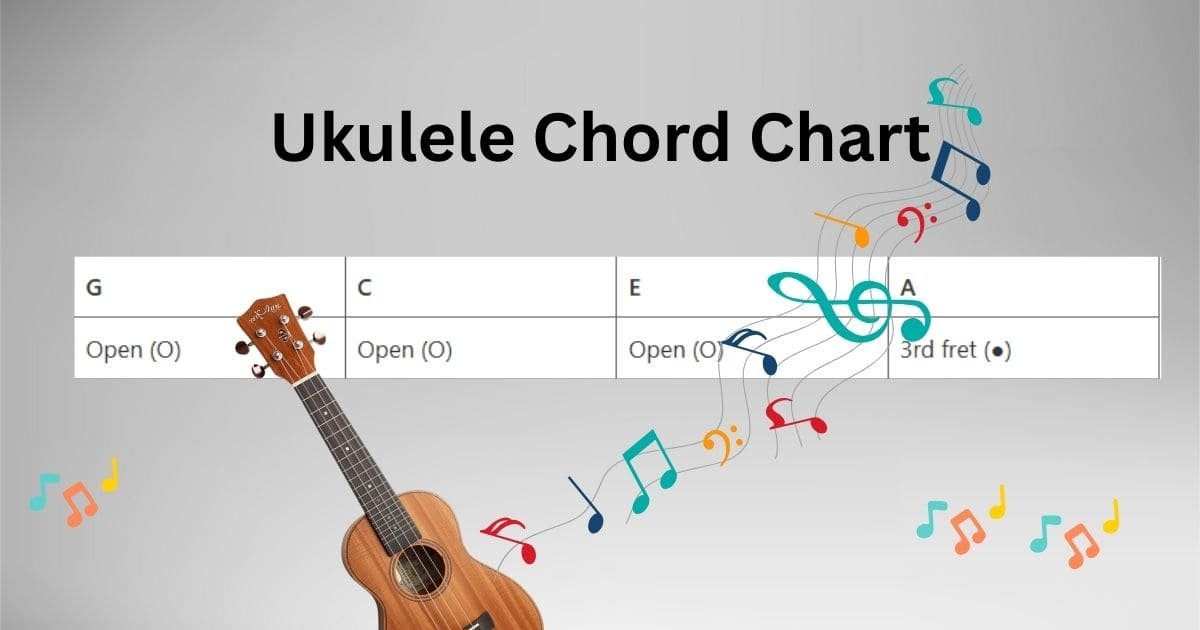
Example of a C Major Ukulele Chord Chart:
| G | C | E | A |
| Open (O) | Open (O) | Open (O) | 3rd fret (●) |
This shows you that the G, C, and E strings should be played open (without pressing any frets), and the A string should be pressed on the 3rd fret.
Types of Ukulele Chords You’ll Find on a Chord Chart
A chord chart is not only useful for visualizing the finger placements for basic chords but also serves as a guide for more advanced chords. Here are the most common types of chords you’ll find on a typical ukulele chord chart:
1. Major Ukulele Chord
Major chords are the building blocks of many songs. They have a bright and happy tone, making them perfect for those diving into a ukulele for beginners guide. Most songs you learn in the early stages will use major chords like C major, G major, F major, and A major.
- C Major: A simple, beginner-friendly chord where you place your third finger on the 3rd fret of the A string. All other strings are played open.
- G Major: A chord that requires a bit more finger dexterity, as you need to press multiple strings across different frets.
2. Minor Ukulele Chord
Minor chords sound more somber or melancholic compared to major chords. These are essential for songs that require a sadder or more emotional tone.
- A Minor: To play the A minor chord, place your second finger on the 2nd fret of the G string. All other strings are played open.
- E Minor: A bit more complex, this chord requires pressing the second fret on the A string, the third fret on the E string, and the fourth fret on the C string.
3. Seventh Ukulele Chord
Seventh chords add complexity to your playing and are commonly used in blues, jazz, and rock music. They create a unique sound that feels like it’s “waiting” for resolution.
- G7: To play the G7 chord, place your first finger on the first fret of the E string, second finger on the second fret of the C string, and third finger on the second fret of the A string.
- C7: A popular chord in Hawaiian music, where you place your first finger on the first fret of the A string and play all other strings open.
4. Suspended Ukulele Chord
Suspended chords don’t feel resolved, which gives them an interesting and open-ended sound. These chords are used for various genres, including pop, rock, and classical music.
- Dsus4: To play the Dsus4 chord, place your third finger on the third fret of the B string and play all other strings open.
5. Barre Ukulele Chord
Barre chords are when you press down all the strings on a particular fret with one finger (usually the index finger). They allow you to play chords in different positions across the neck. These are a bit more challenging but essential for advanced players looking to master complex ukulele chords.
- F Major: To play an F major barre chord, use your index finger to bar all the strings at the first fret and place your third finger on the third fret of the A string.
How to Practice with Ukulele Chord Charts
Now that you have an understanding of what a ukulele chord chart is and how to read it, let’s talk about how to use it to improve your playing. Here are a few tips to get the most out of your practice sessions:
1. Start with Basic Chords
Begin by learning a few basic major and minor chords, such as C major, A minor, F major, and G major. These chords are commonly used in many songs and will form the foundation of your ukulele playing.
2. Work on Chord Transitions
Once you’re comfortable with individual chords, start practicing switching between them. Start slow and focus on smooth transitions. For example, practice going from C major to A minor, or from F major to G major. This will improve your muscle memory and timing.
3. Use Simple Strumming Patterns
To practice chord transitions, start with simple strumming patterns, such as down-strokes and up-strokes. As you get more comfortable, try more complex patterns like down-up-down-up or down-down-up.
4. Learn Easy Songs
he best way to integrate chords into your playing is by learning simple songs that use the chords you’ve been practicing. You can easily learn popular tracks like Riptide or classics like Can’t Help Falling in Love. As you get more advanced, you can try more complex songs with different chord progressions.
5. Focus on Accuracy
When you first start using the chord chart, focus on accuracy rather than speed. Ensure that each string rings clearly, and your fingers are pressing down correctly on the frets. Once your finger placement is accurate, you can begin increasing your speed and playing along with songs.
READ THIS ALSO: Somewhere Over the Rainbow Ukulele: The Song
Tips for Using a Ukulele Chord Chart
Here are some tips that will help you get the most out of your ukulele chord chart practice:
- Keep Your Ukulele Close: Practice frequently and keep your ukulele near you to ensure you’re continually improving.
- Use a Tuner: Ensure that your ukulele is in tune before practicing. Understanding the basics of ukulele tuning regularly will make practicing more enjoyable and productive.
- Take It One Chord at a Time: Don’t rush through chord charts. Focus on learning one chord thoroughly before moving on to the next. Mastering one chord before learning several will help you retain the information.
- Practice Chord Progressions: Practice playing a progression of chords, as this will help you improve your transitions between chords in actual songs.
Conclusion: Ukulele Chord Chart
The ukulele chord chart is an invaluable tool for players of all skill levels. By understanding how to read and use the chart, you can greatly accelerate your learning process. Whether you’re a beginner just learning basic chords or an intermediate player looking to master more advanced chords, the chord chart serves as a visual guide to help you along the way.
As you practice, keep experimenting with different chords, progressions, and strumming patterns to develop your unique style. Remember, the key to success with a ukulele chord chart is consistent practice. Happy playing, and enjoy the musical journey ahead!