Machete de Braga: The Ukulele’s True Ancestor
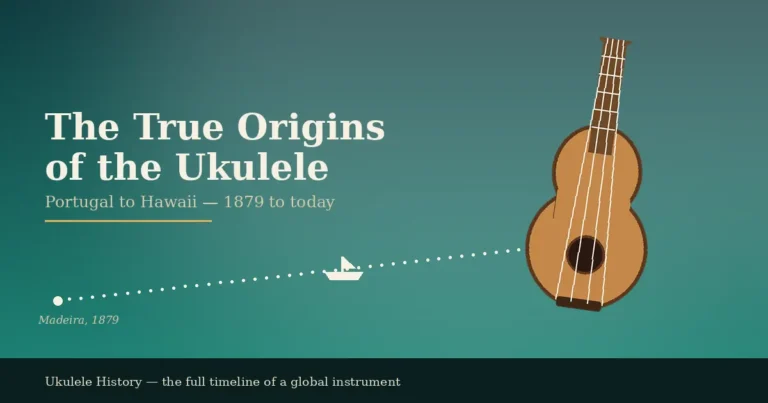
The machete de braga is a small, four-stringed Portuguese instrument — and the closest traceable ancestor of the ukulele. When Madeiran immigrants carried it off a British cargo ship called the Ravenscrag onto Honolulu’s dock on August 23, 1879, the instrument was beginning a transformation that would produce one of the most widely played string instruments on earth. But the machete didn’t arrive alone, and it didn’t become the ukulele overnight. The full story involves a second instrument, three craftsmen, a Hawaiian king, and one specific detail about tuning that most ukulele histories leave out entirely.
Most accounts of the ukulele’s origins stop at “Portuguese.” This page goes further.
Key takeaways:
- The machete de braga is a four-stringed folk instrument from the Braga region of northwestern Portugal, widely adopted in Madeira’s island folk tradition.
- Portuguese immigrants brought it to Hawaiʻi aboard the Ravenscrag, arriving on August 23, 1879.
- Three instrument-making passengers — Manuel Nunes, Augusto Dias, and José do Espírito Santo — built the first ukuleles by adapting the machete using local koa wood.
- A second Madeiran instrument, the five-stringed rajão, contributed the re-entrant tuning concept that defines standard ukulele playing to this day.
- The transformation from machete to ukulele unfolded over roughly a decade — not as a single invention, but as a layered process of craft decisions and cultural exchange.
- King Kalākaua’s patronage gave the emerging instrument its first royal platform, carrying it from immigrant workshops into Hawaiian society at large.
What is the machete de braga?
The machete de braga is a small, lightweight, four-stringed plucked instrument from Portugal’s northwest — its body considerably smaller than a classical guitar, its neck short, its tone bright and forward. Four strings stretched across a narrow wooden resonator produce that characteristic sound: cutting, rhythmic, designed for fast strumming. That same profile — small body, four strings, percussive agility — would become the defining physical template of the ukulele.
Players strum or pluck across the strings in quick, repeating patterns. That rhythmic brightness is a product of string tension, body resonance, and technique developed specifically for Madeiran folk dance. It was exactly the kind of sound Hawaiian players responded to when the instrument arrived on the islands.
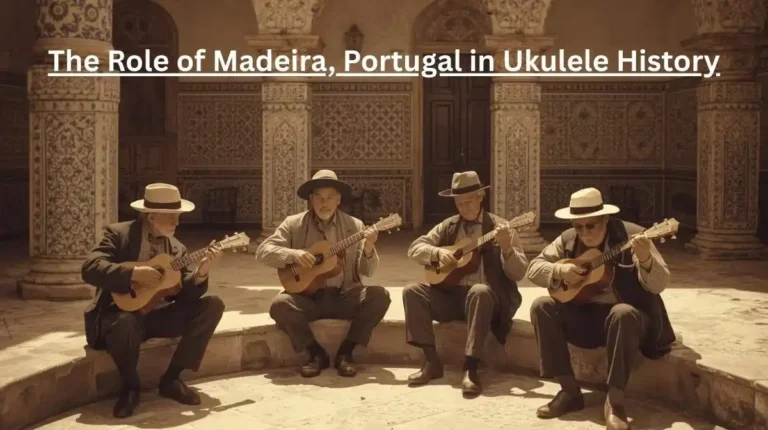
The name needs a little unpacking for non-Portuguese speakers. “Machete” refers to the instrument, not the blade — a confusion almost universal outside Portugal. “De braga” means “from Braga,” anchoring its origin in the Minho region of northwestern mainland Portugal. As the instrument spread to the island of Madeira and became embedded in local folk tradition, it also picked up a regional nickname: the braguinha, carrying the same Braga connection in its name.
The machete’s closest relatives
Portugal’s folk instrument tradition is dense, and the machete de braga has two near-relatives that matter for understanding where the ukulele came from:
The cavaquinho is a structurally similar four-stringed instrument, but its strongest roots are in mainland Portugal and — more significantly — in Brazil, where it became a core instrument in choro. It’s related to the machete but shouldn’t be treated as identical. Regional traditions and tuning practices differed in ways that shaped what craftsmen built in Hawaii.
The rajão is a five-stringed Madeiran instrument with a slightly wider body and a tuning that doesn’t ascend strictly from lowest to highest string. That irregular tuning arrangement — called re-entrant — is the rajão’s specific contribution to the ukulele. It never became the ukulele’s physical template, but its tuning logic is in every chord a ukulele player strums today.
All three instruments crossed the Pacific aboard the Ravenscrag and the ships that followed it. Only one gave the ukulele its body. Only one gave it its tuning.
How the machete reached Honolulu
The machete de braga didn’t travel to Hawaiʻi because anyone planned a cultural exchange. It traveled because of sugar — and because of the hard economics of mid-nineteenth-century Madeira.
Hawaiʻi’s plantation system needed labor from the 1850s onward, and its plantation agents recruited across the Pacific and into Europe. Madeira was a target: the island had been struggling with agricultural depression for decades, and emigration pressure was high. Portuguese workers arrived in waves through the 1870s, mostly under labor contracts, carrying their families, their belongings, and their music.
The machete de braga was among the instruments packed into emigrant luggage. Nobody had a theory about cross-cultural instrument development. They were workers heading to difficult, unfamiliar work on an island they’d never seen.
The Ravenscrag arrives: August 23, 1879
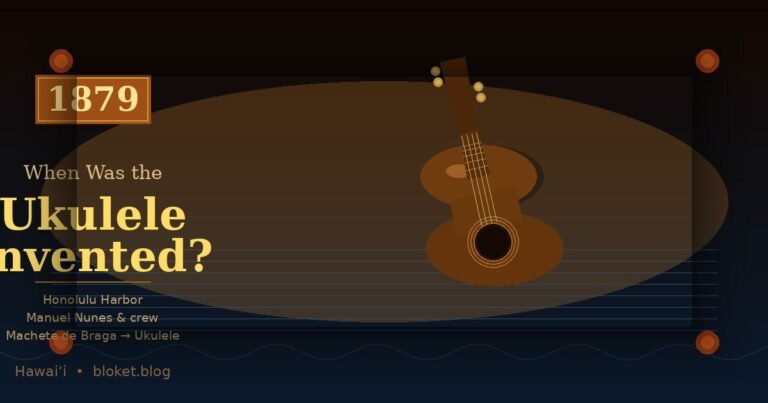
On August 23, 1879, the British ship Ravenscrag entered Honolulu Harbor after a voyage of roughly four months from Madeira. It carried 419 Portuguese emigrants — men, women, and children bound for Oʻahu and Maui’s sugar fields.
Three passengers among that group carry particular weight in the instrument’s history: Manuel Nunes, Augusto Dias, and José do Espírito Santo. All three were instrument makers by trade. Within months of arriving in Honolulu, they had established workshops. Within a decade, those workshops were producing something that descended directly from the machete but had evolved into something distinctly Hawaiian.
The machete de braga they stepped off the Ravenscrag with was not yet the ukulele. But it was the blueprint.
What the craftsmen did in Honolulu
Nunes, Dias, and Espírito Santo were not simply copying a familiar instrument in a new country. They adapted, beginning with the most available material at hand: koa wood. Hawaiian craftsmen had worked with koa for generations, and it was the practical choice for a workshop in Honolulu. It was also a sonically different choice.
A machete built with a European spruce soundboard has a clear, relatively thin tone with a quick attack. Koa produces something else — a warmer fundamental, a more complex harmonic spread through the midrange, a sustain that spruce at similar dimensions doesn’t easily match. When Nunes and his contemporaries switched materials, the sound of the instrument changed with them.
Body proportions shifted too. Playing styles in Hawaiʻi, shaped by existing Hawaiian musical traditions, fed back into what the instrument needed to do. The changes were incremental and practical, not theoretical.
Historian’s note: The Bishop Museum in Honolulu holds records, including Hawaiian-language newspaper accounts from the 1880s, that reference the instrument being played widely before the decade ended. Those accounts consistently associate the instrument with the Portuguese craftsmen from the Ravenscrag. What those records don’t give us is a clean invention date — because there wasn’t one. The machete became the ukulele gradually, through hands-on decisions made in real workshops by craftsmen who were solving real problems, not theorizing about organological evolution.
From machete to ukulele: the three key changes
The machete de braga and the soprano ukulele share structural lineage, but they aren’t the same instrument. Three categories of change — tuning, body proportions, and tonewoods — define what the transformation actually produced.
The tuning problem and the rajão’s answer
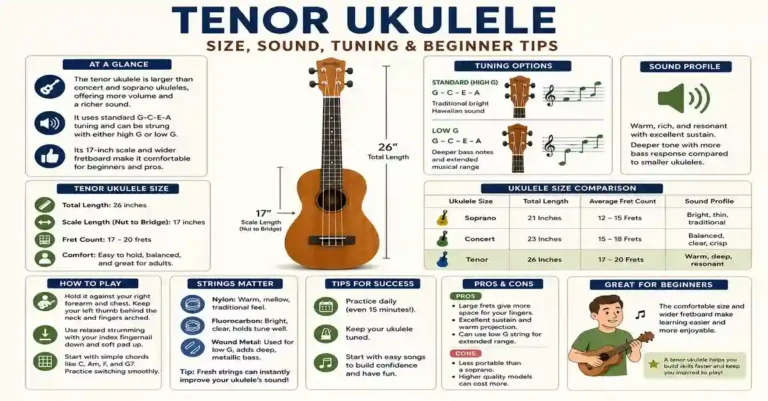
The machete de braga has four strings arranged in a straightforward ascending pitch sequence. The soprano ukulele has four strings tuned G-C-E-A — but the G sits higher in pitch than the C string beside it. That non-sequential arrangement is called re-entrant tuning, and it doesn’t come from the machete.
It comes from the rajão.
The rajão, that five-stringed Madeiran instrument that crossed the Pacific alongside the machete, was tuned so that one of its strings broke the expected low-to-high sequence, sitting higher in pitch than neighboring strings would imply. Hawaiian craftsmen and players took that concept and applied it to the four-string framework of the machete. The result was the high-G re-entrant tuning — G-C-E-A with the G above middle C — that every soprano, concert, and tenor ukulele player encounters today. This is the rajão’s contribution: not the body, not the string count, but the tuning logic that makes the ukulele sound unlike anything in the guitar family.
Scale length and body dimensions
The soprano ukulele has a scale length of approximately 13 inches, or 33 centimeters. The machete de braga sits in a comparable compact range, though body shape and proportions varied by maker and era. Both instruments were built for rhythmic agility: short necks, fast fret access, bodies designed for rapid strumming patterns. That shared design philosophy isn’t coincidental — the ukulele inherited it directly.
Wood, tone, and the koa difference
The tonal shift from a European-made machete to a Hawaiian-made koa ukulele is audible when you listen to recordings of both. A spruce-top machete is bright, even slightly thin at its fundamental. A koa ukulele — particularly one built from dense, mature Hawaiian koa — is warmer, rounder, with harmonic complexity in the midrange that spruce at similar dimensions doesn’t naturally produce. The material changed; the character followed.
Machete de Braga, Rajão, and Soprano Ukulele: a direct comparison
| Feature | Machete de Braga | Rajão | Soprano Ukulele |
|---|---|---|---|
| Number of strings | 4 | 5 | 4 |
| Tuning structure | Linear ascending | Re-entrant on one string | Re-entrant (high G) |
| Approximate scale length | 33–38 cm | 38–43 cm | ~33 cm (13 in) |
| Primary region of origin | Braga / Madeira, Portugal | Madeira, Portugal | Hawaiʻi |
| Traditional tonewoods | Spruce/cedar top, hardwood back | Spruce/cedar top, hardwood back | Koa, mahogany, spruce |
| Role in ukulele lineage | Primary structural ancestor | Tuning concept donor | End product |
The five-step transformation: from Madeira to Honolulu
Most histories of the ukulele present the Portuguese connection as a single event: immigrants arrived, they brought instruments, Hawaiians adapted them. That flattens what was actually a sequence of distinct decisions — craft decisions, cultural decisions, musical decisions — made by specific people over roughly a decade.
The Five-Step Portuguese-to-Hawaiian Transformation maps the process more accurately:
- Transmission (1879): Portuguese immigrants carry the machete de braga and rajão to Hawaiʻi aboard the Ravenscrag. Both instruments exist unchanged at this point.
- Workshop adaptation (1879–1885): Craftsmen Nunes, Dias, and Espírito Santo establish Honolulu workshops. They substitute local koa for European tonewoods and begin adjusting body proportions to local playing needs.
- Cultural adoption (mid-1880s): Hawaiian players take up the instrument. Their musical priorities — percussive rhythm, melodic flexibility, compatibility with Hawaiian vocal traditions — begin shaping how the instrument is built and strung.
- Tuning synthesis (late 1880s–early 1890s): The re-entrant tuning concept from the rajão is applied to the four-string machete body. The G-C-E-A arrangement with a high G string begins to solidify as a practical standard.
- Named identity (early 1890s): The instrument appears in Hawaiian-language newspapers as “ukulele” — most credibly translated as “jumping flea,” possibly a reference to the rapid finger movements of early players. The machete de braga, as a distinct object, no longer exists inside this instrument.
Key moments in the machete-to-ukulele timeline
| Period | Event | Significance |
|---|---|---|
| Mid-1870s | Portuguese immigration to Hawaiʻi begins | Machete and rajão enter the Hawaiian cultural context |
| August 23, 1879 | Ravenscrag arrives in Honolulu Harbor | Nunes, Dias, and Espírito Santo begin their Honolulu workshops |
| 1879–1885 | Workshop period in Honolulu | First ukulele-like instruments built from local koa wood |
| Mid-1880s | Hawaiian players adopt the instrument | Playing style adapts; cultural synthesis begins |
| Early 1890s | “Ukulele” appears in Hawaiian-language press | The instrument receives its permanent name |
| 1915 | Panama-Pacific International Exposition, San Francisco | Ukulele introduced to mainland North American audiences at scale |
A moment fixed in time: On August 23, 1879, Manuel Nunes stepped off the Ravenscrag onto Honolulu’s dock with four months of Pacific crossing behind him. He was a craftsman looking for work in a sugar economy. Within a decade, his Honolulu workshop was producing instruments played at royal gatherings presided over by King Kalākaua. By 1915, a version of that instrument was being demonstrated at the Panama-Pacific International Exposition in San Francisco to audiences who had never encountered it before. None of that arc was planned. All of it began with the machete he knew how to build.
Two persistent misconceptions about the machete de braga
Misconception: The ukulele was invented in Hawaii
In a narrow sense, this is accurate — the ukulele as a named, culturally distinct instrument was developed and named in Hawaiʻi. But the claim implies indigenous invention from scratch, and that misrepresents what actually happened. The ukulele’s four-string body descends directly from the machete de braga. Its re-entrant tuning borrows from the rajão. Its construction methods came from Madeiran instrument makers trained in a Portuguese craft tradition that predates 1879 by centuries.
Hawaiʻi was the site of synthesis, not invention from nothing. That distinction matters for historical accuracy — and for giving proper credit to the Madeiran Portuguese community whose instruments and craft formed the ukulele’s foundation.
Misconception: The machete is just a small guitar
The machete de braga is not a miniature guitar. The guitar’s lineage descends through the Baroque guitar, the Renaissance vihuela, and the lute. The machete’s lineage runs through a separate branch of Portuguese folk instrument tradition, with different body shapes, different playing techniques, and a fundamentally different tuning philosophy.
The clearest evidence is the ukulele’s re-entrant G string. Every guitar in standard tuning places its strings in strict ascending pitch order from lowest string to highest. The ukulele’s high G violates that pattern completely. It makes no sense inside guitar logic. It makes complete sense inside the machete-and-rajão tradition the ukulele actually descended from.
Calling the machete a small guitar collapses two distinct instrument lineages into one because of superficial physical similarity. It also obscures why the ukulele sounds the way it does — because it comes from a different tradition, with a different tonal philosophy, than the guitar.
FAQs
What does “machete de braga” mean? “Machete” is the Portuguese name for this small string instrument and has no connection to any bladed tool. “De braga” means “from Braga” — the city in northwestern Portugal where the instrument originated. In Madeira, a closely related variant is sometimes called the braguinha, which carries the same geographic reference in its name.
Is the machete de braga still played today? Yes. The machete and its closest relatives, particularly the cavaquinho, remain active in Portuguese and Brazilian folk and popular music. In Madeira, traditional folk ensembles still include the instrument. It never disappeared — it simply didn’t follow the same global path as its Hawaiian descendant.
How is the machete de braga different from the cavaquinho? Both are small, four-stringed Portuguese instruments with similar body shapes. The cavaquinho is more closely associated with mainland Portugal and Brazil, where it became central to choro. The machete de braga has stronger ties to Madeira and to the specific craft tradition that produced the ukulele. Treating them as identical instruments obscures real differences in regional origin and playing tradition.
What was King Kalākaua’s role in the ukulele’s early history? King Kalākaua was a musician, composer, and patron of Hawaiian cultural arts who adopted the ukulele openly. His use of the instrument at court — documented in Hawaiian-language newspaper accounts from the 1880s — gave it social legitimacy at a critical moment when it might otherwise have remained confined to Portuguese immigrant communities. His patronage is consistently cited in the historical record as a primary reason the instrument spread across Hawaiian society during its first decade.
Why does the ukulele use re-entrant tuning? Standard ukulele tuning places the G string higher in pitch than the C string beside it — a non-linear arrangement that comes directly from the rajão, the five-stringed Madeiran instrument that Portuguese immigrants brought alongside the machete de braga in 1879. When craftsmen applied the rajão’s tuning logic to the four-string machete framework, the ukulele’s characteristic high-G sound was born. That arrangement gives the ukulele its distinctive brightness on strummed chords and its unusual melodic character in fingerstyle playing.
Did Hawaiian players modify the machete themselves, or did the Portuguese craftsmen do it? Both. Nunes, Dias, and Espírito Santo made the initial material and structural adaptations in their Honolulu workshops — switching to koa, adjusting proportions. But Hawaiian players and musical preferences shaped subsequent decisions about how the instrument was built and strung. The transformation was collaborative and incremental, not a single craftsman’s decision made in isolation.
Conclusion
The machete de braga isn’t a footnote in ukulele history. It’s the structural blueprint from which the ukulele’s body, string count, and rhythmic character directly descended. Follow any ukulele backward through its design, and you arrive — without exception — at a small four-stringed folk instrument from Portugal’s Minho region, adapted across two islands and roughly a decade into something that eventually circled the globe.
That’s the real origin story: not a single invention, but a five-step transformation driven by migration, craft, and musical exchange between two island cultures separated by 15,000 miles of ocean.
Ukulele History’s archive traces each stage of that evolution — from Madeiran workshops to Honolulu Harbor to the stages of the 1915 Exposition and the decades of global spread that followed.
Chase growth, not just goals—start with our progress-driven content.