Ukulele Timeline: Every Key Event From 1879 Onward
The ukulele timeline stretches more than 140 years across three oceans and at least as many cultural reinventions. Most summaries skip large stretches of it — they mention Portuguese immigrants, jump to the 1920s, and treat everything in between as a footnote.
This page traces every documented key event in ukulele history, from the 1879 arrival of a British ship in Honolulu Harbor through the instrument’s 21st-century global community, drawing on ship records, Hawaiian press archives, and instrument-maker histories. One event, in particular, turned the ukulele from a Hawaiian curiosity into something the whole world wanted to learn — and it happened far from the islands.
Key takeaways:
- The ukulele descends from the machete de braga, a four-stringed Madeiran instrument carried to Hawaiʻi aboard the ship Ravenscrag in 1879
- Three craftsmen — Manuel Nunes, Augusto Dias, and José do Espírito Santo — are credited as the instrument’s founding makers on the islands
- King Kalākaua’s royal patronage transformed the ukulele from a plantation instrument into a symbol of Hawaiian culture
- The 1915 Panama-Pacific International Exposition in San Francisco launched it into the American mainstream
- Israel Kamakawiwoʻole’s “Somewhere Over the Rainbow” medley drove a global renaissance that YouTube accelerated after his death in 1997
- Soprano, concert, tenor, and baritone are the four main sizes; standard tuning is G–C–E–A
What is the ukulele, and where did it actually come from?
The ukulele is a four-stringed fretted instrument, tuned G–C–E–A, that developed in Hawaiʻi from Portuguese folk instruments in the late nineteenth century. It belongs to the lute family but descends from the machete de braga — a compact Madeiran instrument with a bright, clear tone — rather than from the guitar’s Spanish lineage, and that distinction shapes everything about how it sounds.
Most introductions skip the part that matters most. The ukulele uses re-entrant tuning: the G string sits higher in pitch than the C, so the strings don’t ascend from lowest to highest as a guitar’s strings do. That single structural choice creates a harmonic brightness and chord character the guitar can’t replicate. It’s why the ukulele sounds unmistakably itself, regardless of what chord shapes you’re playing.
The Portuguese ancestors
Three instruments from the Madeira archipelago and mainland Portugal contributed directly to the ukulele’s lineage. The machete de braga was a small four-stringed plucked instrument widely played across Madeira in the mid-nineteenth century; it’s the closest direct ancestor. A related instrument, the rajão, added a fifth string and a distinctive re-entrant tuning that almost certainly influenced the ukulele’s own string arrangement. The cavaquinho, larger and differently tuned, rounded out the family tree but contributed less to the instrument’s final form.
When Portuguese laborers emigrated to Hawaiʻi beginning in 1878 to work the sugar plantations, they brought these instruments with them. The machete was the one that took root.
The complete ukulele timeline: from 1879 to the present
The ukulele’s documented history runs through five distinct eras, each driven by a different cultural force: colonial migration, royal patronage, commercial explosion, quiet contraction, and a digital-era renaissance few music historians saw coming. Here’s how the timeline unfolds, era by era.
1879: The arrival that started everything
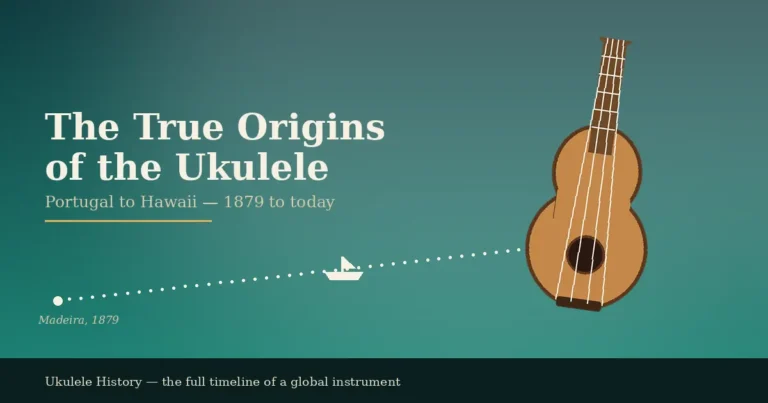
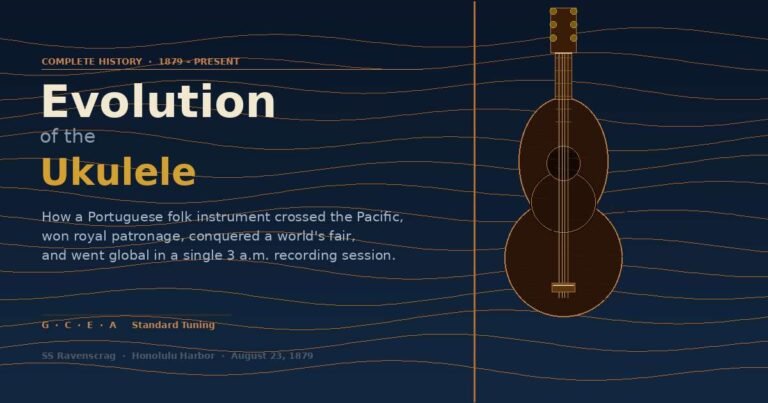
On August 23, 1879, the British merchant ship Ravenscrag docked in Honolulu Harbor after a voyage from Madeira via the Cape of Good Hope. It carried more than four hundred Portuguese immigrants contracted to Oʻahu’s sugar industry. Among them were at least three skilled instrument makers: Manuel Nunes, Augusto Dias, and José do Espírito Santo.
Contemporary accounts describe music being played as the passengers disembarked — the rapid, bright strumming of the machete drawing attention from dockworkers and onlookers. Whether that specific detail has been embellished over the years is hard to say. What’s certain is that the instruments were real, and the craftsmen who carried them soon left the plantation fields to set up workshops in Honolulu.
Manuel Nunes appears in Honolulu city directories as an instrument maker by the mid-1880s. His shop is widely considered the first commercial ukulele workshop in Hawaiʻi.
1880s–1900s: Royal patronage and the Hawaiian transformation
The ukulele didn’t stay a plantation instrument for long. King Kalākaua, who ruled the Kingdom of Hawaiʻi from 1874 to 1891, was an enthusiastic musician and cultural preservationist. He adopted the ukulele for court performances and worked it into the same cultural revival that restored hula after decades of missionary-era suppression.
Kalākaua played the instrument, composed songs for it, and encouraged its use among the Hawaiian nobility. His endorsement changed the ukulele’s social position permanently. Queen Liliʻuokalani, who succeeded him and reigned until the 1893 overthrow of the Hawaiian monarchy, also played and composed for the ukulele. Several of her compositions remain part of the standard Hawaiian repertoire.
By 1900, the ukulele had become the defining sound of Hawaiian popular music. Local newspapers ran advertisements for instruments, and the first generation of Hawaiian-born players had developed a style that owed little to Madeira.
1910s–1920s: The first global explosion
Two events in quick succession pushed the ukulele beyond the islands. First, the annexation of Hawaiʻi by the United States in 1898 and the growth of American tourism created a larger audience for Hawaiian culture on the mainland. Sheet music publishers took notice.
Then came the Panama-Pacific International Exposition. Held in San Francisco in 1915 to celebrate the opening of the Panama Canal, the exposition hosted a Hawaiian pavilion featuring live music. Visitors heard the ukulele for the first time in large numbers, went home wanting to learn, and found that publishers had moved fast: by 1916, ukulele instruction books, chord charts, and beginner songbooks were widely available across the country.
C.F. Martin & Company began producing ukuleles around this period to meet the mainland surge in demand. Kamaka Ukulele, founded in Honolulu in 1916 by Samuel Kamaka Sr., became the first ukulele manufacturer in Hawaiʻi built entirely around the instrument — and it’s still operating today.
By the early 1920s, Tin Pan Alley composers routinely wrote ukulele parts into their arrangements. Vaudeville featured the instrument regularly. Roy Smeck, billed as “The Wizard of the Strings,” demonstrated a level of virtuosity that challenged anyone who still thought the ukulele was a novelty.
1930s–1950s: Contraction, wartime, and two unexpected champions
The Great Depression hit music spending hard, but the ukulele held on longer than most instruments. In the United Kingdom, comedian George Formby built the instrument into the center of his act through the 1930s and 1940s, selling millions of records and creating a devoted British following that persists today through the George Formby Society. His contribution to ukulele history outside Hawaiʻi is often underestimated in American-focused accounts.
In the United States, the ukulele remained a popular home instrument into the late 1940s. Arthur Godfrey brought it to early American television in the 1950s, and for a short time it seemed positioned to drive another boom. But the electric guitar was arriving, and the ukulele was gradually recast — unfairly — as a beginner’s novelty rather than a real instrument. Sales dropped sharply through the late 1950s.
1960s–1980s: The long niche
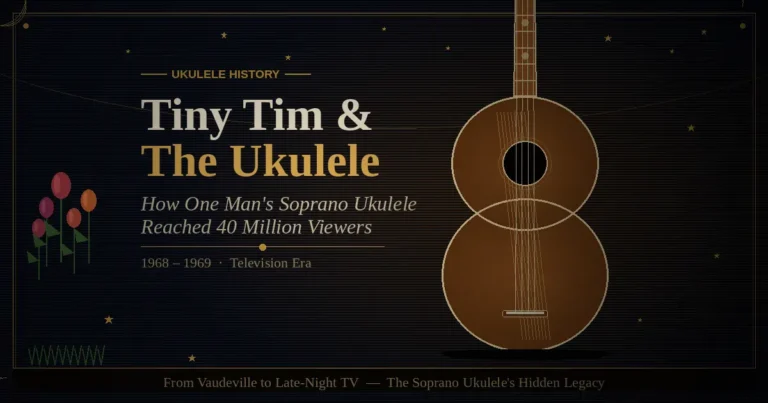
The ukulele didn’t disappear in the 1960s, but it narrowed considerably. Tiny Tim — the stage name of musician Herbert Khaury — put it back in the national conversation in 1968 with his falsetto performance of “Tiptoe Through the Tulips” on The Tonight Show. But the appearance read more as camp than revival, and for many listeners it reinforced the novelty association rather than shaking it.
Japan offered a counterpoint that Western music coverage largely missed. Ukulele instruction had been popular in Japan since the 1920s, and by the 1970s and 1980s the country had a substantial ukulele manufacturing industry and a large active player community. The instrument’s history was never as flat as American pop culture made it seem.
1990s onward: The digital renaissance
Israel Kamakawiwoʻole — known widely as Iz — is where the modern revival most directly begins. In the late 1980s, he recorded a medley of “Somewhere Over the Rainbow” and “What a Wonderful World” in a late-night studio session, accompanying himself on ukulele. The recording appeared on his 1993 album Facing Future and spread slowly at first.
After Kamakawiwoʻole’s death in 1997, the medley reached global audiences through film and television placements. It showed listeners outside Hawaiʻi what the ukulele could carry: not novelty, not camp, but something closer to genuine emotional weight. That reframing mattered enormously.
YouTube did much of the rest. By the late 2000s, the platform was full of ukulele tutorials and original compositions. Jake Shimabukuro’s 2006 video of “While My Guitar Gently Weeps” — played entirely on ukulele with a technical complexity the instrument had rarely been credited with — became one of the early viral music events on the platform. A new generation arrived: global, demographically diverse, and largely self-taught through online resources in a way no earlier ukulele audience had been.
The instruments, makers, and milestones that built the timeline
Understanding the ukulele timeline means tracking not just cultural events but the physical instruments and the people who built them. This table charts the key dates alongside the figures who shaped each era.
| Date | Event | Significance |
|---|---|---|
| 1879 | Ravenscrag arrives in Honolulu Harbor | Manuel Nunes, Augusto Dias, and José do Espírito Santo bring the machete to Hawaiʻi |
| Mid-1880s | Manuel Nunes opens his Honolulu workshop | First documented commercial ukulele maker in Hawaiʻi |
| 1880s–1891 | King Kalākaua adopts the ukulele | Royal endorsement transforms the instrument’s cultural standing |
| 1915 | Panama-Pacific International Exposition, San Francisco | Ukulele reaches mainland American audiences at scale |
| 1916 | Kamaka Ukulele founded by Samuel Kamaka Sr. | Oldest surviving Hawaiian ukulele manufacturer, still operating |
| 1916–early 1920s | C.F. Martin & Co. enters ukulele production | Mainland demand drives established makers into the market |
| 1920s | Tin Pan Alley and vaudeville embrace the ukulele | First mass commercial era; Roy Smeck establishes the virtuoso tradition |
| 1930s–1940s | George Formby builds a UK following | British ukulele tradition established independently of Hawaiian roots |
| 1950s | Arthur Godfrey performs on U.S. television | Brief revival attempt that the electric guitar’s rise cut short |
| 1968 | Tiny Tim performs on The Tonight Show | Cultural visibility without sustained revival |
| 1993 | Facing Future released, featuring Kamakawiwoʻole | Seeds of the global renaissance planted |
| 2006 | Jake Shimabukuro’s “While My Guitar Gently Weeps” goes viral on YouTube | Digital-era global ukulele community established |
| 2010s onward | Global maker market expands | Production spans USA, Japan, China, and Indonesia |
Size and tuning: how the instrument changed across the timeline
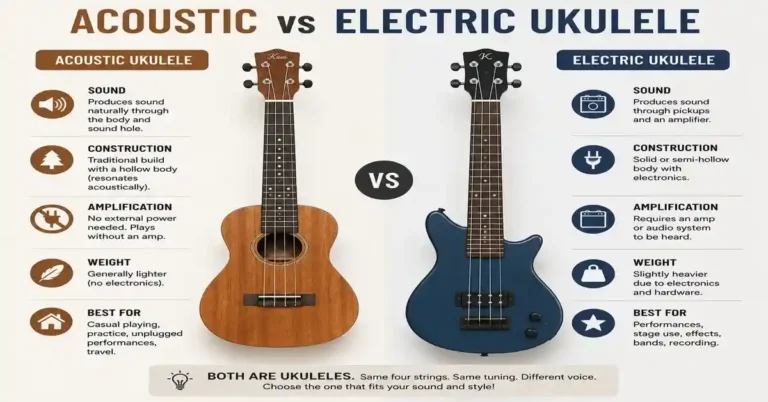
The ukulele didn’t arrive in Hawaiʻi with standardized sizes. Those developed gradually. The soprano — the original form, with a total body length of roughly 21 inches — dominated both the Hawaiian market and the early American boom. Concert and tenor sizes emerged through the 1920s to give players more volume and projection without abandoning the instrument’s fundamental character. The baritone came later still and tuned differently: D–G–B–E, the same as the top four strings of a guitar, making it the outlier of the family.
| Size | Total length (approx.) | Scale length (approx.) | Standard tuning |
|---|---|---|---|
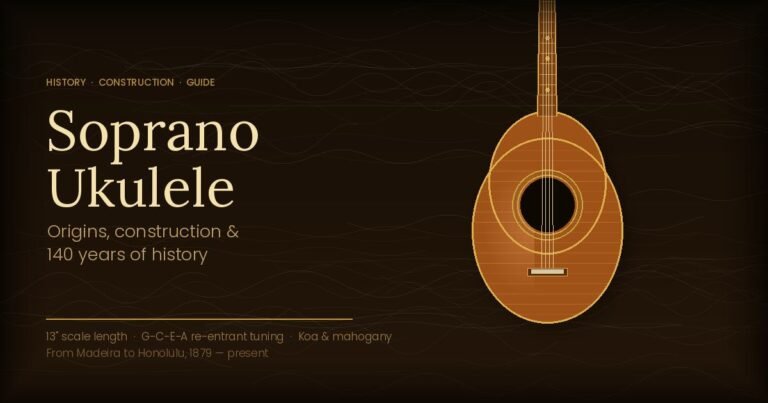
| Soprano | 21 in / 53 cm | 13 in / 33 cm | G–C–E–A |
| Concert | 23 in / 58 cm | 15 in / 38 cm | G–C–E–A |
| Tenor | 26 in / 66 cm | 17 in / 43 cm | G–C–E–A |
| Baritone | 30 in / 76 cm | 19 in / 48 cm | D–G–B–E |
Historian’s note: The soprano’s compact form wasn’t an aesthetic design decision — it was a practical one. The body size descends almost directly from the machete, scaled slightly for local Hawaiian materials. Larger sizes arrived because mainland American audiences wanted an instrument that could project in parlors and vaudeville theaters. Market demand, not tradition, drove the ukulele’s physical evolution.
The Five-Era Arc: a framework for reading the ukulele timeline
Spread across 140-plus years, the ukulele timeline becomes much clearer once you see it in five phases. This framework — the Five-Era Arc — doesn’t appear in most histories, but it’s the most analytically useful way to trace how and why the instrument’s fortunes shifted so dramatically across generations.
- The Portuguese Root (pre-1879): The machete, rajão, and cavaquinho traditions of Madeira and the Azores
- The Hawaiian Transformation (1879–1914): Immigration, royal patronage, and the instrument’s cultural reinvention on the islands
- The Global Boom (1915–1939): The Exposition, Tin Pan Alley, and the instrument’s first worldwide audience
- The Long Contraction (1940–1985): The electric guitar’s rise, the novelty stigma, and survival in dispersed communities
- The Digital Renaissance (1986–present): Kamakawiwoʻole’s recording, YouTube, and the global maker movement
None of these transitions was inevitable. The ukulele survived the Long Contraction because communities in Hawaiʻi, Japan, and the United Kingdom kept playing when American pop culture had moved on. That distributed, quiet survival — not a single dramatic comeback moment — is what made the renaissance possible when the conditions finally aligned.
The Ravenscrag landing: the founding moment in full detail
On August 23, 1879, the Ravenscrag completed a voyage of roughly 15,000 miles from the Madeira Islands via the Cape of Good Hope, arriving in Honolulu Harbor after approximately four months at sea. The ship’s passenger manifest recorded Manuel Nunes among the arrivals. Augusto Dias and José do Espírito Santo were aboard as well.
None of the three men spent long in the plantation fields. Nunes was established as a Honolulu instrument maker by the mid-1880s, building instruments that blended Madeiran construction techniques with local Hawaiian koa wood. Koa — an acacia species native to Hawaiʻi — produced a tone warmer and more complex than the cedar and spruce he’d worked with back home. The wood became so identified with the instrument that top-tier ukuleles are still judged partly by the quality of their koa.
Within a decade of that August landing, the instrument had a Hawaiian name, a Hawaiian royal patron, and a sound that owed something to Madeira but had become genuinely its own.
What most people get wrong about ukulele history
A few persistent myths about the ukulele surface even in well-researched sources. Both are worth addressing directly.
Misconception 1: “The ukulele was invented in Hawaii”
This is a half-truth. Hawaiʻi is where the instrument was developed into its current form and given its name, but it descended directly from Portuguese folk instruments — primarily the machete de braga — that arrived with immigrant workers. Credit belongs to neither Hawaiʻi nor Portugal alone. It belongs to the specific encounter between Madeiran craftsmen, Hawaiian musicians, local materials like koa, and a royal court that chose to embrace the result.
The founding makers were Portuguese-born. The royal patron who shaped the instrument’s status was Hawaiian. The name “ukulele” is Hawaiian. It’s a genuinely bicultural origin, and flattening it in either direction misrepresents what actually happened on those docks in 1879.
Misconception 2: “The ukulele is just a small guitar”
Two fundamental differences make this comparison misleading. First, the ukulele uses re-entrant tuning — the G string sits higher in pitch than the C, so the strings don’t ascend sequentially from lowest to highest. This creates a harmonic brightness and chord voicing character that the guitar simply can’t replicate, regardless of body size.
Second, the genealogy is distinct. The ukulele descends from the machete and the rajão, which belong to a different branch of the lute family than the guitar. The guitar’s direct ancestors are the Spanish vihuela and the baroque guitar. These two instruments share a remote common family, but they diverged centuries before the ukulele existed as a named object. Playing one doesn’t prepare you for the other as intuitively as the “small guitar” framing suggests.
FAQs
When was the ukulele invented? The ukulele emerged in Hawaiʻi through the 1880s, following the August 1879 arrival of Portuguese craftsmen aboard the Ravenscrag. Manuel Nunes is widely credited as the first commercial maker. It wasn’t a single invention so much as a decade-long evolution of the machete de braga using Hawaiian materials and local musical influences.
What does “ukulele” mean? The etymology is genuinely contested. The most widely cited translation is “jumping flea” in Hawaiian, possibly referencing the rapid finger movement of players. A competing theory links the name to Edward Purvis, a British officer who played the instrument and was reportedly nicknamed “jumping flea” for his small, energetic presence. Neither origin has been definitively established from primary sources.
Who made the ukulele famous outside Hawaiʻi? The 1915 Panama-Pacific International Exposition brought it to mainland American audiences at scale, and Tin Pan Alley composers responded immediately. Roy Smeck was among the most significant early virtuosos. In the United Kingdom, George Formby built an enormous following in the 1930s and 1940s. Israel Kamakawiwoʻole’s medley recording became the single most culturally significant moment in the instrument’s modern history, reaching global audiences after his death in 1997.
What is the standard tuning of a ukulele? Soprano, concert, and tenor ukuleles are most commonly tuned G–C–E–A, with the G string — the one nearest your face in playing position — pitched higher than the C. This re-entrant configuration is what gives the ukulele its characteristic brightness. The baritone ukulele uses D–G–B–E, the same as the top four strings of a guitar.
Is the ukulele difficult to learn? Most players find it more approachable than the guitar as a first instrument. Four nylon strings are easier on fingertips than steel, and the basic chord shapes are simpler to execute. You’ll find playable songs within days. That said, the instrument has real depth — fingerstyle technique, chord-melody arrangements, and virtuosic playing take years to develop properly.
What is a koa ukulele? Koa is a Hawaiian acacia wood valued for its acoustic properties and its direct connection to the instrument’s origins. Ukuleles built from solid koa have a warmer, more complex tone than those made from mahogany or laminate, and they carry cultural weight as genuinely Hawaiian material. They sit at the upper end of the price range — a solid koa instrument is a serious investment, and that’s before accounting for its value as a collector’s piece.
The ukulele timeline isn’t a straight line from Honolulu Harbor to global music classrooms. It has sharp turns, long pauses, and at least one era where survival depended entirely on communities outside America keeping the instrument alive while its adopted country moved on.
Understanding that — five eras, three continents, one small instrument with a consistent capacity to outlast the trends that dismissed it — changes what you hear when you pick one up.
At Ukulele History, the archive runs deep. Instrument maker profiles, regional histories, and era-by-era breakdowns are all here if this timeline opened a question worth following further
Got questions? Browse our handpicked articles filled with expert-backed answers.