Portuguese Ukulele Origin: How Madeira Started It All
Most people credit Hawaii with inventing the ukulele. That’s only half true, and it’s the half that leaves out the more interesting story. The ukulele’s real origin sits nearly 8,000 kilometers away, on the volcanic Portuguese island of Madeira, where small four and five-string instruments had been part of everyday street life for generations before a single Hawaiian ever heard one. The ukulele as we know it was built in Honolulu, but its bones, its shape, its plucking technique, and its DNA came from Madeira. Three Madeiran cabinetmakers carried that inheritance across two oceans in 1879, and what happened next turned a regional folk instrument into one of the most recognizable sounds in the world.
Key takeaways:
- The ukulele’s direct ancestors are Madeiran instruments: the machete de braga (braguinha), the rajão, and the cavaquinho.
- Three Madeiran woodworkers, Manuel Nunes, Augusto Dias, and Jose do Espirito Santo, arrived in Honolulu on the ship Ravenscrag on 23 August 1879.
- The Ravenscrag’s four-month voyage from Funchal, Madeira, covered roughly 12,000 miles around Cape Horn.
- Hawaiians renamed the instrument “ukulele,” and King Kalākaua’s personal endorsement turned it into a national symbol within a decade.
- The 1915 Panama-Pacific International Exposition in San Francisco sparked the ukulele’s first mainland American craze.
- Modern GCEA tuning still echoes the reentrant stringing patterns of its Madeiran ancestors.
What is the true origin of the ukulele?
The ukulele descends directly from small Madeiran stringed instruments, chiefly the machete de braga, that Portuguese immigrants brought to Hawaii in 1879. Madeiran craftsmen rebuilt the instrument using local koa wood, and Hawaiians adapted its playing style and gave it its name. The result was a genuinely new instrument, Portuguese in ancestry and Hawaiian in identity.
The Madeiran instruments that came before the ukulele
Before there was a ukulele, there was a small guitar-shaped instrument played on street corners in Funchal, Madeira’s capital. Three related instruments matter here, and mixing them up is one of the most common mistakes in ukulele history writing.
The machete de braga, often shortened to braguinha, was a small four-string instrument tuned in a reentrant pattern, meaning the strings don’t run from lowest to highest pitch in a straight line. It was light, portable, and common at festivals and informal gatherings across Madeira. The rajão was its five-string cousin, slightly larger and tuned differently, and it’s the instrument most historians point to as the direct source of the ukulele’s playful, percussive strumming style. The cavaquinho, a related but distinct instrument from mainland Portugal, is sometimes confused with the machete, though it developed along a separate regional path.
These weren’t obscure curiosities. Madeira had a centuries-old woodworking tradition, and instrument making was a natural extension of that craft. When economic hardship pushed thousands of Madeirans to emigrate in the late 1870s, some of them packed their tools, and a few packed the instruments themselves.
The voyage and the makers who rebuilt an instrument
This is the heart of the story, and it deserves the specificity most articles skip past.
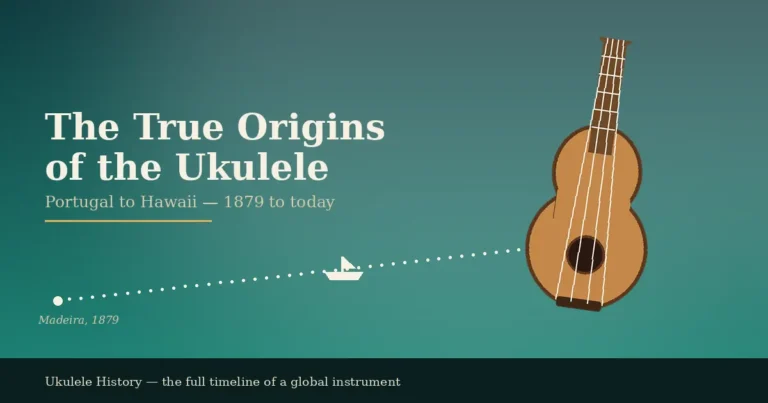
The Ravenscrag sails from Funchal: On 23 April 1879, the British sailing ship Ravenscrag left the Madeiran port of Funchal carrying 419 Portuguese immigrants bound for the Hawaiian sugar plantations. The crossing took exactly four months. It rounded Cape Horn at the southern tip of South America, then continued across the Pacific, a journey of roughly 12,000 miles under Captain Biggam’s command.
Three woodworkers on board: Among the passengers were 40-year-old Manuel Nunes, 37-year-old Augusto Dias, and 28-year-old Jose do Espirito Santo, all cabinetmakers from Funchal. None of them had a documented history as instrument builders before the voyage. They were simply skilled with wood, and that skill would matter more than they knew.
Arrival in Honolulu Harbor: The Ravenscrag docked in Honolulu on 23 August 1879, a Saturday. According to accounts passed down through Augusto Dias’s own family, a fellow passenger named João Fernandes, who had one child and therefore fewer childcare duties than the others that afternoon, borrowed a machete from another traveler and broke into song right there on the dock. Weeks later, the Hawaiian Gazette described the newcomers’ instruments as a striking cross between a guitar and a banjo. That’s the moment most histories treat as the ukulele’s public debut in Hawaii, even though the instrument itself hadn’t been invented yet. What arrived on 23 August 1879 was still a machete. The ukulele came after.
From plantation contracts to Chinatown workshops: Nunes, Dias, and Santo first worked off their labor contracts on sugar plantations across Oahu, Maui, and Hawaii Island. Once free of those obligations, all three made their way back to woodworking, opening instrument shops in Honolulu’s Chinatown district through the mid-1880s. There, working with Hawaiian koa instead of Madeiran wood, they began building a hybrid: the machete’s compact shape combined with tuning ideas closer to the rajão. That hybrid is what became the ukulele.
A royal endorsement changes everything: By the late 1880s, King Kalākaua had taken up the instrument personally and folded it into royal court performances. That endorsement did more for the ukulele’s status than any advertisement could. What had been an immigrant curiosity became, within a decade, something closer to a national symbol, played and celebrated by Hawaiian royalty and commoners alike.
Cultural context: how the ukulele was played and understood
The Madeiran machete was largely a street and festival instrument, chordal, rhythmic, meant for singing along rather than solo virtuosity. Hawaiians kept that spirit but reworked the tuning into what eventually standardized as GCEA, a reentrant pattern where the fourth string is tuned higher than the third, not lower. That’s a direct echo of the reentrant logic found in the rajão, adapted rather than invented from nothing.
Historian’s note: The switch to koa wood wasn’t just about using local materials. Koa produces a warmer, denser midrange than the spruce and rosewood common in European instrument making, and that tonal shift is arguably as important to the ukulele’s identity as its shape. A Madeiran machete and an early Hawaiian ukulele can look almost identical side by side and still sound noticeably different once strung and played.
The table below lays out how the three Madeiran ancestor instruments compare, something most ukulele history pages mention only in passing.
| Instrument | Strings | Tuning style | Region of origin | Relationship to the ukulele |
|---|---|---|---|---|
| Machete de braga (braguinha) | 4 | Reentrant | Madeira, Portugal | Direct structural ancestor; shape and size |
| Rajão | 5 | Reentrant, five-course | Madeira, Portugal | Source of playing style and strumming logic |
| Cavaquinho | 4 | Linear (low to high) | Mainland Portugal | Related cousin, separate regional development |
The three crossings framework
Most timelines of ukulele history list dates in a straight line. That approach misses what actually happened, because the ukulele’s rise wasn’t one journey, it was three distinct crossings, each one changing what the instrument meant.
The first crossing was geographic: a four-month, 12,000-mile voyage across two oceans that physically moved the instrument’s raw materials, its makers, and its playing tradition from Madeira to Oahu. The second crossing was cultural: the shift from immigrant street instrument to Hawaiian royal symbol, driven almost entirely by King Kalākaua’s personal adoption of it in the 1880s. The third crossing was global: the leap from a Pacific island tradition to a worldwide instrument, a transformation that didn’t happen until 1915.
The exposition that changed everything: On the grounds of the Panama-Pacific International Exposition in San Francisco in 1915, a Hawaiian Quartet performed for enormous crowds drawn to the fair’s Hawaiian pavilion. Within months, mainland manufacturers including C.F. Martin were building ukuleles to meet sudden demand. A regional Pacific instrument had, in a matter of months, become a mainland American craze, and from there it never really left popular culture. Samuel Kamaka, who had apprenticed under Manuel Nunes, founded Kamaka Ukulele in Honolulu in 1916, a company still building instruments today. Decades later, Tiny Tim’s novelty fame in the late 1960s and Israel Kamakawiwoʻole’s stripped-down “Over the Rainbow” medley in the 1990s each reintroduced the instrument to new global audiences, with Jake Shimabukuro’s virtuoso playing extending that reach further still.
Naming these three crossings, geographic, cultural, and global, makes the pattern easier to hold onto than a bare list of dates, and it’s the framework Ukulele History uses across this archive.
Common misconceptions about the ukulele’s origin
Isn’t the ukulele just a small guitar?
No. The guitar and the ukulele share a broad family tree, but the ukulele’s direct ancestor is the Madeiran machete, an instrument with its own reentrant tuning tradition that predates the modern six-string guitar’s widespread popularity. Comparing the two instrument by instrument, the tuning logic alone shows they developed down separate branches.
Wasn’t the ukulele invented in Hawaii?
Not from scratch. The instrument’s shape, stringing concept, and playing tradition are Madeiran. What happened in Hawaii was a genuine transformation, new wood, adjusted tuning, a new name, and a cultural identity that made the instrument famous, but calling it a pure Hawaiian invention erases the Portuguese craftsmen who physically built the first examples.
A quick timeline checklist
- 23 April 1879: The Ravenscrag departs Funchal, Madeira, with 419 Portuguese immigrants aboard.
- 23 August 1879: The ship docks in Honolulu Harbor after a four-month voyage.
- Early-to-mid 1880s: Nunes, Dias, and Santo open instrument workshops in Honolulu’s Chinatown.
- Late 1880s: King Kalākaua adopts the instrument, boosting its status across Hawaiian society.
- 1915: The Panama-Pacific International Exposition in San Francisco ignites a mainland American craze.
- 1916: Samuel Kamaka, a Nunes apprentice, founds Kamaka Ukulele.
The table below places these milestones alongside a short note on why each one mattered.
| Year | Milestone | Why it mattered |
|---|---|---|
| 1879 | Ravenscrag arrives in Honolulu | Brought the machete and its Madeiran makers to Hawaii |
| Early 1880s | Chinatown workshops open | Instrument physically rebuilt using koa wood |
| Late 1880s | King Kalākaua’s endorsement | Elevated the instrument to a Hawaiian cultural symbol |
| 1915 | Panama-Pacific Exposition | Launched the ukulele’s first mainland American craze |
| 1916 | Kamaka Ukulele founded | Established a lasting manufacturing lineage |
One honest gap remains in this history. The exact date the word “ukulele” first appeared in print is still debated among researchers, and the surviving Hawaiian-language newspaper record from the 1880s hasn’t settled it conclusively. Most credible sources place the earliest clear usage sometime in the following decade, but nobody can point to a single definitive first mention.
FAQs
Who really invented the ukulele? No single person can claim it. Manuel Nunes, Augusto Dias, and Jose do Espirito Santo all built early versions in Honolulu during the 1880s, and Nunes later advertised himself as the inventor, but surviving records don’t clearly credit one man over the other two.
What Portuguese instrument became the ukulele? The machete de braga, also called the braguinha, is the closest direct ancestor. Hawaiian builders reworked its shape and materials, while borrowing tuning ideas from its larger cousin, the rajão.
Why is the ukulele called “ukulele”? The Hawaiian name translates roughly to “jumping flea,” likely describing how a player’s fingers move across the strings. No single origin story for the name has been proven beyond doubt, though this is the most widely repeated explanation.
When did the ukulele arrive in Hawaii? The instrument’s Madeiran ancestor arrived on 23 August 1879, aboard the Ravenscrag. The ukulele itself, as a distinct rebuilt instrument, took shape over the following few years in Honolulu workshops.
Did King Kalākaua actually play the ukulele? Yes. Hawaii’s last king took up the instrument personally in the 1880s and included it in royal court performances, a public endorsement that helped shift its image from immigrant novelty to Hawaiian cultural icon.
What’s the difference between a machete and a ukulele? The machete is the Madeiran ancestor instrument, typically built from European woods with its own regional tuning habits. The ukulele is the Hawaiian rebuild, made from koa, tuned to what became the standard GCEA pattern, and shaped by a distinct cultural identity.
Conclusion
The ukulele’s story doesn’t start in Hawaii, it starts on a small Portuguese island most people couldn’t point to on a map. Three Madeiran cabinetmakers, a four-month sea voyage, and one king’s personal fondness for the instrument turned a regional folk tradition into a global one. That’s the fuller version of the story, and it’s the one worth remembering next time someone calls it “just a Hawaiian instrument.” For more deep dives into how individual instruments, makers, and eras shaped ukulele culture, keep exploring the archive here at Ukulele History.
Rise above the ordinary by reading our above-average expert content.