
Ukulele Chords and Chords Tool: A Beginner’s Guide
Ukulele Chord Tool
Chord Instructions:
Select a chord to see the instructions.
The ukulele is a small, four-stringed instrument with a big sound, beloved by musicians worldwide for its bright and happy tones. Whether you’re looking to strum along to simple tunes or dive deeper into complex chord progressions, understanding ukulele chords is your first step. In this comprehensive guide, we’ll explore the essential ukulele chords, explain how to read ukulele chord diagrams, provide tips for practicing, and much more.
By the end of this guide, you’ll have the knowledge and tools to start playing your favorite songs on the ukulele!
What Are Ukulele Chords?

A ukulele chord is a group of notes played together to create harmony. The ukulele has only four strings, which makes it easier to form chords compared to other string instruments like the guitar. Each chord is formed by pressing specific frets on certain strings, producing a combination of sounds.
Understanding how to play these chords will allow you to accompany yourself while singing or playing along with other musicians. Ukulele chords are simple to learn, making the ukulele one of the easiest instruments for beginners to pick up.
Understanding Ukulele Tuning
Before we dive into chords, it’s important to understand how the ukulele is tuned. The standard tuning for a ukulele is G-C-E-A, with the G string being the top string. This tuning is known as re-entrant tuning, as the G string is tuned higher than the C string, unlike most other string instruments.
The tuning affects the way chords sound and how you form chord shapes on the fretboard. The simplicity of the tuning is one of the key reasons why the ukulele is a beginner-friendly instrument.
Basic Ukulele Chords: Essential Building Blocks
Now, let’s look at some of the basic ukulele chords that every beginner should learn first. These chords will form the foundation of your ukulele playing and are used in countless songs.
1. C Major Chord: The Easiest Starting Point
The C major Ukulele Chords is often the first chord beginners learn. It’s simple to play and creates a bright, happy sound.
How to play the C major chord:
- Place your ring finger on the 3rd fret of the A string (the bottom string).
- Leave the other three strings open.
The C major chord is used in countless songs and provides a good starting point for beginners.
Chord Diagram:
A |---3--- (Ring Finger)
E |---0---
C |---0---
G |---0---
2. G Major Chord: A Rich, Full Sound
The G major Ukulele Chords is a bit more complex but is essential to many songs. It’s a fuller-sounding chord and gives a great foundation for chord progressions.
How to play the G major chord:
- Place your index finger on the 2nd fret of the C string.
- Place your middle finger on the 2nd fret of the A string.
- Place your ring finger on the 3rd fret of the E string.
Chord Diagram:
A |---2--- (Middle Finger)
E |---3--- (Ring Finger)
C |---2--- (Index Finger)
G |---0---
3. F Major Chord: Soft and Melodic
The F major Ukulele Chords has a softer, more melodic tone. It’s commonly used in folk, pop, and even classical songs.
How to play the F major chord:
- Place your index finger on the 1st fret of the E string.
- Place your middle finger on the 2nd fret of the G string.
Chord Diagram:
A |---0---
E |---1--- (Index Finger)
C |---0---
G |---2--- (Middle Finger)
4. A Minor Chord: The Mellow Minor Chord
The A minor Ukulele Chords is one of the simplest minor chords to play on the ukulele. It has a mellow, reflective sound and is often used to convey sadness or introspection.
How to play the A minor chord:
- Place your middle finger on the 2nd fret of the G string.
Chord Diagram:
A |---0---
E |---0---
C |---0---
G |---2--- (Middle Finger)
Advanced Ukulele Chords: Adding Complexity
Once you’re comfortable with the basic chords, you can start exploring more advanced chords. Seventh chords, minor chords, and suspended chords will allow you to add richness and variety to your playing.
5. G7 Chord: A Jazzy and Bluesy Touch
The G7 chord adds a jazzy feel to your music. It’s commonly used in blues, jazz, and rock songs.
How to play the G7 chord:
- Place your index finger on the 1st fret of the E string.
- Place your middle finger on the 2nd fret of the C string.
- Place your ring finger on the 2nd fret of the A string.
Chord Diagram:
A |---2--- (Ring Finger)
E |---1--- (Index Finger)
C |---2--- (Middle Finger)
G |---0---

Ukulele Chords Graph: Visualizing Chord Shapes
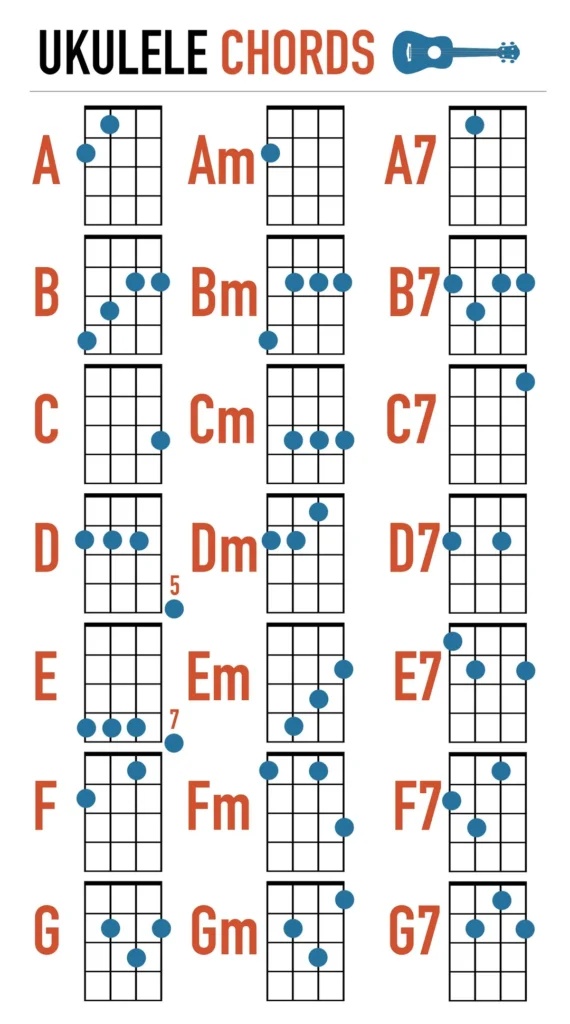
Learning how to read ukulele chord graphs (diagrams) is crucial for mastering the instrument. These diagrams visually represent the fretboard and show where to place your fingers to form chords.
A chord graph typically consists of vertical lines representing the strings and horizontal lines representing the frets. Here’s how to read a basic chord graph:
- The G string is on the left, and the A string is on the right.
- The horizontal lines represent the frets. The topmost line is the nut, where the strings are held in place.
- Numbers on the lines indicate which fret to press down on a string. If a line is blank (no number), it means the string should be played open (unfretted).
For example, here is how you would read the C major chord diagram:
A |---3--- (Ring Finger)
E |---0---
C |---0---
G |---0---
This shows you need to press the 3rd fret of the A string and leave the other strings open.
Tips for Practicing Ukulele Chords
As you begin your ukulele journey, consistent practice is essential for success. Here are some practical tips to help you improve your chord playing:
1. Start Slowly
When learning new chords, start slow. Play each chord carefully, ensuring each string rings out clearly. As you get more comfortable, gradually increase your speed.
2. Practice Switching Between Chords
One of the hardest parts about playing the ukulele is switching between chords smoothly. Start by practicing two-chord progressions like C – F or C – G and focus on making quick, clean transitions.
3. Use Songs with Simple Chords
Choose songs with a simple chord structure to practice. For example, the classic “Twinkle Twinkle Little Star” uses just three chords. These kinds of songs are great for beginners as they help you practice chord progressions in a musical context.
4. Focus on Clean Sound
Make sure each note in your chord rings out clearly. If you’re muting any strings unintentionally, adjust your finger position. Practicing slowly helps you focus on producing a clean, beautiful sound.
Ukulele Chord Progressions: Making Music with Chords
Once you’ve learned a few chords, the next step is to put them together in a chord progression. A chord progression is simply a series of chords played in a specific order, and it’s the foundation of most songs.
For example, one of the most common chord progressions is C – G – F – C. By repeating this progression, you can play many popular songs. Here’s a simple example of a chord progression to try:
- A Minor – F – C – G
This progression is used in songs like “I’m Yours” by Jason Mraz and works well for beginners. As you become more advanced, you can experiment with more complex progressions.
Conclusion: Your Ukulele Journey Begins Here
Learning ukulele chords is the first step in your musical adventure. Whether you’re strumming along to simple tunes or diving into more complex progressions, the ukulele offers endless possibilities for creativity. Keep practicing, and don’t be afraid to experiment with different chord combinations.
Remember, the most important part of learning an instrument is to have fun! Play your favorite songs, make mistakes, and enjoy the process of learning. Soon, you’ll be playing beautiful melodies and sharing your music with others.
Ukulele Chords Diagram and Charts