When Was the Ukulele Invented? The Exact Year & Story
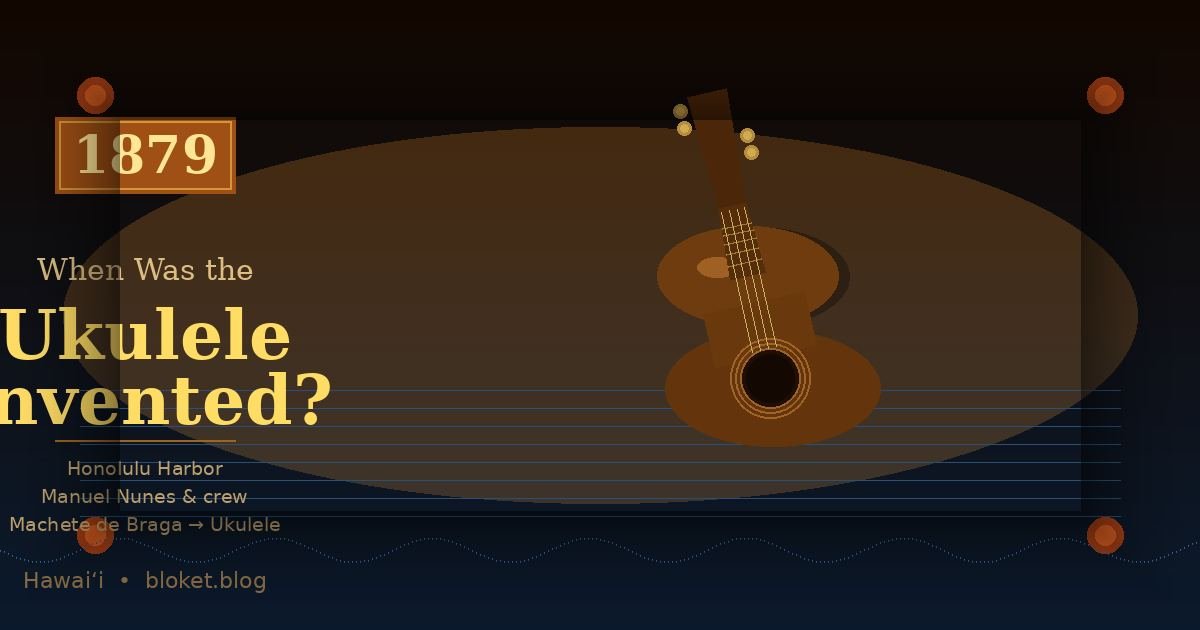
The ukulele was invented in its Hawaiian form in 1879. That year, three Portuguese craftsmen arrived in Honolulu Harbor aboard the British ship Ravenscrag, carrying a small four-stringed folk instrument called the machete de braga. Within a few years, they’d adapted it with local materials and Hawaiian musical sensibility, and the ukulele took shape as something genuinely new.
Most accounts of this history contradict each other. Some cite 1879; some say the 1880s; a few trace the origins to Portugal and leave Hawaiʻi out of the founding story entirely. This page lays out what the record actually shows, settles the dating question as precisely as the evidence allows, and explains why most histories skip the single event that launched the ukulele from an island curiosity to a global instrument.
That event happened 36 years after the Ravenscrag docked.
Key takeaways:
- The ukulele’s direct ancestor arrived in Honolulu on August 23, 1879, aboard the British ship Ravenscrag
- Three Madeiran craftsmen (Manuel Nunes, Augusto Dias, and Jose do Espirito Santo) built the first Hawaiian ukuleles
- The instrument descended from the Portuguese machete de braga, brought by labor immigrants from the Madeira Islands
- King Kalākaua adopted the ukulele at the royal court, giving it cultural legitimacy across Hawaiʻi
- The 1915 Panama-Pacific International Exposition in San Francisco introduced the instrument to mainland America
- “Ukulele” is a Hawaiian word that translates roughly as “jumping flea”
When exactly was the ukulele invented?
The answer depends on what you mean by “invented.” The Portuguese instrument that became the ukulele arrived in Hawaiʻi on August 23, 1879. The distinctly Hawaiian ukulele, built from local koa wood, shaped by Hawaiian musical preferences, and named in Hawaiian, emerged across the 1880s. If forced to choose one year, 1879 is the answer. But its true birth was a decade-long process.
The arrival date on record
The Ravenscrag, a British ship, docked at Honolulu Harbor on August 23, 1879. It carried hundreds of Portuguese-speaking immigrants from the Madeira Islands, recruited by Hawaiian sugar planters who needed agricultural laborers. Three of those passengers (Manuel Nunes, Augusto Dias, and Jose do Espirito Santo) were skilled instrument builders, not cane workers.
Contemporary Hawaiian newspaper accounts described enthusiastic music-making as the ship entered port. That onboard performance, reportedly on small Portuguese instruments, drew notice from Honolulu dockworkers and bystanders. It was, in retrospect, the ukulele’s first public appearance in Hawaiʻi.
From arrival to instrument
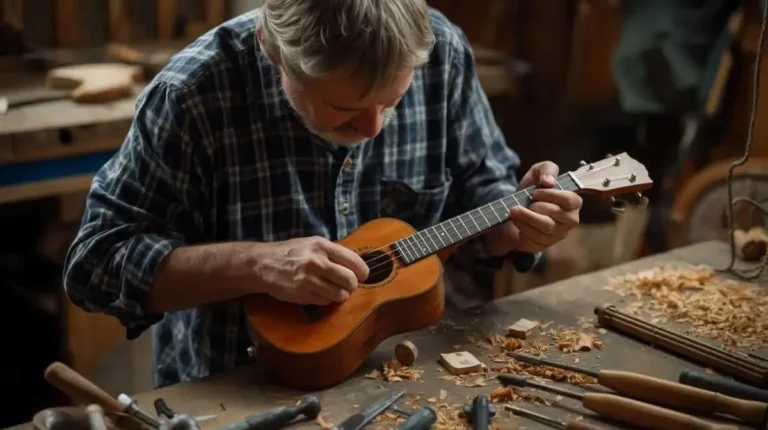
Rather than entering plantation labor, Nunes, Dias, and Espirito Santo opened workshops in Honolulu. They built instruments modeled on the machete de braga, but adapted: Hawaiian koa wood replaced Portuguese hardwoods, construction details shifted to reflect local tastes, and the resulting instruments were smaller and lighter than their Madeiran origins would suggest.
By the mid-1880s, Hawaiian musicians were playing these instruments widely. That’s why some credible sources describe the ukulele as having been “invented in the 1880s.” They’re referring to the Hawaiian instrument, not the year of the craftsmen’s arrival. Both dates are accurate for different things.
Within six years of that August morning in Honolulu Harbor, the workshops of Nunes and his fellow craftsmen had produced the instruments that King Kalākaua would carry into the royal court.
Where did the ukulele come from? The Portuguese roots
The ukulele did not originate in Hawaiʻi. Its direct ancestor, the machete de braga, came from the Madeira Islands, an archipelago off the coast of Portugal in the Atlantic Ocean. Understanding that lineage explains the instrument’s design, its re-entrant tuning, and why three craftsmen from one specific island community could reshape Hawaiian music inside a single generation.
The machete de braga and its relatives
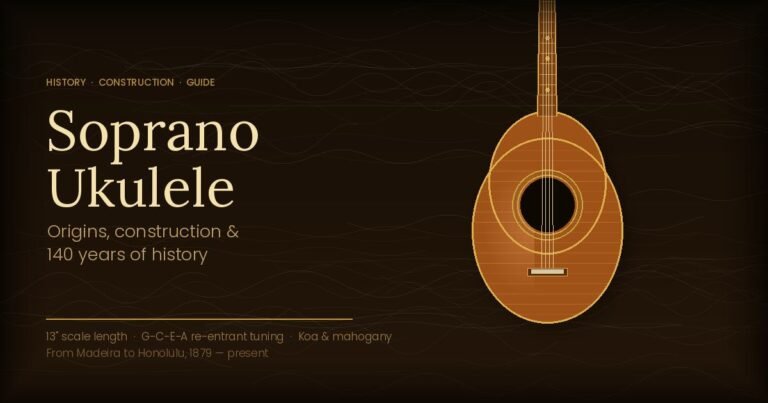
The machete de braga (also called the braguinha, or cavaquinho in related regional forms) is a small, four-stringed instrument tuned in a non-sequential pitch pattern. Its siblings in the Portuguese folk tradition include the rajão, a five-stringed instrument whose top four strings directly gave rise to the ukulele’s standard GCEA tuning, and the cavaquinho, a slightly larger variant still common in Brazil and Portugal today.
Portuguese workers carried these instruments wherever 19th-century labor migration took them. The plantation recruitment that brought the Ravenscrag’s passengers to Hawaiʻi was part of a broader Pacific migration pattern. And wherever those workers went, their music went with them.
Why koa wood changed everything
Switching from Portuguese timbers to Hawaiian koa (Acacia koa) wasn’t just a practical substitution. It created a genuinely different acoustic character. Koa is a tonewood native to Hawaiʻi with strong midrange warmth, natural brightness in the upper registers, and a complex overtone profile that deepens as the wood ages. It responds differently under the fingers than European hardwoods, and that difference helped the Hawaiian ukulele develop its own sonic identity distinct from its Portuguese ancestors.
Premium koa ukuleles today still represent the instrument’s highest tier. The Bishop Museum in Honolulu holds original instruments from early Honolulu workshops, offering a direct material record of how the first Hawaiian ukuleles were built.
King Kalākaua and the royal endorsement
No instrument becomes culturally embedded without influential advocates. For the ukulele, the most important advocate was King David Kalākaua, a musically accomplished monarch who made Hawaiian cultural identity a central project of his reign. His personal adoption of the ukulele gave it legitimacy that popular use alone could not have provided.
Music at ʻIolani Palace
King Kalākaua played the ukulele himself. He hosted musical evenings at ʻIolani Palace in Honolulu where the instrument featured alongside other Hawaiian instruments, and he embraced it as a vehicle for cultural preservation he considered politically necessary. Kalākaua was a composer and poet who understood that Hawaiian music was a form of sovereignty, not just entertainment.
Queen Liliʻuokalani, who succeeded him, was similarly accomplished musically. She is credited with composing “Aloha ʻOe,” one of the most enduring pieces in the Hawaiian musical canon. Both monarchs played multiple instruments and incorporated the ukulele into the musical life of the royal court.
Why royal patronage mattered
Royal endorsement in 19th-century Hawaiʻi carried the cultural weight that a major broadcast appearance might today. When the monarch and the court played the ukulele, it became aspirational throughout Hawaiian society. The instrument moved from immigrant craftsmen’s workshops to the center of Hawaiian cultural life inside a single generation, and that speed was only possible because of who was playing it.
The four eras of ukulele evolution
The ukulele’s history doesn’t move in a straight line from invention to global popularity. It moves in four distinct eras, each with a different geographic center, a different cultural context, and a different cast of key figures. Understanding these eras makes it easier to answer dating questions accurately, and to see why the instrument nearly disappeared before its first major revival.
| Era | Approximate years | Geographic center | Key development |
|---|---|---|---|
| The Portuguese seed | 1879–1885 | Honolulu workshops | Machete de braga adapted into first Hawaiian ukuleles by Nunes, Dias, and Espirito Santo |
| Hawaiian transformation | 1886–1914 | Royal Honolulu | Royal court adoption; instrument gains its name, identity, and first dedicated builders |
| Mainland explosion | 1915–1950 | San Francisco, New York | Panama-Pacific Exposition; Tin Pan Alley publishing boom; radio; early film |
| Global revival | 1990s–present | Worldwide (digital) | Kamakawiwoʻole, YouTube, Jake Shimabukuro; global player base across every continent |
Era 1 — the Portuguese seed (1879–1885)
Three craftsmen, one harbor, one ship’s manifest. The ukulele’s first era is defined by craft rather than fame. Nunes, Dias, and Espirito Santo had no audience beyond the immigrant community, no instrument with a name, and no cultural cachet in these early years. They built and sold small stringed instruments in Honolulu, adapting Madeiran techniques to Hawaiian materials. Everything that followed starts here.
Era 2 — Hawaiian transformation (1886–1914)
This era is when the instrument earned its identity. Royal patronage gave it cultural standing. The name “ukulele” became standard, possibly linked to a British court officer named Edward Purvis whose rapid playing style had earned him the Hawaiian nickname. Kamaka Hawaii, founded in 1916 and still operating today as the oldest ukulele manufacturer in continuous production, emerged from this era’s creative energy. Hawaiian musicians began composing specifically for the instrument’s four-string voice.
Era 3 — mainland explosion (1915–1950)
This is the era that turned a cultural instrument into a consumer product. The 1915 Panama-Pacific International Exposition in San Francisco was the catalyst. But the explosion that followed (Tin Pan Alley arrangements, Martin Guitar Company production lines, vaudeville performances, and radio broadcasts) was driven by commercial infrastructure that moved fast. Arthur Godfrey’s national radio broadcasts in the 1940s brought the instrument into millions of American living rooms.
Era 4 — global revival (the digital era)
Israel Kamakawiwoʻole’s medley of “Somewhere Over the Rainbow / What a Wonderful World,” recorded in a single late-night session and released on his 1993 album Facing Future, became one of the most widely placed recordings in film and television history. His voice and his ukulele reached billions of people who couldn’t have named the instrument before hearing it. Jake Shimabukuro’s 2006 YouTube performance of a ukulele arrangement of “While My Guitar Gently Weeps” then demonstrated the instrument’s technical range in a way that shifted how serious musicians perceived it. These two Hawaiian artists, separated by a generation, rebuilt the ukulele’s global standing from the inside.
The 1915 Panama-Pacific Exposition — the moment the world found out
The 1915 Panama-Pacific International Exposition, held in San Francisco, was the single event that carried the ukulele from a Hawaiian regional instrument to a mainland American phenomenon. Without the Hawaiian Pavilion’s live performances and the publisher and manufacturer response that followed, the instrument’s trajectory through the 20th century looks completely different.
Historian’s note: Most ukulele histories treat the Panama-Pacific Exposition as a brief data point. It deserves more attention. This was the moment when the commercial infrastructure of mainstream American music got hold of the ukulele, and once that happened, its path through vaudeville, radio, and the sheet music market was nearly inevitable.
The Hawaiian Pavilion
The exposition celebrated the opening of the Panama Canal and San Francisco’s recovery from the 1906 earthquake. Hawaiʻi, then a US territory, built a pavilion centered on its distinctive culture. The Hawaiian Pavilion drew consistently large crowds throughout the exposition’s run. Mainstream music journalists heard ukulele and steel guitar performed live, found the sound compelling, and wrote about what they’d heard.
From performance to product
Sheet music publishers, always alert to what people were hearing and wanting to play at home, responded immediately. And hundreds of ukulele arrangements flooded the market within a year of the exposition’s close. Martin Guitar Company and other major American manufacturers launched ukulele production lines. The instrument went from regional cultural artifact to national consumer product inside three years.
That compression of adoption, from live performance to publisher to living room in under a decade, is without parallel in the instrument’s history.
What does “ukulele” actually mean?
“Ukulele” is a Hawaiian word. Its most widely accepted translation is “jumping flea,” with uku meaning flea and lele meaning to jump or fly. The name is thought to refer either to the quick, darting finger movements of early players or to a specific individual whose energetic playing style earned him the nickname.
The Edward Purvis theory
One persistent attribution links the name to Edward Purvis, a British officer in the court of King Kalākaua. Purvis was reportedly small in stature and played the ukulele with an energetic, rapid style that earned him the Hawaiian nickname. The name then transferred to the instrument he was famous for playing. This story appears in several credible Hawaiian historical accounts, though it relies primarily on secondary sources and oral tradition. Treat it as the most plausible explanation rather than a confirmed fact.
When did the word first appear in print?
The exact date of “ukulele” appearing in print for the first time remains uncertain. Most credible sources point to Hawaiian-language newspapers of the 1890s as the earliest documented usage. The Hawaiian-language press was active and widely read during this period, making it the most likely place for the instrument’s name to enter written record. Sources claiming an earlier date without citing a specific primary document should be treated with skepticism.
Two things most people get wrong
Two persistent misunderstandings shape how people think about the ukulele’s origins. Both are understandable given how the history is typically taught, but both lead to incomplete pictures of where the instrument actually came from and what makes it distinct from related instruments.
“The ukulele was invented in Hawaii”
This is half true. The ukulele was built and developed in Hawaiʻi, but by Portuguese craftsmen using Portuguese instrumental knowledge and a Portuguese folk instrument as the template. The machete de braga that Manuel Nunes and his colleagues carried across the Pacific was not Hawaiian; it was Madeiran, with a lineage going back centuries in Portuguese musical culture.
Saying the ukulele was “invented in Hawaii” erases the origin story that explains its design, its re-entrant tuning, and the names of its earliest builders. The accurate framing: the ukulele was created in Hawaiʻi by Portuguese craftsmen adapting a Portuguese instrument using local materials. It’s Hawaiian in identity and cultural meaning; it’s Madeiran in structural and musical ancestry.
“The ukulele is just a small guitar”
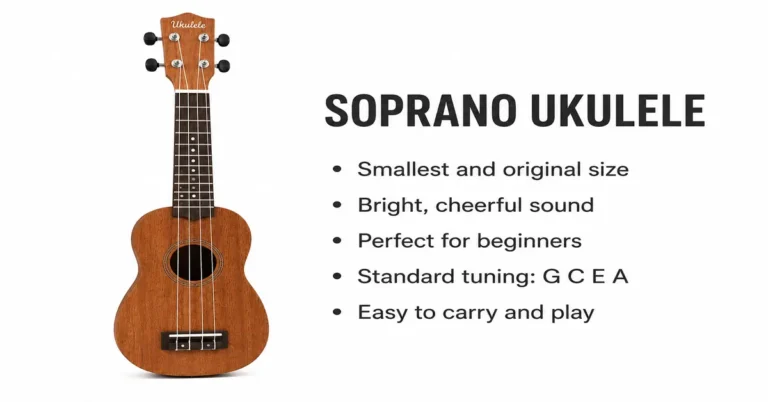
This one misses something structurally significant. The ukulele’s standard GCEA tuning doesn’t follow the guitar’s linear pitch progression from lowest string to highest. The G string on a standard soprano ukulele is tuned higher than the C and E strings, a re-entrant arrangement the guitar doesn’t use. This approach descends from the Portuguese rajão, not from the guitar family.
The ukulele is also typically strung with nylon or fluorocarbon strings rather than steel, producing a warmer, rounder tonal character. Calling it a small guitar is like calling a mandolin a small violin: superficially plausible based on appearance, structurally misleading based on tuning and ancestry.
Key dates in ukulele history
The ukulele’s development spans nearly 150 years, with several distinct turning points that determined how far the instrument traveled. The table below maps the major milestones, from the Ravenscrag’s arrival in Honolulu Harbor through the digital-era events that brought the instrument to its widest-ever global audience.
| Year | Milestone |
|---|---|
| August 23, 1879 | Ravenscrag arrives in Honolulu; Nunes, Dias, and Espirito Santo begin building instruments |
| Mid-1880s | Ukulele adopted by King Kalākaua; incorporated into royal court music at ʻIolani Palace |
| 1893 | Queen Liliʻuokalani composes “Aloha ʻOe”; ukulele embedded in Hawaiian musical tradition |
| 1915 | Panama-Pacific International Exposition introduces the ukulele to mainland America |
| 1916 | Kamaka Hawaii founded in Honolulu, the oldest continuously operating ukulele manufacturer |
| 1920s–1930s | Tin Pan Alley publishing boom; Martin Guitar Company launches ukulele production |
| 1940s | Arthur Godfrey’s national radio broadcasts bring the instrument into American living rooms |
| 1993 | Israel Kamakawiwoʻole releases Facing Future |
| 2006 | Jake Shimabukuro’s YouTube performance reaches a global audience |
FAQs
What year was the ukulele invented? The foundational year is 1879, when Portuguese craftsmen arrived in Honolulu and began building the first Hawaiian ukuleles. The instrument took its distinctly Hawaiian form across the 1880s, so some historians cite the mid-1880s as the true birth point. Both answers are defensible; they describe different stages of the same process.
Who invented the ukulele? Three Madeiran craftsmen are credited: Manuel Nunes, Augusto Dias, and Jose do Espirito Santo. All three arrived aboard the Ravenscrag on August 23, 1879. Nunes is often singled out individually in historical accounts, but the early development of the Hawaiian ukulele is attributed to all three men working in separate Honolulu workshops.
Where was the ukulele invented? The ukulele was built and developed in Honolulu, Hawaiʻi. Its direct ancestor, the machete de braga, came from the Madeira Islands off the coast of Portugal. The instrument’s identity and cultural meaning are Hawaiian; its structural and musical roots are Madeiran.
What does the word “ukulele” mean? In Hawaiian, “ukulele” translates roughly as “jumping flea.” The name probably refers to the quick finger movements of early players. One well-known theory links it to a British court officer, Edward Purvis, who earned the nickname for his energetic playing style, though this attribution relies on secondary sources.
How did the ukulele spread from Hawaiʻi to the rest of the world? The 1915 Panama-Pacific International Exposition in San Francisco was the primary catalyst for mainland American adoption. Sheet music publishers and instrument manufacturers responded quickly to audience interest. The ukulele then spread through vaudeville, radio, and global digital media, with Israel Kamakawiwoʻole and Jake Shimabukuro as the two most significant modern catalysts.
Is the ukulele Portuguese or Hawaiian? Both, and that distinction matters. The instrument is Madeiran-Portuguese in ancestry (descended from the machete de braga) and Hawaiian in identity, cultural meaning, and development. It took its name, its cultural significance, and its distinct musical character in Hawaiʻi, but its structural roots are clearly Portuguese.
The ukulele’s origin is a story about migration as much as music. Three craftsmen from Madeira carried an instrument across thousands of miles of ocean, arrived in Honolulu in August 1879, and built something new from the materials and cultural context they found there. What they created became the defining sound of an island culture, and eventually reached every country on earth.
The year is 1879. The place is Honolulu. The people are Manuel Nunes, Augusto Dias, and Jose do Espirito Santo. Everything else in the ukulele’s history (the royal patronage, the exposition, the radio years, the YouTube era) flows from that one August morning in the harbor.
For deeper research into the instrument’s construction, the evolution of soprano to baritone styles, and profiles of every key figure in its story, the Ukulele History archive has everything you need.
Explore content that respects your intelligence—browse our thoughtful expert reads.