Ukulele History Timeline: The Complete 1879–Today Guide
The ukulele history timeline starts on August 23, 1879, when the British clipper ship SS Ravenscrag docked in Honolulu carrying 423 Madeiran immigrants. Within five years, three of them had built the first ukuleles. In the 146 years since, the instrument has crossed oceans twice, ridden three global crazes, and become one of the most-played instruments on earth.
Most articles on ukulele history compress that story into vague decades. This one gives you the dated milestones, the people behind them, and the primary sources historians actually cite — from the Hawaiian Gazette of September 1879 to Jake Shimabukuro’s 2006 YouTube breakthrough.
If you want a clean, sourced timeline you can trust — not a rewrite of a rewrite — this is it.
What Is the Ukulele History Timeline?
The ukulele history timeline is the chronological record of how a Madeiran folk instrument became a global one. It spans roughly 146 years, from 1879 to today, and breaks into five clear eras: origin (1879–1889), Hawaiian era (1890s–1910s), Jazz-Age boom (1915–1935), decline and reinvention (1940s–1980s), and modern revival (1993–present).
The instrument itself is Portuguese in build and Hawaiian in soul. Three Madeiran cabinetmakers — Manuel Nunes, Augusto Dias, and José do Espírito Santo — combined the shape of the Portuguese machete with the tuning of the rajão, and swapped European tonewoods for Hawaiian koa. That change of material is what turned an immigrant instrument into a Hawaiian one.
Understanding the ukulele’s story matters because it explains its sound. The bright, jangly voice comes from reentrant G-C-E-A tuning — the top G string pitched high, not low. The warmth comes from koa. Everything else — from IZ’s Over the Rainbow to a kid’s first strum — traces back to choices made in the 1880s.

How Did the Ukulele Evolve? A Year-by-Year Timeline
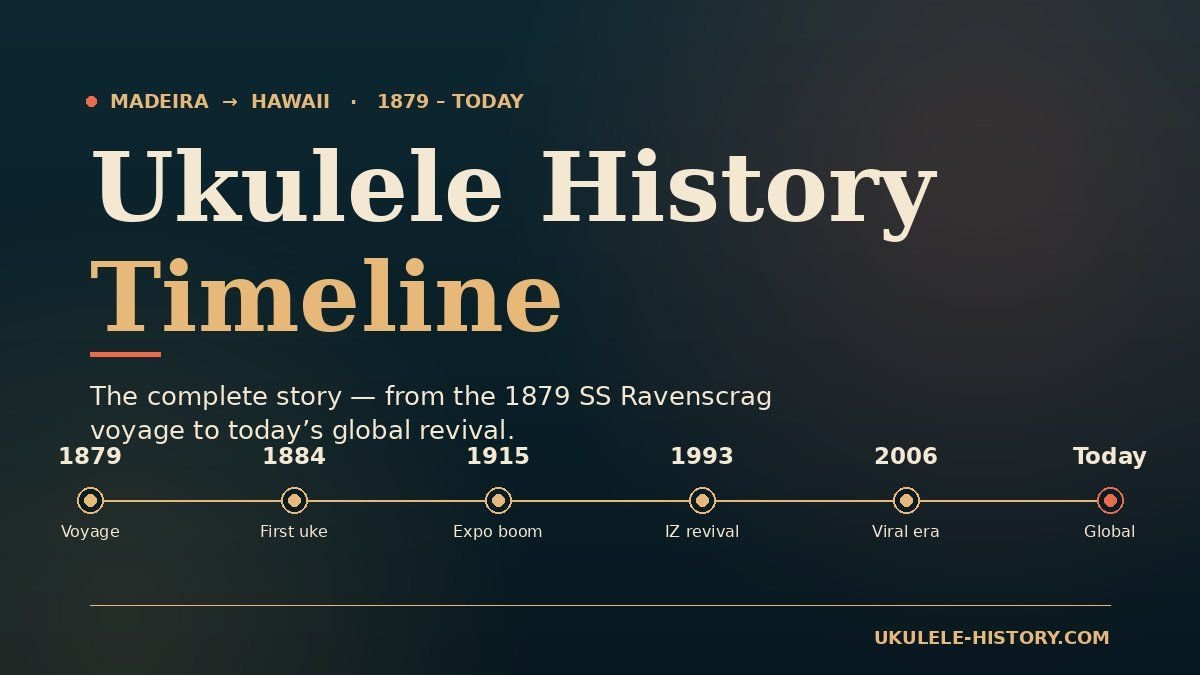
The ukulele evolved in five distinct waves. Each has a clear trigger event — the Ravenscrag voyage, King Kalākaua’s endorsement, the 1915 San Francisco expo, Israel Kamakawiwoʻole’s 1993 recording, and Jake Shimabukuro’s viral 2006 clip. Together they explain why the uke has never really disappeared, only paused between comebacks.
Era 1 — Portuguese roots (Pre-1879)
Long before the ukulele existed, Madeira had a thriving string tradition. Local craftsmen built three small instruments that would matter: the machete (also called braguinha or machete de Braga), the rajão, and the cavaquinho. These were common at wine-country festivals across the island.
The machete gave the future ukulele its body shape and its size — small, waisted, four strings. The rajão gave it its tuning idea: take the top four notes of a five-string rajão and you land on G-C-E-A. That combination is the ukulele’s DNA.
Era 2 — Arrival and invention (1879–1889)
1878 — Emigration begins. Madeira’s wine industry collapses after the Phylloxera blight, and Hawaii’s sugar plantations begin recruiting Portuguese labor. The first ship, the German bark Priscilla, arrives September 30, 1878.
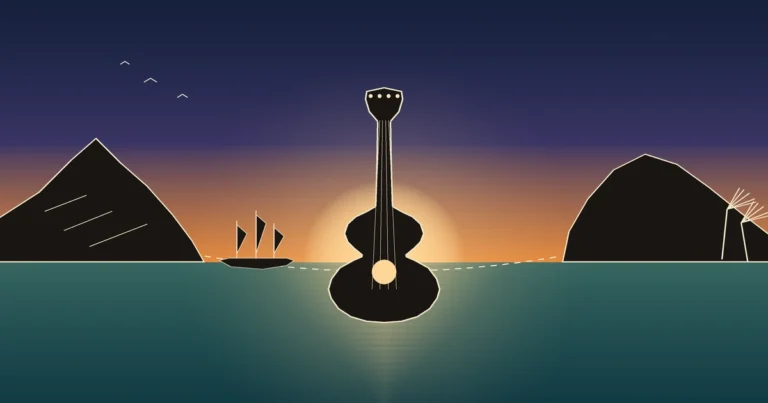
1879 — The Ravenscrag voyage. The clipper Ravenscrag leaves Funchal on April 23 and reaches Honolulu on August 23, 1879, after a 12,000-mile journey around Cape Horn. On board are 423 Madeirans — including three future ukulele makers and a musician named João Fernandes, who reportedly leaps ashore playing a borrowed machete.
September 3, 1879 — The first press mention. The Hawaiian Gazette prints a short item about “Madeira Islanders” giving “nightly street concerts” — the earliest known written record of Portuguese instruments delighting Hawaiian audiences.
1884 — First ukulele workshops. Manuel Nunes advertises “guitars and other instruments” in Honolulu. Augusto Dias opens a shop in Chinatown; José do Espírito Santo follows. The Portuguese machete now has koa wood bodies, reentrant tuning, and a new Hawaiian name. Learn how these luthiers reshaped it in just a few years.
Era 3 — Royal patronage & Hawaiian identity (1890s–1914)
1886 onward — King Kalākaua embraces the uke. Hawaii’s Merrie Monarch champions hula and Hawaiian music, and the ukulele becomes a fixture at royal events. His endorsement gives the immigrant instrument cultural legitimacy overnight.
1891 — Queen Liliʻuokalani. The queen — a composer herself — reportedly translates ukulele as “the gift that came here,” a poetic alternative to “jumping flea.” Her interpretation ties the instrument to migration and welcome, not just mimicry.
1898 — Annexation and export. After Hawaii’s annexation by the United States, ukuleles begin traveling to the mainland with sailors, tourists, and returning missionaries.
Era 4 — The mainland boom (1915–1935)
February 20, 1915 — The Panama-Pacific International Exposition. Nearly 17 million visitors pass through San Francisco’s world’s fair. The Hawaiian Pavilion features ukulele maker and player Jonah Kumalae, plus George E. K. Awai’s Royal Hawaiian Quartet. Mainland America meets the uke.
1916 — Martin enters the game. C.F. Martin & Company begins ukulele production, followed by Gibson, Regal, and Harmony. The instrument shifts from Hawaiian craft to mass-market product.
1920s — The Jazz Age boom. Sheet-music publishers start printing ukulele chord tablature above every popular song. Cliff “Ukulele Ike” Edwards scores a hit with I’ll See You in My Dreams (1925) and later records When You Wish Upon a Star. Roy Smeck earns the nickname “Wizard of the Strings.”
1929 — The ukulele reaches Japan. Yukihiko Haida returns from Hawaii and introduces the ukulele to Tokyo, where Hawaiian music will remain popular for nearly a century.
Era 5 — Plastic, TV, and decline (1935–1990)
Late 1940s — The plastic revolution. Inventor Mario Maccaferri manufactures roughly 9 million plastic Islander ukuleles between 1949 and the mid-1950s. They cost a few dollars and end up in millions of American homes.
1950s — Arthur Godfrey’s TV era. Broadcaster Arthur Godfrey teaches viewers to play on network television, fueling the second American craze.
1960s onward — The great pause. Rock ‘n’ roll and folk-guitar culture push the uke aside. For thirty years it’s seen as a novelty or a beginner’s toy.
Era 6 — Revival and global renaissance (1993–today)
1993 — Israel Kamakawiwoʻole’s “Over the Rainbow” medley. Released on his album Facing Future, IZ’s tender ukulele arrangement quietly begins reshaping how the world hears the instrument. It later charts on the Billboard Hot Digital Songs.
April 22, 2006 — Jake Shimabukuro goes viral. A clip of Shimabukuro playing While My Guitar Gently Weeps in New York’s Central Park is uploaded to YouTube. It racks up millions of views and proves the ukulele can carry a solo instrument the way a classical guitar can.
2010s — The classroom era. Schools across the UK, Canada, Australia, and the US adopt the ukulele as an entry instrument, replacing recorders. Online lessons and cheap starter ukes (under $50) make it the easiest instrument in the world to try.
Today. According to industry estimates, tens of millions of ukuleles have sold worldwide since 2010, and the ukulele now sits alongside guitar and piano as one of the most accessible “first instruments” a person can pick up.
Ukulele history at a glance
| Year | Event | Why it matters |
|---|---|---|
| Pre-1879 | Machete & rajão in Madeira | The ukulele’s Portuguese ancestors |
| Aug 23, 1879 | SS Ravenscrag arrives in Honolulu | 423 Madeirans reach Hawaii |
| Sept 3, 1879 | Hawaiian Gazette mentions “nightly concerts” | First written record |
| ~1884 | Nunes, Dias & Santo open shops | First koa-wood ukuleles |
| 1886 → | King Kalākaua embraces the uke | Cultural legitimacy |
| Feb 20, 1915 | Panama-Pacific Exposition | Mainland US discovers ukulele |
| 1916 | Martin starts production | Mass-market era begins |
| 1925 | Ukulele Ike records I’ll See You in My Dreams | Uke becomes pop sound |
| Late 1940s | Maccaferri’s plastic ukes | ~9 million sold |
| 1993 | IZ’s Over the Rainbow released | Modern revival begins |
| 2006 | Jake Shimabukuro’s YouTube clip | Uke becomes a serious solo instrument |
| Today | Global classroom instrument | Millions of players worldwide |
Which Moments Shaped the Ukulele Most?
Five events did the heavy lifting: the 1879 voyage, the 1880s workshops, the 1915 San Francisco expo, IZ’s 1993 recording, and Jake Shimabukuro’s 2006 video. Everything else built on those five turning points, and knowing them is the fastest way to understand the whole timeline.
1. The Ravenscrag voyage (1879). Without those 423 passengers, the machete would have stayed a Madeiran folk instrument. According to Tranquada and King’s The Ukulele: A History (University of Hawaii Press, 2012), historians treat the Ravenscrag‘s arrival as the ukulele’s true origin point.
2. The first workshops (1884). Three men working in Honolulu Chinatown swapped juniper and spruce for koa, and adopted the top four notes of the rajão as a tuning. That was the actual invention — not a single moment, but a set of decisions made in three small shops.
3. The Panama-Pacific Exposition (1915). The San Francisco fair drew nearly 17 million visitors over ten months. The Hawaiian Pavilion was one of the top attractions, and mainland tourists went home wanting a ukulele. Every uke sold in America between 1915 and 1935 traces back to that fair.
4. Israel Kamakawiwoʻole (1993). IZ’s medley of Over the Rainbow and What a Wonderful World did something rare: it made the ukulele sound emotional again. After thirty years as a punchline, the uke was suddenly the sound of longing.
5. Jake Shimabukuro (2006). One YouTube clip filmed in Central Park proved the uke could carry a symphony. Within a year, ukulele sales in the US were reportedly climbing at double digits, and the “renaissance” was official.
Together, these five moments are the ukulele history timeline in miniature. If you only remember five dates, remember these.
What People Get Wrong About Ukulele History
Most articles on the ukulele’s past repeat the same three mistakes: crediting Hawaii for inventing it, calling Manuel Nunes “the inventor,” and treating the instrument as a novelty. All three are wrong, or at least incomplete.
Myth 1 — “The ukulele is a Hawaiian invention.” The design, tuning, and technique are Portuguese. What Hawaii contributed was koa wood, a new name, and — through King Kalākaua — cultural adoption. The honest description is that the ukulele is Portuguese in construction and Hawaiian in identity.
Myth 2 — “Manuel Nunes invented the ukulele alone.” Nunes marketed himself hardest, so his name stuck. But Augusto Dias and José do Espírito Santo were building nearly identical instruments in shops just blocks away, in the same years. There is no single inventor — see our full breakdown of who really invented the ukulele.
Myth 3 — “The ukulele is a toy.” This one is a hangover from the plastic-uke era of the 1950s. In practice, the modern ukulele has a serious solo repertoire, professional players in every major music scene, and a place in university music programmes from Hawaii to the UK.
Correcting these three myths is the fastest way to sound informed about ukulele history. Every serious source — from the Smithsonian to the University of Hawaii Press — treats the story as shared authorship, not a single-inventor legend.
Ukulele History Timeline FAQ
When was the ukulele invented?
The ukulele was invented in 1884 or shortly after, in Honolulu, once Manuel Nunes, Augusto Dias, and José do Espírito Santo opened their workshops. The Portuguese immigrants had arrived on August 23, 1879, so the true “invention” spans a five-year window from arrival to the first Hawaiian-built instruments.
Who invented the ukulele?
Three Madeiran cabinetmakers — Manuel Nunes, Augusto Dias, and José do Espírito Santo — are jointly credited as the ukulele’s makers. Nunes is most often called “the father of the ukulele” because he advertised the claim most aggressively, but historians agree all three shaped the instrument in the same years.
What is the origin of the ukulele?
The ukulele’s origin is Portuguese, and its birthplace is Hawaii. Its ancestors are the machete, braguinha, and rajão from Madeira, Portugal. It became the ukulele only after Madeiran craftsmen adapted these instruments in 1880s Honolulu, using Hawaiian koa wood and a reentrant G-C-E-A tuning.
Why is it called “ukulele”?
“Ukulele” is Hawaiian for “jumping flea” — ‘uku (flea) plus lele (jumping). One theory says the name describes a player’s fingers dancing across the strings. Queen Liliʻuokalani preferred a different translation: “the gift that came here,” honouring the instrument’s Portuguese roots.
When did the ukulele become popular in America?
The ukulele became popular in the United States after the 1915 Panama-Pacific International Exposition in San Francisco, where nearly 17 million visitors encountered the Hawaiian Pavilion’s music. Within a year, C.F. Martin & Company began mass production, and by the mid-1920s the ukulele was the sound of the American Jazz Age.
How did the ukulele become popular again?
The modern revival started in 1993 with Israel Kamakawiwoʻole’s Over the Rainbow medley, and accelerated in 2006 when Jake Shimabukuro’s While My Guitar Gently Weeps video went viral on YouTube. Affordable starter instruments and the rise of online lessons then turned the uke into a global classroom favourite.
What was the first ukulele made of?
The first Hawaiian ukuleles were built almost entirely from koa, a native acacia wood prized for its warm tone and figured golden grain. Portuguese machetes had used spruce and juniper, but Nunes, Dias, and Santo swapped these for koa — one of the decisions that turned the instrument into something distinctly Hawaiian.
How old is the ukulele today?
Counting from the first Hawaiian-built instruments in the mid-1880s, the ukulele is about 140 years old. If you count from the Ravenscrag‘s 1879 arrival — the moment the story really starts — it is roughly 146 years old as of today.
Bringing the Ukulele History Timeline Home
The ukulele’s story is one of migration, adaptation, and quiet comebacks. It travelled from a wine-country island in the Atlantic to a sugar-country island in the Pacific, changed material and name, and then rode three global crazes without ever quite becoming ordinary.
If you’re learning the instrument — or just curious about it — the timeline above is the shortest honest version. Bookmark the table, remember the five turning-point moments, and you’ll know more about the ukulele than most of the people you’ll ever play with.
If you’d like to keep exploring, start at our ukulele history homepage for the full origin story, then dive into the parts of a ukulele and the four modern sizes — each of which fits somewhere on this same timeline.