Ukulele Revival History: 4 Times It Conquered the World
The ukulele has died and been reborn more times than most instruments get a first life. The ukulele revival history is not a list of random cultural trends — it’s a documented pattern of four distinct waves, each triggered by a single high-visibility event, each sustained by the same core properties. The short answer to why it keeps coming back: portability, affordability, fast early progress, and genuine emotional depth make the instrument uniquely suited to moments of cultural reset.
The longer answer is more interesting. Most histories of the ukulele focus on the moments — the ship arrival, the exposition, the television appearance, the viral video. What they miss is the mechanism behind those moments, and the one force that kept the instrument alive through every stretch of mainstream indifference.
Key takeaways:
- The ukulele arrived in Hawaiʻi on August 23, 1879, aboard the British ship Ravenscrag, carried by Madeiran craftsmen
- Four distinct waves have reshaped the instrument’s global standing since that year
- Each wave was triggered by a high-visibility exposure event, not by a marketing campaign
- The 1915 Panama-Pacific International Exposition launched the ukulele’s first continental reach
- Israel Kamakawiwoʻole’s 1993 album and Jake Shimabukuro’s YouTube performances anchored the fourth wave
- The instrument’s accessibility is both its greatest strength and the reason mainstream interest periodically fades
What is the ukulele revival history, and why does it keep repeating?
Ukulele revival history describes a four-part cycle of mainstream adoption, gradual cultural retreat, and resurgence that has repeated since 1879. Each cycle shares the same structural trigger: a single high-visibility event pushes a quietly thriving community into broad public awareness, accessibility drives rapid uptake, and cultural skepticism eventually pulls mainstream attention elsewhere. Understanding the pattern means understanding the instrument.
The Portuguese roots that made revival possible
Three Madeiran craftsmen arrived in Honolulu Harbor on August 23, 1879, aboard the British ship Ravenscrag. Manuel Nunes, Augusto Dias, and José do Espírito Santo were among the Portuguese contract workers who made the long Pacific crossing, and they brought with them the machete de braga — a small four-stringed instrument from the Madeiran folk tradition. By some contemporary accounts, passengers played and sang as the ship entered the harbor, drawing onlookers on the dock.
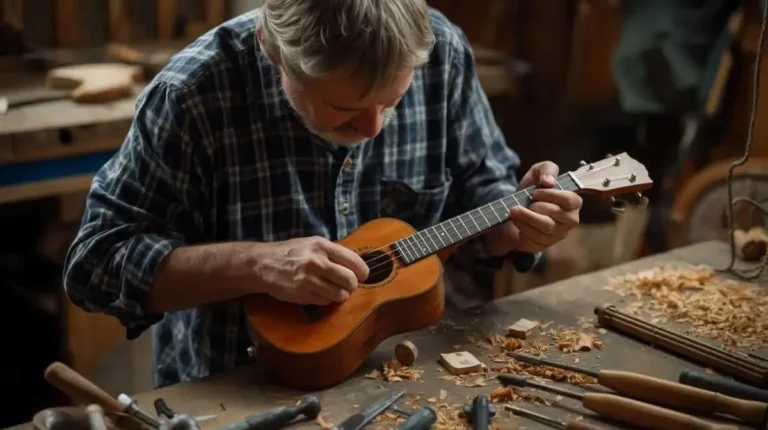
Nunes established a workshop in Honolulu and appears in Hawaiian business records within years of his arrival. He and his counterparts adapted the machete for Hawaiian conditions: local koa wood replaced the tighter-grained European timbers, and the instrument gradually settled into the form that became recognizable as the ukulele — four strings, re-entrant tuning, soprano scale. The rajão, another Portuguese instrument the immigrants knew, also contributed elements to the final form.
The name came from Hawaiʻi, not Portugal. Most cited etymologies translate “ukulele” as “jumping flea” in Hawaiian, reportedly a nickname for the quick movement of a player’s fingers across the fretboard. The exact date the word first appeared in Hawaiian-language print remains debated — most credible sources point to the 1890s press.
Royal adoption and the first cultural wave
The ukulele might have stayed a plantation instrument without one significant advocate: King Kalākaua. The Hawaiian monarch was a deliberate cultural architect, not just an enthusiast. He incorporated the ukulele into court performances and promoted Hawaiian artistic traditions during a period when American commercial and political pressure was eroding indigenous culture from multiple directions.
Queen Liliʻuokalani, his successor and an accomplished composer, also played ukulele. Their patronage gave the instrument a standing within Hawaiʻi that no outside market force could easily undercut. That cultural foundation proved essential when the instrument first met a continental audience.
The four waves of ukulele revival
The ukulele revival history divides into four identifiable waves. Each was initiated by a specific, datable event. Each spread because the instrument’s core accessibility met a moment of cultural openness. And each receded not because the instrument failed, but because a residual community preserved it until the next trigger arrived.
The ukulele revival timeline at a glance:
- 1879 — Ravenscrag arrives in Honolulu; Madeiran craftsmen establish workshops
- 1915 — Panama-Pacific International Exposition triggers the first continental wave
- Early 1920s — Peak of the second wave; Tin Pan Alley, George Formby, mass sheet music
- 1950s–60s — Third wave via television; Arthur Godfrey and Tiny Tim reach mass audiences
- 1993 — “Facing Future” album begins the fourth wave
- ~2006 — Jake Shimabukuro’s YouTube video accelerates the ongoing digital revival
| Wave | Period | Trigger event | Key figures | Why it receded |
|---|---|---|---|---|
| First | 1879–1914 | Ravenscrag arrival; royal patronage | Manuel Nunes, Kalākaua, Liliʻuokalani | Contained within Hawaiʻi; no mass-media reach |
| Second | 1915–late 1930s | Panama-Pacific International Exposition | Tin Pan Alley publishers, George Formby | Great Depression; radio consolidation shifted listening habits |
| Third | 1950s–early 1970s | Arthur Godfrey’s television appearances | Arthur Godfrey, Tiny Tim | Rock music’s dominance made small acoustic instruments feel marginal |
| Fourth | 1993–present | IZ recording; YouTube viral moment | Israel Kamakawiwoʻole, Jake Shimabukuro | Ongoing — digital infrastructure sustains it differently |
Wave two — the exposition that changed everything
When the Panama-Pacific International Exposition opened in San Francisco in 1915, its Hawaiian Pavilion introduced mainland Americans to something most had never encountered: skilled Hawaiian musicians performing live on ukuleles, continuously, for a general public audience.
The impact reached New York within months. Tin Pan Alley publishers started including ukulele chord charts as standard features on popular song sheets. Established makers of acoustic instruments, including Martin, entered ukulele production to meet demand they hadn’t anticipated the previous decade. Hawaiian makers including Kamaka, established in Honolulu in the 1910s, were building for a domestic market that the second wave helped amplify beyond Hawaiʻi’s shores.
By the early 1920s, the ukulele was the parlor instrument of choice for a generation that wanted music without needing a piano or formal training. George Formby extended the wave into British popular culture through music hall work with his banjo-ukulele, demonstrating that the instrument could sustain an entire entertainment career, not just an evening’s novelty.
Historian’s note: The 1915 Exposition tends to be framed as a music business story. Commercially, it was. But the Hawaiian musicians who performed there were not novelty acts brought in for effect. They were practitioners of a tradition already thirty-five years deep. The mainland heard novelty; Hawaiʻi sent craftsmanship.
Wave three — television and the living room player
Arthur Godfrey’s contribution to the third wave is consistently underestimated because it doesn’t fit the “star player” narrative most music histories prefer. He was a television personality, not a virtuoso. But his on-air ukulele playing in the 1950s — chord demonstrations, instructional records, comfortable visible playing — reached a domestic audience that dwarfed any concert tour or sheet music run from the earlier wave.
Tiny Tim’s appearances on The Tonight Show in the late 1960s created a more complicated moment. His falsetto voice and deliberately old-fashioned style read as comedy to many viewers. That’s fine. The viewing numbers were real regardless of interpretation, and the ukulele was in living rooms again, prime time, while rock music was actively pulling cultural attention toward electric instruments that could fill arenas.
The wave receded because the ukulele couldn’t compete on those terms. But it didn’t disappear. It retreated into Hawaiian music communities, folk circles, and the collections of players who had never needed mainstream validation to keep playing.
Wave four — from a recording session to a billion streams
Israel Kamakawiwoʻole recorded his medley of “Somewhere Over the Rainbow” and “What a Wonderful World” in a single late-night session, on short notice, with minimal preparation. The recording appeared on his 1993 album “Facing Future.” After Kamakawiwoʻole died in 1997, the medley expanded steadily as it appeared in film and television soundtracks across countries and decades.
What that medley achieved for global ukulele awareness exceeds what any single moment since the 1915 Exposition had managed — not because of chart performance, but because it reached audiences in grief and wonder, contexts where the instrument’s particular warmth mattered most. Kamakawiwoʻole showed that the ukulele could hold emotional weight that its reputation for cheerfulness had long obscured.
Jake Shimabukuro’s solo arrangement of “While My Guitar Gently Weeps,” uploaded to YouTube around 2006, made a different argument: the instrument had a technical ceiling that could satisfy demanding musicians. That video spread without a label, without radio play, without any of the institutional machinery that had structured the previous three waves. It spread because people sent it to each other.
The fourth wave is structurally different from its predecessors. Digital platforms removed the gatekeepers — the sheet music publisher, the television executive, the record company — that had previously determined when and how each wave reached new audiences. This time, the community has grown continuously rather than in a single burst, and it has not receded in the way the first three waves did.
The cultural and musical context behind each revival
Understanding why the ukulele revival history keeps repeating means examining what each wave actually offered its era — not just the instrument, but the conditions that made it resonate. The answer lies in a consistent tension between two forces: the accessibility that opens each wave and the cultural skepticism that has periodically closed it.
The accessibility paradox
Every wave has been driven by the same structural advantage: a motivated beginner can play recognizable songs on a ukulele within a week. That fact drives adoption. But it also plants the seed of each wave’s eventual retreat from the mainstream.
When an instrument is easy to start, cultural gatekeepers tend to assume it’s easy to master. That assumption is wrong, as Shimabukuro and Kamakawiwoʻole demonstrated on opposite ends of the technique spectrum. But the perception persists. It’s one reason rock and jazz cultures have periodically dismissed the instrument even while its grassroots following remained steady. The very accessibility that opens each wave feeds the cultural skepticism that eventually closes it.
What the instrument actually sounds like
Koa wood, native to Hawaiʻi and used in higher-quality ukuleles, produces a warmth in the upper register that mahogany approaches differently. Koa tends to bloom with a slight sweetness on sustained notes; mahogany delivers a more even, present sound. Neither is objectively better — they suit different players and different repertoires.
The GCEA tuning is re-entrant: the G string sits higher in pitch than the C string, breaking the low-to-high sequence you’d expect from a guitar. Strumming downward produces a brightness that a standard ascending-pitch arrangement wouldn’t create. This isn’t a limitation — it’s the tuning choice that defines the ukulele’s sound and has remained consistent since its Hawaiian evolution.
| Size | Approximate scale length | Approximate total length | Standard tuning | Common use |
|---|---|---|---|---|
| Soprano | 13 in / 33 cm | 21 in / 53 cm | GCEA | Traditional Hawaiian tone; original form |
| Concert | 15 in / 38 cm | 23 in / 58 cm | GCEA | Fuller sound, more frets, slightly more volume |
| Tenor | 17 in / 43 cm | 26 in / 66 cm | GCEA or DGBE | Louder, fuller; favored by performing musicians |
| Baritone | 19 in / 48 cm | 30 in / 76 cm | DGBE | Closest to guitar sound and tuning |
The four-wave framework — why this pattern holds
No other instrument of similar simplicity has revived as consistently, across as many distinct cultural contexts, as the ukulele. The four-wave pattern reflects four permanent properties that make revival not just possible but predictable — and those properties haven’t changed since 1879.
The Ravenscrag-to-revival arc — a historical vignette
On August 23, 1879, the Ravenscrag docked in Honolulu Harbor after months at sea. Among the passengers were Manuel Nunes, Augusto Dias, and José do Espírito Santo — woodworkers from Madeira who had crossed the Pacific with their craft and their instruments. Nunes is documented in Hawaiian business records within years of his arrival, operating a musical instrument workshop in Honolulu.
The machete he brought became something distinct under Hawaiian conditions: built with local koa, adjusted in proportion, gradually standardized into the ukulele’s soprano form. Within a decade, workshops like Nunes’s were supplying instruments to a royal court that had made the ukulele central to Hawaiian musical identity. Within four decades, the instrument had reached San Francisco, New York, and London.
That transformation — a Portuguese folk instrument becoming something specifically Hawaiian, then something globally adopted — is the prototype for every revival that followed. The ukulele absorbs new cultural contexts without losing its core form. That flexibility is what makes each revival possible and what makes the pattern repeat.
The four permanent properties
Four properties have remained unchanged through every wave and every trough:
- Portability: A soprano ukulele fits in a backpack. No other chordal instrument is as unconditionally portable.
- Affordability: Entry-level ukuleles have stayed within a modest budget throughout the instrument’s history. That keeps the barrier to first contact low.
- Fast early progress: Beginners can play a recognizable song within days. That experience of competence drives continued engagement in ways slower instruments don’t.
- Emotional range: Despite its reputation for lightness, the ukulele handles grief, longing, and musical complexity. Kamakawiwoʻole demonstrated this to a global audience; Shimabukuro demonstrated it to technically demanding musicians.
Remove any one of these, and the revival pattern breaks. All four together explain why no cultural dismissal, economic disruption, or competing technology has permanently ended the instrument’s appeal.
What most people get wrong about ukulele revival history
Two persistent misconceptions shape how the ukulele’s history gets told — and misread. Both underestimate the instrument.
Misconception 1 — the ukulele is a toy or a beginner’s stepping stone to guitar
This is the most common misreading of the instrument’s history, and it’s wrong on two counts. First, the ukulele isn’t a simplified guitar. Its ancestors — the machete de braga and the rajão — developed independently from the modern acoustic guitar’s popularization, and its re-entrant GCEA tuning descends from a different instrumental logic entirely. The chord shapes differ, the fingerboard logic differs, and the musical possibilities aren’t a subset of the guitar’s.
Second, the “stepping stone” idea contradicts what the historical record shows: most serious ukulele players don’t move on to guitar. They stay, because the instrument rewards them on its own terms. The fourth wave has produced a generation of players who consider the ukulele a primary instrument, not a training aid.
Misconception 2 — each revival is a separate trend with no connection to the last
Music journalism tends to treat each ukulele wave as a fresh discovery. But every wave has been built directly on the residual community from the previous one.
The Hawaiian musicians who performed at the 1915 Exposition were the inheritors of Nunes and Dias’s tradition. The folk and Hawaiian music players who kept the instrument alive through the 1970s and 1980s formed the audience that responded to Kamakawiwoʻole’s recording and Shimabukuro’s video. Revivals don’t emerge from nothing. They emerge from continuity — from communities that never needed mainstream validation to keep playing.
FAQs
Why does the ukulele keep having revivals? The ukulele revives because its core properties — portability, affordability, fast early progress, and genuine emotional depth — match the needs of each new generation that discovers it. When a high-visibility event brings it to broad attention, those properties do the rest. The instrument doesn’t need to change between waves. It just needs a new audience.
When did the ukulele first become popular in the United States? The first major mainland US wave followed the Panama-Pacific International Exposition in San Francisco in 1915, where Hawaiian musicians performed to general public audiences. Tin Pan Alley publishers responded within months by including ukulele chord charts on popular song sheets, and by the early 1920s the ukulele was a fixture in American parlor music. A prior domestic market was essentially nonexistent before 1915.
Who sparked the modern ukulele revival? Israel Kamakawiwoʻole’s “Somewhere Over the Rainbow” medley, released on his 1993 album “Facing Future,” introduced the instrument’s emotional range to a global audience. Jake Shimabukuro’s YouTube performances in the mid-2000s demonstrated its technical depth to skeptical musicians. Both contributed to a fourth wave sustained by digital platforms rather than the institutional gatekeepers — publishers, broadcasters, labels — that structured the previous three.
Is the ukulele related to the guitar? The ukulele and guitar are both chordophones, but they descend from different instruments. The ukulele’s ancestors are the Portuguese machete de braga and rajão, which arrived in Hawaiʻi in 1879. Its standard GCEA re-entrant tuning produces a different sound and requires different playing logic from a guitar. Players who know both typically describe them as complementary, not interchangeable.
What are the differences between soprano, concert, tenor, and baritone ukuleles? The four main sizes differ in scale length, total length, volume, and tuning. Soprano, the original Hawaiian form, produces the classic bright tone at roughly 21 inches total length. Concert and tenor add frets and volume while keeping GCEA tuning. Baritone uses DGBE tuning — identical to a guitar’s top four strings — and sounds warmer and more guitar-like than the smaller three sizes.
Strip away the cultural detail, and the ukulele revival history is a story about what happens when an instrument gets its fundamental properties right. Portability, affordability, fast early returns, real emotional depth — that combination has outlasted every force that’s tried to push the ukulele to the margins: the Depression, the dominance of electric guitar, the collapse of the physical music industry.
Four waves. One instrument. The same four reasons each time.
Ukulele History covers this full pattern — from the Ravenscrag’s arrival in 1879 to the ongoing fourth wave — for readers who want to understand not just what the ukulele is, but why it refuses to disappear
Every scroll should count—make it meaningful with our value-packed posts.