Tiny Tim Ukulele: The Man Who Brought It Back
The ukulele nearly vanished from American culture between the 1940s and the 1960s. Then Herbert Buckingham Khaury — known as Tiny Tim — changed that. His soprano ukulele playing and high falsetto voice, broadcast on national television in 1968 and 1969, introduced the instrument to tens of millions of viewers and sparked renewed interest at a time when the four-stringed instrument had been quietly fading for two decades.
Most accounts treat him as a novelty act. That reading misses the point.
Tiny Tim was a serious musical archivist who memorized hundreds of songs from the Tin Pan Alley and vaudeville era — songs that existed in no other active performer’s repertoire. His ukulele wasn’t a stage prop. It was the thread connecting an almost-lost musical tradition to a television generation that had never heard it. The single event that anchored his place in that tradition is one most histories still brush past.
Key takeaways:
- Tiny Tim’s real name was Herbert Buckingham Khaury, born in New York City in 1932
- He played soprano ukulele throughout his career, using it to perform songs from the 1900s–1930s that had largely disappeared from popular culture
- His 1968 appearances on Rowan & Martin’s Laugh-In and The Tonight Show introduced the ukulele to a mass television audience for the first time since the Arthur Godfrey era
- On December 17, 1969, an estimated 40 million viewers watched him marry Miss Vicki live on The Tonight Show — one of the most-watched late-night events in American broadcasting history
- He died on November 30, 1996, while performing “Tiptoe Through the Tulips” at a benefit concert in Minneapolis, Minnesota — still playing his ukulele to the end
- Music historians increasingly recognize his role as a bridge between the vaudeville-era ukulele tradition and the modern revival led by artists like Israel Kamakawiwoʻole and Jake Shimabukuro
Who was Tiny Tim?
Tiny Tim was an American singer and entertainer whose soprano ukulele playing and dramatic falsetto made him one of the most singular figures in 1960s popular culture. Born Herbert Buckingham Khaury on April 12, 1932, in New York City, he spent his formative years absorbing music from a fading era — collecting 78 rpm records, memorizing songs from the 1900s through the 1930s, and teaching himself ukulele as the natural vehicle for that repertoire. While his generation listened to Chuck Berry and Buddy Holly, he was studying vaudeville.
The real man behind the persona
The Tiny Tim that television audiences encountered — the long hair, the tulips, the shopping bag, the operatic falsetto — was theatrical. The musical knowledge underneath it was not.
He reportedly maintained a personal archive of thousands of recordings and could perform from memory songs that existed nowhere else in the active performance repertoire of his time. He worked under several stage names before settling on Tiny Tim, including Larry Love and Darry Dover. For much of the late 1950s and early 1960s, he played coffeehouses and small clubs across New York City — particularly in Greenwich Village — developing his act for modest and occasionally resistant audiences. The mainstream music industry ignored him for almost a decade.
From Greenwich Village to national television
His profile grew slowly through New York’s downtown arts scene before television changed everything. By 1968, Rowan & Martin’s Laugh-In had brought him to a prime-time audience that had no existing category for what it was seeing.
Tiny Tim’s soprano ukulele and falsetto were strange in the best possible way — technically earnest, visually unforgettable, and rooted in a musical tradition the prime-time viewer had never encountered in that form. His debut album, God Bless Tiny Tim, was released that same year on Reprise Records. It found a wide commercial audience that surprised the industry, and his Tonight Show bookings began building into a sustained national platform.
Tiny Tim’s ukulele: the instrument at the center of everything
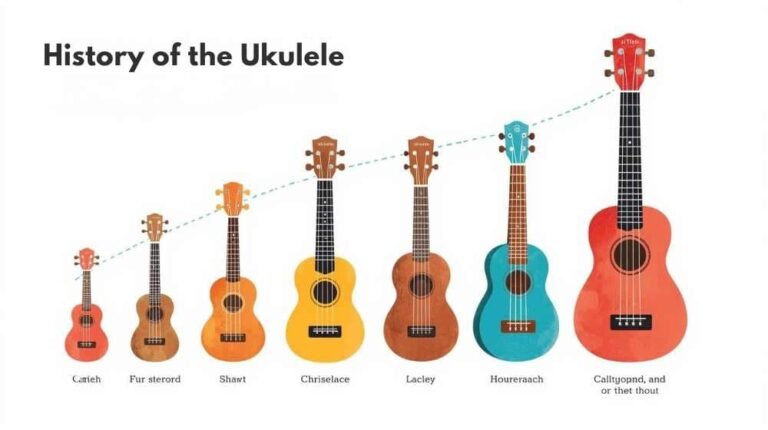
Tiny Tim played the soprano ukulele — the smallest of the four main sizes, with a scale length of approximately 13 inches (33 cm). Its bright, reedy tone matched his high vocal register and the early 20th-century repertoire he built his career around. The soprano’s quick attack and limited sustain fit the strumming patterns that characterized parlor music and vaudeville song accompaniment — the exact tradition he was working inside.
Why he chose the ukulele
The ukulele was already embedded in the Tin Pan Alley and vaudeville traditions Tiny Tim devoted his life to preserving. During the 1910s and 1920s, it was the dominant popular instrument in American homes, played in vaudeville houses by figures like Rudy Vallée and later on early television by Arthur Godfrey. For Tiny Tim, choosing the ukulele wasn’t a quirky aesthetic decision. It was historically correct — those songs were written for that instrument, and playing them on anything else would have been a misreading of the source material.
His technique and musical range
His playing style was functional rather than virtuosic: clear chord strumming that supported his vocal melody without overpowering it, consistent with how the ukulele was used in parlor music and early recorded performance. What made him remarkable wasn’t dexterity. It was his vocal range — a documented ability to move between a deep natural voice and a high soprano falsetto within the same song, creating an effect that audiences found impossible to categorize or ignore.
His repertoire ranged across several decades of American song: “Tiptoe Through the Tulips,” “I Love Me (I’m Wild About Myself),” “On the Old Front Porch,” and dozens of other numbers largely absent from any other performer’s active set list in the 1960s.
“Tiptoe Through the Tulips” and the song that became a cultural artifact
The original “Tiptoe Through the Tulips” was written by Al Dubin and Joe Burke and first recorded by Nick Lucas for the 1929 musical film Gold Diggers of Broadway. Tiny Tim’s 1968 version transformed it from a forgotten pre-war novelty into one of the most recognizable — and most parodied — songs of its era. That transformation required the right instrument. A guitar would have made it a folk song. The ukulele made it something genuinely alien to 1968 ears, which was precisely the point.
The Tonight Show moments that shaped public memory
No single setting did more for Tiny Tim’s ukulele legacy than The Tonight Show Starring Johnny Carson. His appearances there, beginning in the late 1960s, exposed the soprano ukulele to a nightly audience of millions at a moment when the instrument had almost no other mainstream presence in American popular culture.
His television breakthrough in 1968
Between his Laugh-In appearances and his Tonight Show bookings, 1968 was the year Tiny Tim moved from cult figure to national phenomenon. He had achieved something no amount of club performances could produce: he made a pre-war instrument visible to a generation raised on electric guitars and Marshall amplifiers.
Television did what years of Greenwich Village stages couldn’t. The soprano ukulele was on screen, weekly, played with evident sincerity by a man who existed entirely outside contemporary musical categories. That visibility mattered — not as advertising for the instrument, but as proof that it existed and that a real person was playing it.
The wedding heard around the world
On December 17, 1969, Tiny Tim married Victoria May Budinger — known publicly as Miss Vicki — live on The Tonight Show with Johnny Carson. An estimated 40 million viewers watched. It remains among the most-watched late-night broadcasts in American television history.
He carried tulips. He strummed his soprano ukulele. For those 40 million viewers, the ukulele was the instrument of that moment — small, quiet, four-stringed, and at the center of something that felt simultaneously absurd and wholly sincere. Instrument retailers and music educators noted increased interest in the ukulele during and following his television peak, though the precise commercial effect is difficult to quantify — no contemporary study tracked the correlation directly. The anecdotal record from this period, however, points consistently in the same direction.
Key milestones in Tiny Tim’s ukulele timeline
| Year | Event | Ukulele cultural significance |
|---|---|---|
| Late 1950s–early 1960s | Performs in Greenwich Village coffeehouses | Soprano ukulele nearly absent from mainstream American culture |
| 1968 | God Bless Tiny Tim released; Laugh-In and Tonight Show appearances begin | Ukulele reaches prime-time and late-night television for first time since Godfrey |
| December 17, 1969 | Marries Miss Vicki live on The Tonight Show (est. 40 million viewers) | Most-watched ukulele performance in American broadcasting history |
| 1970s | Career declines; cult following persists | Ukulele awareness remains above pre-1968 baseline |
| November 30, 1996 | Dies while performing “Tiptoe Through the Tulips” in Minneapolis | Legacy reassessment begins; role in ukulele revival examined |
| 1990s onward | Israel Kamakawiwoʻole’s recordings reach global mainstream audiences | Tiny Tim recognized as a significant precursor to the revival |
The Three-Stage Tiny Tim Effect
Understanding Tiny Tim’s contribution to ukulele culture requires a framework beyond “he was famous for playing one.” His impact moved through three distinct stages — each building on the one before — from a decade of quiet preservation work in Manhattan coffeehouses to the largest late-night audience in American television history.
Stage one: preservation
Before Tiny Tim could bring the ukulele to a television audience, he spent years preserving the musical tradition that instrument carried. While peers were building electric guitar collections, he was cataloguing 78 rpm recordings from 1908 and 1914 and memorizing songs that existed nowhere else in active performance. His soprano ukulele was the instrument those songs required, and he learned it not as a hobby but as a commitment to music he genuinely believed mattered.
This wasn’t nostalgia performed for effect. It was archival work conducted with the seriousness of a scholar who happened to perform his research live.
Stage two: dramatization
Preservation alone doesn’t reach 40 million people. Tiny Tim made the ukulele undeniable by surrounding it with theater: his appearance, his vocal technique, his complete sincerity in an era defined by irony. All of it created a package that television could not look away from.
But the drama never obscured the playing. He was clearly strumming those chords. The soprano ukulele was visible and central in every frame — not a prop, not a costume piece, but the thing he was actually doing.
Stage three: democratization
His playing was functional, not virtuosic. He strummed four strings in chord patterns that any viewer could imagine replicating. That accessibility was an unintentional invitation.
Historian’s note: The soprano ukulele’s compact size and relatively low cost — combined with its association with a performer who was visibly having genuine fun — made it approachable in a way the guitar was not in the late 1960s. The guitar carried the weight of counterculture seriousness: Dylan, Hendrix, the protest movement. The ukulele, through Tiny Tim, carried something lighter. That contrast created space for a different kind of learner, one who wanted to play music without the political freight of the era’s dominant instrument.
A night in Minneapolis: the man and his instrument to the end
On the evening of November 30, 1996, Tiny Tim was performing “Tiptoe Through the Tulips” at a benefit concert at the Woman’s Club of Minneapolis, Minnesota. He was 64 years old and in declining health, having suffered cardiac trouble in the years prior. Mid-performance, he collapsed on stage and was transported to Hennepin County Medical Center. He died there that same night.
He was playing his ukulele when it happened. Whatever the entertainment industry chose to make of his career across four decades, that fact carries its own weight: the instrument wasn’t a costume. It was the constant.
What Tiny Tim’s legacy means for ukulele history
Placing Tiny Tim accurately in the ukulele revival timeline changes how the whole story looks. He fills a gap that most histories either miss or compress into a single transitional note — the decades between Arthur Godfrey’s era and the Israel Kamakawiwoʻole breakthrough during which the ukulele had almost no mainstream visibility in American popular culture.
The ukulele’s popularizers across eras
| Era | Key figure | Primary medium | Audience scale |
|---|---|---|---|
| 1920s–1930s | Rudy Vallée | Radio, vaudeville, early film | National radio audience |
| 1940s–1950s | Arthur Godfrey | Radio and early television | Daytime television viewers |
| Late 1960s–1970s | Tiny Tim | Prime-time and late-night television | Up to 40 million per event |
| 1990s onward | Israel Kamakawiwoʻole | Recording, then digital platforms | Global streaming audience |
| 2000s onward | Jake Shimabukuro | YouTube and live performance | International online audience |
The pattern across this table is consistent: each figure expanded the ukulele into a new medium and a new demographic. Tiny Tim’s medium was the prime-time and late-night living room. Without his television decade, the instrument had no meaningful popular presence between Arthur Godfrey’s era and the Kamakawiwoʻole recording wave. He occupied that space. The gap he filled was not incidental to the revival — it was structural.
What most people get wrong about Tiny Tim and the ukulele
Two persistent misreadings have distorted his place in ukulele history. The first collapses him into a comedy act. The second assigns the instrument’s modern revival to a later generation without acknowledging the groundwork laid before it.
Misconception 1: he was a novelty act who happened to hold a ukulele
The theatrical packaging — the falsetto, the tulips, the archaic wardrobe, the shopping bag of flowers — made it easy for critics and audiences to file him under comedy. That filing was a failure of categorization, not a description of his musicianship.
His repertoire covered more than half a century of American popular song in specific detail, including recordings that existed nowhere in the active performance traditions of the 1960s. His falsetto was a developed vocal technique, not an accident of pitch. His soprano ukulele playing was accurate, consistent, and appropriate to the tradition he was representing. The entertainment industry processed him as a novelty because novelty was the only available category. That says more about the industry than about him.
Misconception 2: the ukulele revival began with Kamakawiwoʻole
Israel Kamakawiwoʻole’s recording of “Somewhere Over the Rainbow” and “What a Wonderful World” is rightly celebrated as a transformative moment for global ukulele awareness. But it didn’t arrive in a vacuum.
Tiny Tim’s television peak in 1968 and 1969 created a generation of American viewers who had seen the soprano ukulele played on screen. That exposure left a residue — not a conscious enthusiasm, but a familiarity that sat in cultural memory. When Kamakawiwoʻole’s recording reached mainstream audiences in the 1990s, it arrived on ground that had at least partial preparation. The modern revival had roots. Tiny Tim was one of the most visible of them.
FAQs
What ukulele did Tiny Tim play? Tiny Tim played soprano ukulele — the smallest standard size, with a scale length of approximately 13 inches (33 cm). Its bright, compact sound suited his high falsetto vocal style and the early 20th-century repertoire he performed throughout his career.
Did Tiny Tim actually know how to play ukulele? Yes. His technique was functional rather than advanced: clear, consistent chord strumming appropriate to the parlor song and vaudeville tradition he worked in. His exceptional quality was his musical memory and vocal range. The ukulele playing was real; the encyclopedic knowledge of a vanishing repertoire was what made it matter.
Why did Tiny Tim play ukulele rather than guitar? The ukulele was native to the Tin Pan Alley and vaudeville tradition he devoted his life to preserving. Artists like Rudy Vallée and Nick Lucas played ukulele in the era whose songs Tiny Tim performed. For him, the instrument was inseparable from the music. A guitar would have been historically inaccurate.
How many people watched Tiny Tim’s Tonight Show wedding? An estimated 40 million viewers watched Tiny Tim marry Victoria May Budinger (Miss Vicki) live on The Tonight Show on December 17, 1969, making it one of the most-watched late-night events in American broadcasting history.
Did Tiny Tim influence the modern ukulele revival? Music historians increasingly recognize him as a significant precursor. His late-1960s television appearances kept the soprano ukulele visible during a period when it had almost no other mainstream presence, bridging the gap between Arthur Godfrey’s era and the Israel Kamakawiwoʻole breakthrough of the 1990s.
How did Tiny Tim die? Tiny Tim died on November 30, 1996, after collapsing while performing “Tiptoe Through the Tulips” at a benefit concert at the Woman’s Club of Minneapolis, Minnesota. He was transported to Hennepin County Medical Center, where he died that evening. He was 64 years old.
Conclusion
Herbert Buckingham Khaury spent forty years refusing to be categorized correctly by an industry that had no real category for him. He wasn’t a comedian with a ukulele. He was a musical archivist who happened to be commercially strange — and who chose the historically correct instrument for music that would otherwise have disappeared entirely.
His soprano ukulele appeared on the largest television stages of the late 1960s not because it was a gimmick, but because it was the right tool for the music he was preserving. That’s a quieter legacy than most pop histories prefer to tell. But it’s the accurate one.
For the full story of how the ukulele traveled from the Madeira Islands to American living rooms — and why it keeps returning — the complete archive is at Ukulele History.
Your success toolkit starts with our resource-rich expert articles.