Famous ukulele players in history: the top 12
Famous ukulele players have shaped music history across five distinct eras, from vaudeville stages in the 1920s to global streaming platforms. Most lists miss the full story.
The 12 players in this guide represent the documented line from the instrument’s first recording stars to its current technical frontier. They worked in jazz, Hawaiian, rock, folk, and classical music. Each changed how musicians, audiences, or the music industry understood what four strings on a small wooden body could accomplish.
Most sources get the list half right. They know Tiny Tim and Jake Shimabukuro. They skip the jazz pioneer who put ukulele on a major label in 1957, the television host who drove instrument sales more effectively than any ad campaign, and the player who made the most-heard ukulele recording in history from a single spontaneous session before sunrise.
Key takeaways:
- Famous ukulele players appear across jazz, Hawaiian, blues, rock, folk, and classical traditions — the instrument has never belonged to one genre
- Cliff Edwards (Ukulele Ike) was charting hits and appearing in major films before most Hawaiian players had reached the US mainland
- Lyle Ritz recorded jazz ukulele for Verve Records in the late 1950s, establishing a genre most ukulele history sources never acknowledge
- Israel Kamakawiwoʻole’s “Somewhere Over the Rainbow / What a Wonderful World” medley was recorded in a single spontaneous session in 1988 and became one of the most globally distributed recordings in history
- Arthur Godfrey introduced the ukulele to American television audiences in the 1950s and drove instrument sales more effectively than any manufacturer’s campaign
- Jake Shimabukuro’s 2006 YouTube performance of “While My Guitar Gently Weeps” is one of the earliest examples of a musician building a global audience through online video alone
Famous ukulele players and the five waves of history
Understanding the famous ukulele players in this guide means knowing the era each one belonged to. The instrument’s public life didn’t develop in a straight line — it moved in five distinct waves, each shaped by new technology, cultural context, and a different set of audience expectations. Placing each player in the right wave explains why their style sounds the way it does and why their impact landed when it did.
The five waves: a framework for ukulele fame
| Wave | Period | Defining Technology | Cultural Context | Key Players (This List) |
|---|---|---|---|---|
| Wave 1: The Vaudeville Boom | 1915–1940s | Early recording, Vitaphone short films | Mainland US entertainment boom | Cliff Edwards, Roy Smeck |
| Wave 2: The Broadcast Age | 1945–1965 | Network radio, network television | Post-war leisure culture, Hawaiian tourism | Arthur Godfrey, Lyle Ritz, Don Ho, Herb Ohta |
| Wave 3: The Counterculture Crossover | 1965–1980 | Pop television, late-night media | British Invasion, counterculture | Tiny Tim, George Harrison |
| Wave 4: The Hawaiian Renaissance | 1970s–1997 | Cassette and CD distribution | Hawaiian cultural identity movement | Israel Kamakawiwoʻole |
| Wave 5: The Digital Explosion | 2000s–present | YouTube, streaming, social platforms | Global online music community | Jake Shimabukuro, Eddie Vedder, Taimane Gardner |
Each wave produced different playing styles and a different public idea of what the ukulele was for. That variation is precisely what the players below reveal.
The top 12 famous ukulele players in history
The 12 players below span more than a century of performance history, five distinct waves, and six different genres. Each entry places a player in the wave they belong to and identifies the specific recording or moment that defines why their career matters — not just to ukulele history but to the broader history of recorded music. The list runs chronologically by the decade of each player’s peak influence.
| Player | Birth–Death | Wave | Genre | Key Moment |
|---|---|---|---|---|
| Cliff Edwards | 1895–1971 | Vaudeville Boom | Jazz/Pop | “Singin’ in the Rain,” The Hollywood Revue of 1929 |
| Roy Smeck | 1900–1994 | Vaudeville Boom | Vaudeville/Jazz | Vitaphone short films, from 1926 |
| Arthur Godfrey | 1903–1983 | Broadcast Age | Pop/Television | CBS network programs, 1950s |
| Lyle Ritz | 1930–2017 | Broadcast Age | Jazz | How About Uke? (Verve Records, 1957) |
| Don Ho | 1930–2007 | Broadcast Age | Hawaiian | “Tiny Bubbles” (1966) |
| Herb Ohta (Ohta-San) | b. 1934 | Broadcast / Hawaiian Renaissance | Hawaiian/Jazz | Decades of solo recordings |
| Tiny Tim | 1932–1996 | Counterculture Crossover | Pop/Vaudeville | Tonight Show wedding broadcast, December 1969 |
| George Harrison | 1943–2001 | Counterculture Crossover | Rock | Daily private practice; social influence on musicians |
| Israel Kamakawiwoʻole | 1959–1997 | Hawaiian Renaissance | Hawaiian | “Somewhere Over the Rainbow” (recorded 1988) |
| Eddie Vedder | b. 1964 | Digital Explosion | Rock/Folk | Ukulele Songs (2011) |
| Jake Shimabukuro | b. 1976 | Digital Explosion | Cross-genre | “While My Guitar Gently Weeps” (YouTube, 2006) |
| Taimane Gardner | b. 1990 | Digital Explosion | Classical/Flamenco/Hawaiian | Original international concert work |
1. Cliff Edwards (Ukulele Ike) — the first recording star
Wave 1: The Vaudeville Boom
Cliff Edwards (born June 14, 1895, in Hannibal, Missouri) was performing on vaudeville stages before most Americans had heard a ukulele played live. His playing treated the instrument as a jazz rhythm machine — bright, percussive, and built to cut through the thin fidelity of early microphones. That approach suited the new recording era exactly, and he became one of its first genuine ukulele stars.
In 1929, he introduced “Singin’ in the Rain” in MGM’s The Hollywood Revue of 1929, connecting the ukulele to one of the most enduring songs in American popular music. He later voiced Jiminy Cricket in Walt Disney’s Pinocchio (1940), keeping his name visible for a generation of listeners who never saw his vaudeville work. No ukulele player before him had reached that scale of mainstream cultural visibility. He died on July 17, 1971.
2. Roy Smeck — the wizard of the strings
Wave 1: The Vaudeville Boom
Roy Smeck (born February 6, 1900, in Reading, Pennsylvania) did what Edwards didn’t: he turned the ukulele into a demonstration of virtuosic technique. Where Edwards used it rhythmically, Smeck pulled melody lines, harmonics, and rapid chord work from it that contemporaries assumed required a guitar or banjo. His nickname, “The Wizard of the Strings,” reflected how audiences actually experienced his playing — not as entertainment, but as a feat.
He appeared in Vitaphone film shorts beginning in 1926, leaving behind some of the earliest sound-on-film footage of ukulele performance anywhere. Those recordings show him switching between ukulele, banjo, and Hawaiian guitar mid-set with a technical range that established the instrument as a showpiece rather than a novelty prop. Smeck recorded across nearly seven decades. He died on April 5, 1994, at 94.
3. Arthur Godfrey — television’s ukulele teacher
Wave 2: The Broadcast Age
Arthur Godfrey (born August 31, 1903, in New York City) was a broadcaster first and a musician second — and that’s precisely what made him historically significant. His genuine, casual enthusiasm for the ukulele, demonstrated on his network television programs throughout the 1950s, converted passive viewers into active instrument buyers in a way no recording artist could have managed on their own.
He made the instrument look achievable. Where Roy Smeck’s playing was technically intimidating, Godfrey’s was relaxed and encouragingly imperfect. He framed the ukulele as something viewers could pick up at home and actually learn, and instrument sales rose measurably during his peak broadcasting years. He built a player base from a television audience — a different kind of legacy than chart success ever creates. Godfrey died on March 16, 1983.
4. Lyle Ritz — the jazz ukulele pioneer
Wave 2: The Broadcast Age
Lyle Ritz (born January 10, 1930, in Columbus, Ohio) is the most overlooked player on this list by a significant margin. He recorded jazz ukulele for Verve Records in the late 1950s — including How About Uke? (1957) — that established jazz ukulele as a documented genre with serious label backing. Verve was the home of Ella Fitzgerald and Oscar Peterson at the time. Getting a ukulele album placed there meant convincing serious jazz producers the instrument belonged in that company.
Ritz later became one of Los Angeles’s most in-demand session bassists, meaning many listeners have heard his work without knowing his ukulele records at all. His Verve recordings remain the foundation for any serious study of the instrument’s jazz history. He died on November 13, 2017.
5. Don Ho — the Hawaiian ambassador
Wave 2: The Broadcast Age
Don Ho (born August 13, 1930, in Honolulu) is best known for “Tiny Bubbles” (1966), a song that became a global shorthand for Hawaiian culture. But his contribution to ukulele history lies in his broader role as the most visible Hawaiian entertainer of his era — performing nightly in Honolulu and broadcasting Hawaiian music to mainland and international audiences who had limited other access to it.
His ukulele playing was never technically ambitious. It was communal and contextual — the instrument supporting vocals as part of a group, the way it had been played in Hawaiian social music for generations. That approach preserved a living tradition at the moment when American pop was moving entirely toward amplified guitar. Don Ho died on April 14, 2007.
6. Herb Ohta (Ohta-San) — the recording ambassador
Wave 2: The Broadcast Age / Wave 4: The Hawaiian Renaissance
Herb Ohta, known across Hawaii and internationally as Ohta-San, is among the most prolific ukulele recording artists in the instrument’s history. Born in 1934 in Honolulu, he represents the Hawaiian performance tradition at its most disciplined — rooted in the instrument’s native musical language rather than shaped by mainland entertainment expectations.
Where many post-war Hawaiian musicians adapted their style for tourist audiences, Ohta maintained an approach built on traditional Hawaiian harmonic language and developed fingerpicking technique. His recording catalog spans decades and ranges from traditional Hawaiian melodies to jazz standards. On a concert ukulele, four nylon strings produce a warm, rounded tone with clean projection in the treble register — a quality Ohta’s playing used fully rather than simplifying for accessibility. He helped establish the concert ukulele as a serious Hawaiian solo voice before Shimabukuro and others extended that argument to international concert stages.
7. Tiny Tim — the counterculture messenger
Wave 3: The Counterculture Crossover
Tiny Tim (born Herbert Buckingham Khaury on April 12, 1932, in New York City) is the player most people remember as a novelty act — which is accurate but misleading about what he was actually doing. His falsetto voice and ukulele playing were unusual enough to land him on Rowan & Martin’s Laugh-In and, eventually, on The Tonight Show with Johnny Carson, where his wedding to Miss Vicki on December 17, 1969, drew an estimated 40 million viewers.
But Tiny Tim was also a dedicated music historian with encyclopedic knowledge of Tin Pan Alley and vaudeville repertoire. His choice to use the ukulele was deliberate — he knew exactly what the instrument had represented in the 1920s and was placing it in the middle of late-1960s television with full awareness of the incongruity. He died on November 30, 1996, while performing “Tiptoe Through the Tulips” on stage in Minneapolis.
8. George Harrison — the Beatle who played ukulele every day
Wave 3: The Counterculture Crossover
George Harrison (born February 25, 1943, in Liverpool, England) never released a celebrated solo ukulele album. His place on this list rests on something different: a documented, lifelong devotion to the instrument as a daily object. He reportedly owned many ukuleles, gave them as gifts to close friends including Eric Clapton and Tom Petty, and played daily through the latter decades of his life.
And that devotion matters because of who Harrison was. When one of the four Beatles carries a ukulele everywhere and gives them to other well-known musicians, the instrument stops reading as a beginner’s toy. Harrison’s presence in the ukulele lineage is about cultural credibility — making the instrument visible to a rock audience that would otherwise have had no reason to take it seriously. He died on November 29, 2001.
9. Israel Kamakawiwoʻole — the global voice
Wave 4: The Hawaiian Renaissance
Israel Kamakawiwoʻole (born May 20, 1959, in Honolulu) is probably the most widely heard ukulele player in history. His medley of “Somewhere Over the Rainbow / What a Wonderful World” has appeared in films, television series, memorial broadcasts, and international sporting events on a scale no other ukulele recording has approached.
He played in a style rooted in traditional Hawaiian slack-key sensibilities, placing the ukulele at the center of the arrangement rather than using it as accompaniment. His chord voicings were gentle and unhurried, suited to close listening rather than stadium amplification. IZ died on June 26, 1997. His music’s posthumous reach through film licensing and digital distribution created the global audience that now recognizes his name, making him the only player on this list whose widest impact came after his death.
10. Jake Shimabukuro — the digital-age virtuoso
Wave 5: The Digital Explosion
Jake Shimabukuro (born February 26, 1976, in Honolulu) is the most technically documented ukulele player in public performance history. His 2006 YouTube video performing “While My Guitar Gently Weeps” — a George Harrison composition, almost certainly a deliberate homage — became one of the earliest viral music performances on the platform, accumulating tens of millions of views before most musicians understood what that meant for a career.
What Shimabukuro proved wasn’t only technical range. He showed that the ukulele could carry a demanding rock composition without compromise — no simplification, no novelty framing, no concession to the instrument’s historical reputation. His style incorporates jazz chording, flamenco-influenced fingerpicking, and rock phrasing, delivered on concert stages internationally. He effectively closed the argument about whether the ukulele was a serious instrument.
11. Eddie Vedder — rock credibility at scale
Wave 5: The Digital Explosion
Eddie Vedder (born December 23, 1964, in Evanston, Illinois) released Ukulele Songs in 2011 — a solo album recorded entirely on ukulele that charted on the US Billboard 200. For the instrument, that chart position was meaningful: it proved that an A-list rock musician recording a ukulele album could reach a mainstream pop audience without novelty framing required.
Vedder’s approach was deliberately spare. He used the ukulele as a singer-songwriter’s vehicle — intimate, stripped-down performances where the song mattered more than the technical display. That positioning placed the ukulele alongside the acoustic guitar as a credible solo instrument rather than an ensemble novelty. Coming from Pearl Jam’s lead singer, the positioning carried real weight with an audience that had never previously thought about the instrument.
12. Taimane Gardner — the technical boundary-pusher
Wave 5: The Digital Explosion
Taimane Gardner (born in 1990 in Honolulu) represents the instrument’s most recent technical expansion. She plays in a style that combines classical fingerpicking, flamenco rasqueado technique, and rock-influenced dynamics — all applied to a concert ukulele rather than a guitar. Her compositions draw on traditional Hawaiian melodic vocabulary and then push into arrangements that would challenge players on larger instruments.
She’s the clearest current evidence that the ukulele’s technical ceiling hasn’t been located yet. Where Shimabukuro’s breakthrough came from adapting existing complex material to the instrument, Gardner’s work is often original composition — which requires understanding the instrument’s own vocabulary rather than translating from somewhere else. She performs internationally to audiences with no prior connection to Hawaiian music or ukulele.
How the most famous ukulele recording was made
The most widely heard ukulele recording in history wasn’t planned, professionally arranged, or the product of a scheduled session. It happened spontaneously at a Honolulu studio in 1988, was completed in roughly fifteen minutes, and sat unreleased for five years before reaching a global audience no Hawaiian recording had previously approached.
The 1988 session that changed everything
In 1988, Israel Kamakawiwoʻole contacted the Mountain Apple Company’s recording studio in Honolulu and asked for time to lay down a song. Producer Jon de Mello has described letting IZ into the studio in the early hours of the morning. Sitting with his Kamaka tenor ukulele and a vocal microphone, IZ recorded a medley of “Somewhere Over the Rainbow” and “What a Wonderful World” in a single take. No overdubs, no orchestration, no production apparatus — just four nylon strings, one voice, and a spare room in the early hours before dawn.
The recording appeared on Facing Future in 1993 and spent months on Hawaiian charts. From there, its reach extended through film soundtracks and television dramas into memorial services and broadcast contexts on multiple continents. One unrehearsed take, laid down in a studio nobody had officially opened that night, became the most globally distributed ukulele performance in history.
Historian’s note: The exact date of this session isn’t formally documented in public archives — Jon de Mello’s firsthand accounts are the primary source, and different retellings vary slightly in detail. The 1988 date is consistent across credible sources. This is a common challenge with informal studio sessions: the most consequential recordings are often the least formally logged at the time they’re made.
What the most significant players have in common
Five patterns appear consistently across the 12 players above:
- Genre expansion: each player took the ukulele into a musical context it hadn’t previously entered
- Technology alignment: each player’s peak moment was inseparable from the dominant media technology of their era — early recording in the 1920s, network television in the 1950s, YouTube in 2006
- Audience creation: they didn’t find existing ukulele audiences — they built new ones from outside the instrument’s existing fanbase
- Deliberate intent: even the players often dismissed as novelty acts, including Tiny Tim, were doing something historically informed and purposeful
- One defining moment: each player has a specific recording or decision where their historical impact concentrated
What most sources get wrong about famous ukulele players
Two misconceptions appear in nearly every published overview of the instrument’s performance history, and both actively distort how people understand the players above. Neither is a minor quibble — each one shapes which players get credit for what, and where the ukulele tradition is understood to have actually come from.
Misconception 1: the ukulele is a Hawaiian instrument
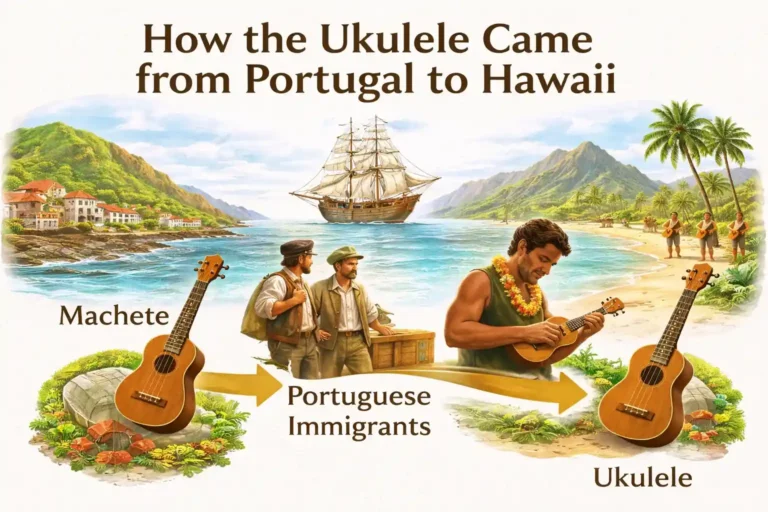
It isn’t — not in its origins. The instrument descends from Portuguese stringed instruments carried to Hawaiʻi by immigrants from Madeira and the Azores in the 1870s and 1880s, particularly the machete de braga and related forms. Hawaiian craftsmen and musicians adopted the form, refined it, and gave it its cultural home and its distinctive name. But the physical instrument predates Hawaiian contact with it.
Calling the ukulele a Hawaiian instrument is accurate as a cultural statement but misleading as a historical one. And it matters for understanding the players above: Cliff Edwards and Roy Smeck developed their styles entirely within American vaudeville, with no connection to Hawaii. The instrument they played had already moved through two cultural transformations — Portuguese to Hawaiian, Hawaiian to the American mainland — before it reached their stages.
Misconception 2: Jake Shimabukuro invented the modern ukulele style
Shimabukuro’s 2006 YouTube video was a breakthrough in visibility, not in technique. The technical groundwork had been accumulating for decades before him. Roy Smeck was demonstrating virtuosic range in Vitaphone films from 1926. Lyle Ritz was applying jazz-level harmonic sophistication on Verve Records in 1957. Herb Ohta had built a rigorous concert solo tradition within Hawaiian music before Shimabukuro’s first album.
So what Shimabukuro actually did was make that cumulative tradition visible to a global online audience, simultaneously, in a format they could share. That’s a different achievement from inventing a style — and it may be the more historically significant contribution of the two. Viral reach at that scale had never happened to a ukulele performance before. His contribution was to distribution and perception, not to technique. Both are real achievements; conflating them misrepresents both the player and the tradition behind him.
FAQs about famous ukulele players
Who is the most famous ukulele player of all time? Israel Kamakawiwoʻole holds the strongest claim by sheer reach — his “Somewhere Over the Rainbow / What a Wonderful World” medley has been heard by more people than any other ukulele recording. Jake Shimabukuro is the most recognized living player for technical mastery and international concert performance. Both answers are defensible depending on how you define fame.
Who made the ukulele popular in America? Three distinct waves of popularization happened at different times. Cliff Edwards and Roy Smeck brought it to mainstream American audiences through vaudeville and early recording in the 1920s and 1930s. Arthur Godfrey introduced it to television audiences in the 1950s. Jake Shimabukuro’s 2006 YouTube performance sparked the most recent global wave of interest. No single event explains the instrument’s full reach.
Did George Harrison really play ukulele? Yes — and seriously, not casually. Harrison was devoted to the instrument through the latter decades of his life, reportedly owned many ukuleles, gave them as gifts to close friends, and played daily. Multiple musicians who spent time with him documented this. It’s one of the more consistently overlooked facts about one of the most studied musicians in rock history.
What ukulele did Israel Kamakawiwoʻole play? IZ played a Kamaka tenor ukulele — a Honolulu-made instrument from one of Hawaiʻi’s oldest manufacturers, which has been building ukuleles in Honolulu since 1916. Tenor size gave IZ the volume and sustain his powerful voice and large hands required. The fuller resonance of the tenor body, particularly in the lower register, suits the open and unhurried chord voicings he favored.
Is the ukulele a serious instrument? Lyle Ritz’s Verve Records recordings from the late 1950s, Roy Smeck’s Vitaphone film demonstrations from 1926, and Jake Shimabukuro’s international concert tours collectively answer this. The instrument has a documented record of serious musicianship across more than a century of jazz, Hawaiian, classical-influenced, and rock performance. The “beginner’s toy” reputation reflects decades of novelty marketing, not the instrument’s actual performance history.
Who is the best female ukulele player in history? Taimane Gardner is the most frequently cited for technical range and compositional originality among fully documented contemporary players. Within traditional Hawaiian music, women were central to the instrument’s social performance tradition throughout the 20th century, though far fewer were captured in formal recordings. Gardner’s international concert work represents the most thoroughly documented case for the instrument’s technical range in any performance context.
Famous ukulele players don’t share a genre, a nationality, or a playing style. What they share is this: each one found the instrument at a specific cultural moment, understood what it could do within that moment’s context, and used it to create something that changed how the next generation of listeners and players thought about four strings and a small wooden body.
Cliff Edwards put it on the radio. Lyle Ritz put it on Verve Records. Arthur Godfrey put it on television. Israel Kamakawiwoʻole put it into the emotional memory of hundreds of millions of people. Jake Shimabukuro put it on concert stages worldwide. That’s not a novelty tradition. That’s a documented performance history spanning more than a century and every major format music has moved through.
For more on the instrument’s full history — its Portuguese origins, its Hawaiian transformation, and the craft behind the instruments these players held — Ukulele History covers it all.
Stop overthinking—our straightforward expert posts cut right to the point.