
Hawaiian Ukulele History: From Immigrants to Icon
The ukulele is Hawaiian by heart but Portuguese by birth. It arrived in Honolulu Harbor aboard a British immigrant ship in 1879, carried by three craftsmen from the island of Madeira who had no idea they were about to reshape the sound of an entire culture. Within twenty years, the instrument had caught the ear of Hawaiian royalty. Within forty, it had crossed the Pacific to reach mainland America. The full arc of Hawaiian ukulele history runs from the rocky hillsides of Madeira through the courts of Honolulu to stages around the world, and it moves through more turning points than most histories acknowledge.
What most accounts gloss over is one specific moment: a spontaneous royal endorsement that turned a Portuguese immigrant’s workshop instrument into Hawaiʻi’s most recognizable musical voice. That’s where this guide begins.
Key takeaways:
- The ukulele evolved from the machete de braga, a four-stringed folk instrument from the Madeira Islands of Portugal
- Three craftsmen — Manuel Nunes, Augusto Dias, and Jose do Espirito Santo — arrived in Honolulu on August 23, 1879, aboard the immigrant ship Ravenscrag
- King Kalākaua’s personal patronage gave the instrument cultural authority across Hawaiian society
- The 1915 Panama-Pacific International Exposition in San Francisco introduced the ukulele to a mainland American audience in the millions
- Israel Kamakawiwoʻole’s recording of “Somewhere Over the Rainbow/What a Wonderful World” sparked the worldwide revival that built through the 1990s
- The ukulele comes in four standard sizes — soprano, concert, tenor, and baritone — each with distinct tuning and tonal character
What is the Hawaiian ukulele?
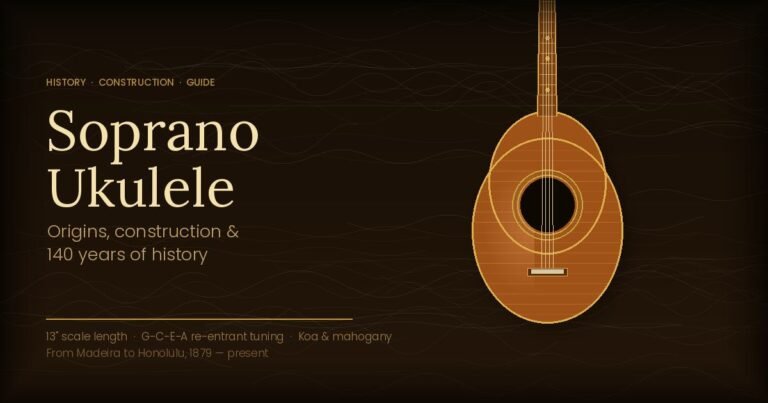
The ukulele is a small, four-stringed chordophone developed in Hawaiʻi from Portuguese folk instruments during the late 19th century. Its standard tuning, G, C, E, A across the four strings, uses a re-entrant configuration where the fourth string (G) sits pitched higher than the third (C). That arrangement puts the instrument in a completely different sonic register from the guitar, and it’s one of the clearest signals that the ukulele descends from a distinct lineage rather than simply being a scaled-down six-string.
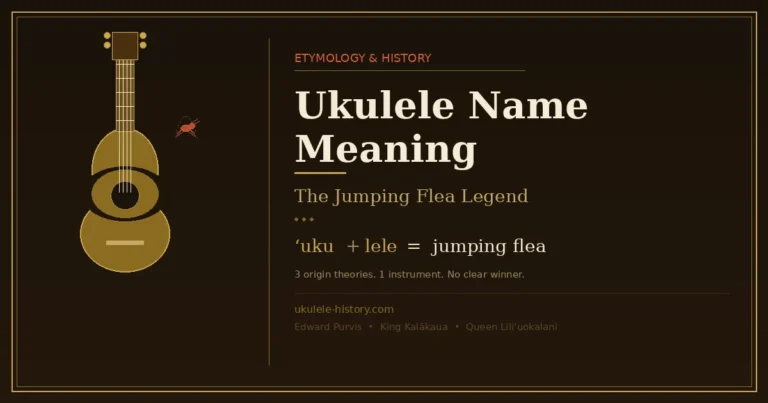
Its name’s origin is disputed. The most widely accepted Hawaiian reading translates “ukulele” as “jumping flea,” thought to reference the rapid finger movements of early players. Queen Liliʻuokalani offered an alternative: uku (gift or reward) and lele (to come), rendering it “the gift that came here.” Whichever reading holds, both point to the same underlying fact — something arrived from outside, took root, and became entirely Hawaiian.
The five eras of Hawaiian ukulele evolution
Hawaiian ukulele history doesn’t unfold as a single continuous story. It moves in five distinct eras, each with its own geographic center, key figures, and defining moments. The Five Eras of Hawaiian Ukulele Evolution — the framework used throughout this article — maps the clearest path from a Madeiran workshop instrument to a global phenomenon with millions of active players worldwide.
Key dates in Hawaiian ukulele history:
- 1879 — The Ravenscrag arrives in Honolulu; Madeiran craftsmen begin adapting their instruments for a Hawaiian audience
- 1890s — The term “ukulele” appears in Hawaiian-language newspapers
- 1915 — Panama-Pacific International Exposition brings live Hawaiian music to mainland America
- 1916 — Kamaka Hawaii founded in Honolulu; Martin expands ukulele production
- 1968 — Tiny Tim’s “Tiptoe Through the Tulips” deepens the novelty perception of the instrument
- 1988 — Israel Kamakawiwoʻole records “Somewhere Over the Rainbow/What a Wonderful World”
- 1993 — Facing Future released; the recording reaches listeners on every continent
The five eras at a glance
| Era | Period | Geographic center | Key figures | Defining moment |
|---|---|---|---|---|
| The Madeiran root | Pre-1879 | Madeira Islands, Portugal | Madeiran folk musicians | Machete de braga tradition carried into emigration |
| The Hawaiian birth | 1879–1900 | Honolulu | Nunes, Dias, Espirito Santo; King Kalākaua | Ravenscrag arrival; royal patronage |
| The continental boom | 1900–1945 | San Francisco, New York | Tin Pan Alley composers; Arthur Godfrey | 1915 Panama-Pacific Exposition |
| The lean years | 1945–1990 | United States | Tiny Tim | Novelty reputation takes hold post-WWII |
| The global revival | 1990–present | Hawaii, worldwide | Kamakawiwoʻole; Jake Shimabukuro | Facing Future reaches a global audience |
Era 1 — The Madeiran root (pre-1879)
The ukulele didn’t emerge in isolation. Its most direct ancestor, the machete de braga (also called the braguinha, or in its mainland Portuguese form, the cavaquinho), was a small four-stringed instrument played widely across the Madeira Islands. Madeirans carried it to festivals, sang over it at home, and brought it on the long sea voyages that took them to Brazil, Cape Verde, and eventually Hawaiʻi.
A related instrument, the rajão, used a five-string re-entrant tuning that may have contributed the G-string logic that defines the modern ukulele. These weren’t rare folk relics. They were everyday instruments that working-class Madeirans knew how to build, repair, and play — and that craft knowledge traveled with the people who owned it.
Era 2 — The Hawaiian birth (1879–1900)
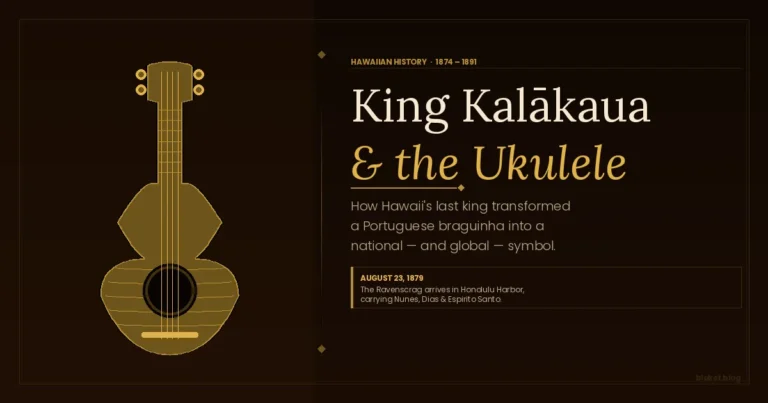
On August 23, 1879, the Ravenscrag dropped anchor in Honolulu Harbor after a four-month voyage from Madeira. The British ship carried Portuguese-speaking immigrants recruited by the Hawaiian Board of Immigration to work the island’s sugarcane industry.
Most of them went to the fields. Three of them built instruments.
Manuel Nunes, Augusto Dias, and Jose do Espirito Santo were cabinetmakers and craftsmen. Nunes opened a workshop in Honolulu and adapted the machete he knew from home, working with local materials and adjusting the instrument’s proportions and tuning to fit the musical environment he was entering. His workshop is widely considered the birthplace of the Hawaiian ukulele as a distinct instrument — not a copy of the machete, but something genuinely new.
Decisive change came through royal attention. King Kalākaua, a musician himself and a committed defender of Hawaiian cultural identity, heard the ukulele, adopted it publicly, and welcomed performances from its builders at court. In a society that took its cultural cues from the monarchy, that endorsement transformed the instrument’s standing almost overnight. Queen Liliʻuokalani, who succeeded Kalākaua, was also a composer and player. She wrote “Aloha ʻOe” and many other pieces associated with the instrument, deepening its connection to Hawaiian emotional and poetic life.
Era 3 — The continental boom (1900–1945)
The 1915 Panama-Pacific International Exposition — a World’s Fair staged in San Francisco to mark the completion of the Panama Canal — included a dedicated Hawaiian pavilion. Hawaiian musicians performed live throughout the event, reaching an audience of millions who had never before encountered Hawaiian music.
They went home wanting to play.
And Tin Pan Alley publishers in New York saw the opening. Ukulele chord books and songbooks flooded the market within months. Vaudeville performers worked the instrument into their acts, and by the 1920s the ukulele ranked among the most popular instruments in the United States. Martin had begun producing quality ukuleles in the 1910s, and demand stayed strong through the 1930s.
Arthur Godfrey carried that momentum into the postwar decade. His nationally broadcast radio and television programs featured the ukulele prominently, and his visible enthusiasm moved instruments off shop floors by the thousands. It’s worth noting that this era produced some of the most technically accomplished ukulele players in history — figures whose work on the instrument far outpaced the casual image that would later take hold.
Era 4 — The lean years (1945–1990)
After World War II, the cultural winds changed. Electric guitar arrived and drew younger players toward rock and roll. There was no obvious place for an acoustic four-string Hawaiian instrument in that sonic world, and the ukulele drifted toward the novelty end of the spectrum.
That drift hardened into a reputation when Tiny Tim charted with “Tiptoe Through the Tulips” in 1968, playing the ukulele in a deliberately theatrical, high-falsetto style. The song was a commercial success — but it reinforced the idea that the instrument was campy rather than serious. For roughly four decades after the war, the ukulele sat at the cultural edges.
Era 5 — The global revival (1990–present)
Reversal came from Hawaiʻi. Israel Kamakawiwoʻole — known throughout the islands as Bruddah IZ — recorded a medley of “Somewhere Over the Rainbow” and “What a Wonderful World” in 1988, backed by his tenor ukulele alone. That recording appeared on his 1993 album Facing Future and was licensed for films, television commercials, and documentary soundtracks worldwide.
One track. Listeners on every continent. The ukulele was reframed: not a novelty prop but a vehicle for serious emotional expression in the hands of someone who understood exactly what the instrument could do. Kamakawiwoʻole’s medley did more for global ukulele awareness than any single event since the 1915 Exposition, because it reached people who had no prior connection to Hawaiian music and gave them a reason to start.
Jake Shimabukuro extended the revival through the 2000s with a virtuoso approach drawing on jazz, classical, and rock influences. His YouTube performances reached millions and demonstrated that the instrument’s expressive range had barely been explored. Kamaka Hawaii — the Honolulu maker founded in 1916 by Sam Kamaka Sr. — became a reference point for instrument quality during this period, its koa-wood ukuleles sought by players who wanted the real thing.
The sound, the wood, and the craft
The Hawaiian ukulele’s tone is shaped by what it’s built from as much as how it’s played. Koa wood — an acacia species native to Hawaiʻi, found in significant quantity nowhere else on earth — produces a warmth and resonance that mahogany can’t quite match. Its prominent mid-range frequencies give the instrument a characteristic shimmer. Spruce tops add brightness; solid construction outperforms laminate at every volume level. But the sound also depends on size, and the size differences are not minor.
Standard ukulele sizes: tone, scale, and use
| Size | Scale length | Total length | Standard tuning | Tonal character | Best suited for |
|---|---|---|---|---|---|
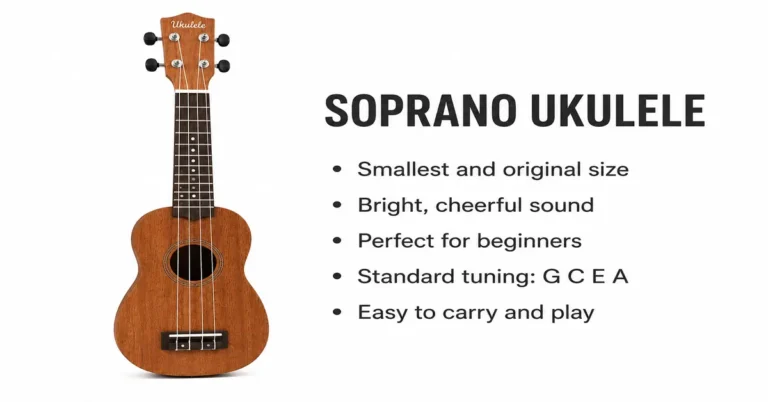
| Soprano | ~13 in / 33 cm | ~21 in / 53 cm | GCEA | Bright, punchy, traditional | Classic Hawaiian sound; beginners |
| Concert | ~15 in / 38 cm | ~23 in / 58 cm | GCEA | Warmer, more projection | Versatile; popular all-around size |
| Tenor | ~17 in / 43 cm | ~26 in / 66 cm | GCEA or DGBE | Rich, full, strong volume | Fingerpickers, solo performers |
| Baritone | ~19 in / 48 cm | ~30 in / 76 cm | DGBE | Deep, guitar-adjacent tone | Guitar players transitioning to ukulele |
Soprano was the original Hawaiian ukulele and the size closest to the machete de braga’s proportions. Concert and tenor sizes developed as the instrument moved to the mainland, where larger-handed players and performers needing more volume pushed makers to scale up. The baritone, largest of the standard four, uses DGBE tuning identical to the top four strings of a guitar. It makes a natural bridge for guitarists crossing over — but it’s a distinct instrument, not a guitar shortcut.
Historian’s note: The soprano’s re-entrant GCEA tuning — where the G string is pitched higher than the C rather than lower — creates a two-octave color spread that no guitar configuration can replicate. It’s the primary reason the ukulele sounds like itself. And it connects the instrument directly to the rajão tuning tradition that Madeiran immigrants brought to Honolulu in 1879.
The Ravenscrag moment and the five-era arc
The Five Eras of Hawaiian Ukulele Evolution framework hinges on one fixed point: a ship docking on August 23, 1879.
On that day, the Ravenscrag — a British bark — arrived in Honolulu Harbor after a voyage covering roughly 15,000 miles and lasting approximately four months. It carried Portuguese-speaking immigrants from Madeira under contract with the Hawaiian Board of Immigration, bound for the sugarcane plantations of Oʻahu and Maui.
Manuel Nunes, Augusto Dias, and Jose do Espirito Santo were among the passengers.
Most went to the fields. These three opened workshops. Nunes adapted the machete de braga into something new, adjusting proportions, tuning, and construction to fit the musical environment he was building in Honolulu. Within a decade, instruments from his workshop were being played at the royal court. Within two decades, the word “ukulele” was appearing in Hawaiian-language newspapers. The Bishop Museum in Honolulu holds documentation of the early instrument-making community during this period, and Hawaii State Archives records trace the Portuguese immigrant community that formed the first generation of Hawaiian ukulele builders.
Without those three men choosing workshops over cane fields, the five-era arc doesn’t exist. No Hawaiian birth, no royal patronage, no 1915 Exposition breakthrough, no Facing Future recording to revive a tradition a century later. Every subsequent era stands on the Ravenscrag’s passenger list. That’s not sentiment. It’s the structure of the history.
What most people get wrong about ukulele history
“The ukulele is just a small guitar”
It isn’t. A guitar descends from lutes and vihuelas, uses six strings in standard EADGBE tuning, and comes from a different European instrument family than the ukulele’s Madeiran ancestors. The ukulele evolved from the machete de braga, the rajão, and the cavaquinho — instruments with their own string counts, body shapes, and tuning systems. Re-entrant GCEA tuning isn’t a simplified version of guitar tuning. It’s a different harmonic logic that produces a different sonic result.
The size difference between a guitar and a ukulele is visible. The tuning difference is structural. And the tuning difference is what makes the ukulele what it is.
“Hawaiians invented the ukulele”
Hawaiian musicians, craftsmen, and royalty developed the ukulele into the instrument the world recognizes. But the foundational form — the machete de braga, the four-string configuration, the re-entrant tuning concept — arrived from Madeira in 1879. What happened in Nunes’s Honolulu workshop was transformation, not invention from zero. Hawaiian culture, koa wood, and local musical sensibility produced something genuinely distinct. The originating form, however, is Portuguese.
That isn’t a footnote. It’s the reason the instrument exists.
FAQs
Why is the ukulele associated with Hawaii if it came from Portugal? Because it was invented as a distinct instrument in Honolulu. Madeiran craftsmen adapted a Portuguese model using local tonewoods, local tunings, and Hawaiian musical sensibility. King Kalākaua’s royal patronage then embedded it firmly in Hawaiian cultural identity. The ancestry is Portuguese; the invention is Hawaiian.
Who is credited with making the first Hawaiian ukulele? Manuel Nunes is most frequently cited as the primary developer. He arrived aboard the Ravenscrag in August 1879, established a workshop in Honolulu, and adapted the machete de braga into what became the Hawaiian ukulele. Augusto Dias and Jose do Espirito Santo contributed to the same early tradition and are recognized alongside Nunes in most historical accounts.
What does “ukulele” mean in Hawaiian? The most widely accepted translation is “jumping flea,” thought to describe the rapid finger movement of early players. Queen Liliʻuokalani preferred a reading that translates as “the gift that came here.” Earliest documented uses of the word appear in the Hawaiian press in the 1890s, and scholarly debate over the exact etymology continues.
How did the ukulele reach mainland America? The 1915 Panama-Pacific International Exposition in San Francisco was the catalyst. Hawaiian performers played throughout the event, introducing millions of mainland visitors to Hawaiian music for the first time. Tin Pan Alley publishers followed with songbooks and method books, and the ukulele’s US popularity peaked through the 1920s.
What is standard ukulele tuning? Standard tuning is GCEA — G, C, E, A from the fourth string to the first. In the re-entrant configuration used on soprano, concert, and tenor sizes, the G string is pitched one octave higher than expected, producing the instrument’s bright, chimey sound. Baritone ukuleles use DGBE tuning, matching the top four strings of a guitar.
Why did the ukulele decline after World War II? Electric guitar and rock and roll redirected popular interest toward louder, amplified sounds. The ukulele also developed a novelty reputation, reinforced in part by Tiny Tim’s theatrical 1968 performance of “Tiptoe Through the Tulips.” It didn’t recover in mainstream culture until Israel Kamakawiwoʻole’s recordings reached a global audience in the 1990s.
Hawaiian ukulele history moves across five eras, two oceans, and more than a century — from the machete workshops of Madeira to bedroom practice sessions in countries that didn’t exist when the Ravenscrag first docked. Three craftsmen chose workshops over cane fields in 1879. A king heard something worth preserving. An exposition planner included a Hawaiian pavilion in San Francisco. And a musician named Israel Kamakawiwoʻole called his recording engineer in the small hours of a 1988 night with one song ready to go.
Each decision narrowed the path to the instrument you know today.
If you want to go deeper — into the Madeiran origins, the royal patronage years, the wood science, or the modern revival — the Ukulele History archive covers each era in dedicated detail. Start with whichever era surprised you most.
Simplify the complex with our easy-to-digest knowledge articles.