Who Invented the Ukulele? The 3 Men Behind It
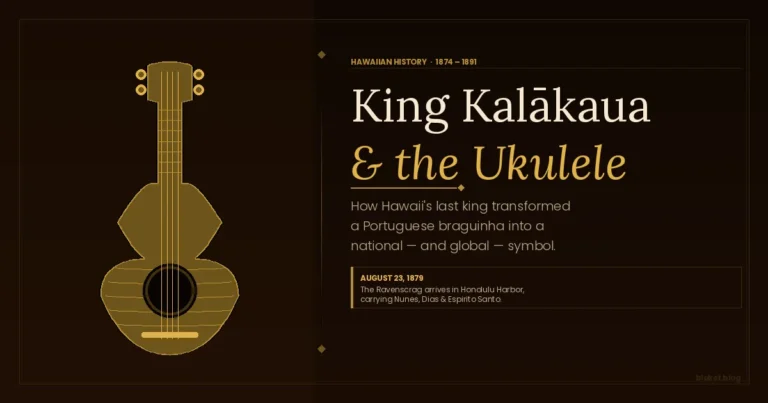
Three men invented the ukulele — and none of them were Hawaiian. On August 23, 1879, a British merchant vessel called the Ravenscrag docked in Honolulu Harbor, carrying more than 400 Portuguese immigrants from the island of Madeira. Among them were three cabinet makers: Manuel Nunes, Augusto Dias, and José do Espírito Santo. They brought with them a small, four-stringed folk instrument called the machete de braga. Within a decade, their Honolulu workshops had transformed it into something the world would eventually call the ukulele. That transformation is the true story of who invented the ukulele — and most histories tell only half of it.
The part most histories skip: these three men didn’t collaborate. They competed. Understanding that changes everything about how you hear the instrument today.
Key takeaways:
- The ukulele was invented by three Portuguese craftsmen — Manuel Nunes, Augusto Dias, and José do Espírito Santo — who arrived in Hawaii together in 1879
- All three came from the island of Madeira and were trained cabinet makers and instrument builders
- They adapted the machete de braga, a small four-stringed Portuguese folk instrument, into what became the ukulele
- King Kalākaua’s royal patronage gave the instrument social prestige and accelerated its spread far beyond the Portuguese immigrant community
- The name “ukulele” most likely means “jumping flea” in Hawaiian, though Queen Liliʻuokalani offered an alternative translation
- Manuel Nunes is most often credited as the primary inventor, but the historical record supports a shared origin across all three workshops
Where did the ukulele really come from?
The ukulele originated in the Portuguese island of Madeira, where a small four-stringed instrument called the machete de braga — also known as the braguinha, or simply the machete — had been played for generations. Portuguese immigrants carried this instrument to Hawaii in 1879, where local craftsmen adapted it into the ukulele. The journey from Madeira to Honolulu was not a straight line; it ran through decades of Portuguese folk tradition.
The machete de braga — the ukulele’s true ancestor
The machete de braga is a small, guitar-shaped instrument from Madeira with four strings and a tuning close to the modern ukulele’s reentrant GCEA. It belongs to a distinct family of Portuguese plucked-string instruments that also includes the larger rajão and the cavaquinho — not the guitar lineage most people assume.
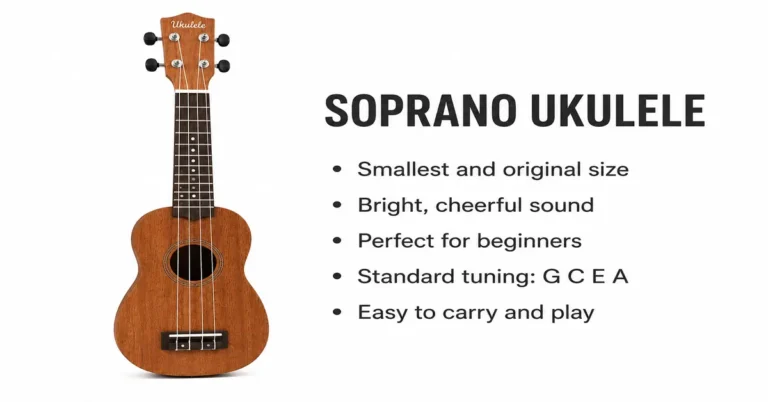
Its body is roughly the size of a modern soprano ukulele. Historically strung with gut, it produces a bright, percussive tone that differs markedly from the rounder sound of a guitar. That brightness carries across a crowded room, which made it perfect for Madeiran festas and, as it turned out, for the Hawaiian royal court.
Here’s the definition that matters for this history: the machete de braga is not a small guitar. Its tuning system, body geometry, and string spacing descend from a different branch of the European lute family. When Madeiran craftsmen brought it to Hawaii, they didn’t bring a stripped-down guitar — they brought a fully formed instrument tradition of its own.
Why Madeiran craftsmen brought it to Hawaii
In the 1870s, the Kingdom of Hawaiʻi faced a severe agricultural labor shortage. Sugar plantation owners, backed by the Hawaiian government, recruited workers from Portugal — specifically from Madeira and the Azores. The first large organized group arrived in 1878; the Ravenscrag’s 1879 voyage was part of the same wave.
Like migrants everywhere, those workers packed what mattered most: tools, family ties, and music. For Nunes, Dias, and Santo, the machete de braga wasn’t cargo. It was home.
Who invented the ukulele? The three men who built it
The ukulele was invented through the combined, competing work of Manuel Nunes, Augusto Dias, and José do Espírito Santo — three Madeiran cabinet makers who arrived in Hawaii on the Ravenscrag in 1879. Each man established his own Honolulu workshop and adapted the Portuguese machete de braga using local materials, Hawaiian musical tastes, and the practical knowledge of trained woodworkers.
Manuel Nunes — the craftsman most credited with the ukulele’s invention
Manuel Nunes is the name most authoritative sources cite when the question is who invented the ukulele. He was a trained joiner and cabinet maker from Madeira who arrived on the Ravenscrag at roughly 27 years of age. Within a few years of landing in Honolulu, he had left plantation work and opened an instrument-making shop.
Nunes is credited with several key developments. He experimented with Hawaiian koa wood — a species of acacia with dense, figured grain — as a tonewood for the new instrument. Koa’s sound character is specific: it starts bright and clarifies over years of playing, giving aged instruments a warmth and complexity that differs from both mahogany and spruce. That tonal decision gave the Hawaiian ukulele a distinct voice no imported wood could replicate.
His workshop in Honolulu was the longest-running of the three and outlasted his competitors by decades. Nunes continued building instruments into old age. Instruments attributed to him are held in museum collections in Honolulu, and his name appears in Hawaiian newspaper advertisements from the 1880s onward. That commercial longevity is one of the main reasons his name became most firmly attached to the instrument’s invention.
Augusto Dias — the early performer who put it in front of crowds
Augusto Dias arrived on the same ship as Nunes and Santo, with the same craft training and the same instrument in his cultural memory. Where Dias distinguished himself was in performance. Contemporaneous Honolulu newspaper accounts from the early 1880s describe public performances of the new small instrument drawing enthusiastic crowds, and Dias’s name appears in connection with some of the earliest of these events.
Those accounts described audiences watching a player’s fingers move across the strings with remarkable speed — a visual impression that almost certainly contributed to the “jumping flea” association that would eventually name the instrument. Watching a skilled machete player in a small room is genuinely striking; the hand moves in quick, light flicks that look nothing like guitar playing.
Dias’s workshop did not survive as long as Nunes’s, and fewer physical instruments attributed to him have been documented. But as one of the earliest public performers of the machete-derived instrument in Hawaiʻi, he helped move it from the Portuguese community into the broader Hawaiian social world — which is where it needed to go to become the ukulele.
José do Espírito Santo — the third workshop that completed the picture
José do Espírito Santo is the least documented of the three, though his presence on the Ravenscrag and his instrument-making work in Honolulu appear in historical records. Like Nunes and Dias, he came from a cabinet-making background in Madeira and established a Honolulu workshop after leaving plantation labor.
Santo’s contribution is harder to isolate, partly because the three craftsmen operated in a small, interconnected community. They almost certainly shared techniques, hired from the same pool of Portuguese workers, and built instruments for some of the same buyers. That cross-pollination may be exactly why the ukulele emerged as a coherent, recognizable instrument rather than three slightly different regional variants.
Historian’s note: The thin historical record on Santo reflects the limits of archival preservation, not the limits of his contribution. Before the Bishop Museum and the Hawaii State Archives began systematic collection, most small-workshop records from this period didn’t survive. What we know today comes largely from newspaper advertisements, business records, and instrument provenance — evidence that naturally favors whoever built the most instruments and stayed in business the longest. Santo’s workshop did both, just not as long as Nunes’s.
The Ravenscrag voyage — the moment that made the ukulele possible
The Ravenscrag’s arrival in Honolulu on August 23, 1879, is the single most documented event in the ukulele’s origin story. The ship carried more than 400 Portuguese contract laborers from Madeira under an agreement with Hawaiʻi’s sugar industry. Among those passengers were the three craftsmen whose workshops would produce a new instrument within the decade. No single date is more important to the ukulele’s history.
Key events on the road from Madeira to the modern ukulele:
- August 23, 1879 — The Ravenscrag docks in Honolulu Harbor; Nunes, Dias, and Santo disembark
- Early 1880s — All three craftsmen leave plantation work and establish instrument-making workshops in Honolulu
- Early-to-mid 1880s — Contemporaneous Honolulu newspapers begin describing public performances of the new small instrument
- Late 1880s — King Kalākaua publicly embraces the ukulele; royal patronage transforms its social standing
- 1890s — The name “ukulele” appears in the Hawaiian-language press; the instrument is fully absorbed into Hawaiian cultural identity
- 1915 — The Panama-Pacific International Exposition in San Francisco introduces the ukulele to mainland America and, through subsequent Tin Pan Alley adoption, to the wider world
| Era | Key development | Primary figures |
|---|---|---|
| 1879–1883 | Portuguese craftsmen adapt the machete for Hawaiian buyers | Nunes, Dias, Santo |
| 1884–1889 | Public performances and newspaper coverage build local awareness | Dias, King Kalākaua |
| 1890–1914 | Hawaiian cultural identity absorbs the instrument; name established | Kalākaua, Liliʻuokalani, Nunes workshop |
| 1915 onwards | Mainland America discovers it; global spread begins | Tin Pan Alley, Kamaka, Martin |
How the ukulele got its name
The word “ukulele” is Hawaiian, but its precise origin is genuinely debated. The most widely accepted meaning is “jumping flea” — uku (flea) and lele (to jump or leap) — describing the appearance of a player’s fingers darting across the strings. But Queen Liliʻuokalani proposed a different reading, and a third theory ties the name to a specific person at the Hawaiian royal court.
“Jumping flea” — the most widely accepted etymology
The jumping flea interpretation refers to the visual impression of watching skilled players perform the rapid, flicking fingerpicking patterns the instrument demands. A ukulele is small enough that a fast player’s hand appears to dance or leap across the body — an image that early Hawaiian observers found vivid enough to name the thing after it.
This etymology holds up well against what we know about how Hawaiian language works: concrete, observational names for newly encountered objects are a consistent pattern. “Jumping flea” is exactly the kind of name a Hawaiian speaker in the 1880s might apply to a small foreign instrument played with quick, light fingers.
Queen Liliʻuokalani’s alternative translation
Queen Liliʻuokalani — an accomplished musician and composer in her own right, best known for writing “Aloha ʻOe” — offered a different reading. She translated “ukulele” as “the gift that came here,” parsing uku as “gift” and lele as “to come” or “to arrive.” Her interpretation carries real cultural weight. It frames the instrument not as a foreign curiosity observed from outside, but as something received and made part of Hawaiian life.
Both readings may reflect genuine aspects of the same word. Hawaiian, like most living languages, tolerates layered meaning — and a name that could simultaneously mean “jumping flea” and “the gift that came here” would be entirely consistent with how the ukulele actually arrived.
The Edward Purvis connection
A third theory ties the name to Edward Purvis, a British officer who served as vice-chamberlain at King Kalākaua’s court. Purvis was reportedly small in stature, energetic, and an enthusiastic player of the machete-style instrument. Some historical accounts claim that Hawaiian court observers nicknamed him “ukulele” — jumping flea — because of his lively playing style, and that the nickname then transferred to the instrument itself.
This theory appears in a number of historical accounts. Primary documentation is limited, though, and most musicologists treat it as a plausible contributing thread rather than the definitive answer. What it does confirm is that the instrument was being played at the Hawaiian royal court early enough for nickname stories to form — which supports the timeline of rapid royal adoption in the mid-to-late 1880s.
The Three Craftsmen Framework — why the ukulele had no single inventor
The ukulele’s invention is best understood not as a single eureka moment but as a process of parallel adaptation across three competing Honolulu workshops. The Three Craftsmen Framework recognizes that Nunes, Dias, and Santo each shaped the instrument independently, and that the competition between their shops — for buyers, for reputation, for the patronage of an enthusiastic royal court — is what produced the final form we know today.
This reframing matters. When you ask “who invented the ukulele,” you’re really asking which of three simultaneous, interconnected processes produced the dominant result. Here’s what the framework looks like when you map it against the historical record:
| Craftsman | Primary contribution | Workshop longevity | Key legacy |
|---|---|---|---|
| Manuel Nunes | Koa wood adoption; long-term instrument building | Longest — active into the 20th century | Instruments in museum collections; most cited as primary inventor |
| Augusto Dias | Early public performance; community adoption | Medium — left instrument trade before Nunes | First documented public performances of the new instrument |
| José do Espírito Santo | Third parallel workshop; cross-community technique sharing | Medium — active through the 1880s–1890s | Third voice completing the competitive craftsman community |
The framework also explains something historians often gloss over: why the ukulele’s identity became Hawaiian rather than Portuguese almost immediately. With three craftsmen competing for Hawaiian buyers, Hawaiian tastes — for koa wood, for specific body proportions, for certain playing styles — shaped the instrument from its first years. No single craftsman’s Portuguese preferences dominated. The market settled the question.
A vignette from the harbor: On August 23, 1879, the Ravenscrag docked in Honolulu after a voyage of more than four months and roughly 15,000 miles from the shores of Madeira. The three cabinet makers who walked down the gangway carried no fame and no expectation of musical legacy. They were contract workers, expected to cut sugarcane. Within a few years, all three had left the fields, opened shops on Honolulu streets, and were advertising handmade instruments in local newspapers. The instrument they built had a name by the 1890s. By 1915, it was being demonstrated at a World’s Fair.
What most histories get wrong about the ukulele’s invention
Two misconceptions recur in nearly every popular account of the ukulele’s origins: that Hawaiians invented it, and that it’s simply a small guitar. Both errors flatten a more interesting history. Getting them right changes how you understand the instrument and the broader story of what happens when musical traditions meet across cultures.
Misconception 1: Hawaiians invented the ukulele
Hawaiians did not invent the ukulele. They transformed it — which is a more interesting story. The instrument arrived fully formed as the Portuguese machete de braga. What Hawaiians did, in the decade following the Ravenscrag’s arrival, was adopt it with such completeness — adapting it to local materials, elevating it through royal patronage, absorbing it into existing musical traditions — that it became identified as a Hawaiian instrument.
King Kalākaua’s role was decisive. He was a musician himself and an active patron of Hawaiian cultural revival. When he publicly embraced the ukulele at court and encouraged its use in royal celebrations, it stopped being a Portuguese immigrant’s instrument and became a Hawaiian one. By the 1890s, that transformation was complete. The instrument’s Portuguese ancestry didn’t disappear, but it moved into the background. What’s extraordinary is how quickly it happened — within roughly a decade of the Ravenscrag’s arrival.
Misconception 2: the ukulele is just a small guitar
The ukulele is not a small guitar. Its ancestor, the machete de braga, belongs to a different branch of the European stringed instrument family entirely. The tuning is the clearest evidence. A standard guitar uses a linear EADGBE tuning across six strings, where pitch rises consistently from the lowest to the highest string. A standard soprano ukulele uses reentrant GCEA tuning across four strings — where the top G string is tuned higher than the A string below it, not lower.
That reentrant G isn’t borrowed from the guitar at all. It comes from the rajão, a larger Portuguese instrument the Madeiran craftsmen also knew well. The result is a chord voicing logic, a fingerpicking technique, and a music theory context that differ from guitar playing in ways that become obvious within the first hour of serious practice. Players who approach the ukulele as a simplified guitar usually hit a wall. Players who treat it as its own instrument move faster.
FAQs
Who is most credited with inventing the ukulele? Manuel Nunes is most often credited as the primary inventor of the ukulele, largely because his Honolulu workshop was the longest-running and his instruments are the best documented in museum collections. That said, Augusto Dias and José do Espírito Santo arrived on the same ship and opened competing workshops at roughly the same time, making the invention genuinely shared across all three craftsmen.
What instrument did the ukulele come from? The ukulele descended primarily from the machete de braga, also called the braguinha or machete — a small, four-stringed folk instrument from the island of Madeira in Portugal. Its reentrant tuning also draws from the rajão, another Portuguese instrument. It is not a direct descendant of the classical or folk guitar, despite the physical resemblance.
When exactly was the ukulele invented? There’s no single invention date, but the process began after August 23, 1879, when the Ravenscrag arrived in Honolulu carrying the three Madeiran craftsmen. The instrument took recognizable form through the early-to-mid 1880s, and the name “ukulele” appeared in the Hawaiian-language press by the 1890s. Think of it as an invention that unfolded over roughly a decade, not a single moment.
Did King Kalākaua invent the ukulele? No. King Kalākaua did not invent the ukulele, but his patronage was essential to its rise. He was an accomplished musician and a dedicated promoter of Hawaiian culture, and his public embrace of the instrument — playing it at court, encouraging its inclusion in royal gatherings — gave it a social legitimacy that propelled it far beyond the Portuguese immigrant community within just a few years.
What does ukulele mean in Hawaiian? The most widely accepted translation is “jumping flea,” from uku (flea) and lele (to jump), describing the appearance of a player’s fingers moving rapidly across the strings. Queen Liliʻuokalani offered an alternative translation of “the gift that came here.” Both interpretations have cultural backing, and the two readings aren’t necessarily in conflict — Hawaiian oral traditions often carry layered meaning.
Is the ukulele Portuguese or Hawaiian? Both, depending on what you’re measuring. Its physical form, tuning system, and construction techniques are Portuguese in origin, descending directly from the Madeiran machete de braga. Its cultural identity, its association with koa wood, and its global image as a symbol of island music are Hawaiian. The ukulele is one of the cleaner examples in music history of an instrument that was built by one culture and claimed, completely and permanently, by another.
Conclusion
The ukulele’s origin is a story about three men who arrived expecting to cut sugarcane and ended up building an instrument that would reach every part of the world. Manuel Nunes, Augusto Dias, and José do Espírito Santo didn’t set out to invent anything. They brought what they knew — the craft of Madeiran instrument making and the sound of the machete de braga — and found, in Hawaiʻi, a culture ready to make it something new.
The Three Craftsmen Framework helps clarify what most histories oversimplify: invention is rarely a single act. It’s a process, shaped by competition, by the materials available in a new place, and by the tastes of the people who adopt a new thing and decide to call it their own.
At Ukulele History, this is exactly the kind of origin story we think deserves more than a paragraph. If you want to follow the thread further — into the instrument’s spread across America after 1915, the master builders who carried the tradition through the 20th century, or the revival that brought the ukulele back to global audiences in the 1990s — there’s considerably more to explore in the archive.
The right article at the right time—discover our perfectly timed content picks.