
Ukulele Origin: The True Story Behind the Instrument
SEO Title: Ukulele Origin: The True Story Behind the Instrument URL slug: /ukulele-origin-true-story Meta description: Ukulele origin explained: trace the instrument from 1879 Madeira to global stages. Discover the true story behind Hawaii’s most recognized sound.
Most people assume the ukulele is a Hawaiian invention — born on the islands, shaped by the Pacific, native to the archipelago. That assumption is half right and half wrong. The ukulele descends from Portuguese folk instruments carried to Honolulu aboard a labor ship in 1879, where three Madeiran craftsmen set up workshops and, within a decade, produced something that neither Portugal nor Hawaii could have made alone. This page traces that complete story — the Madeiran workshops, the voyage, the royal patronage, and the single event that pushed a regional instrument onto the world stage. Most histories treat that last part in one sentence. It deserves more.
Key takeaways:
- The ukulele descends from the machete de braga, a small four-stringed Portuguese folk instrument from the Madeira Islands.
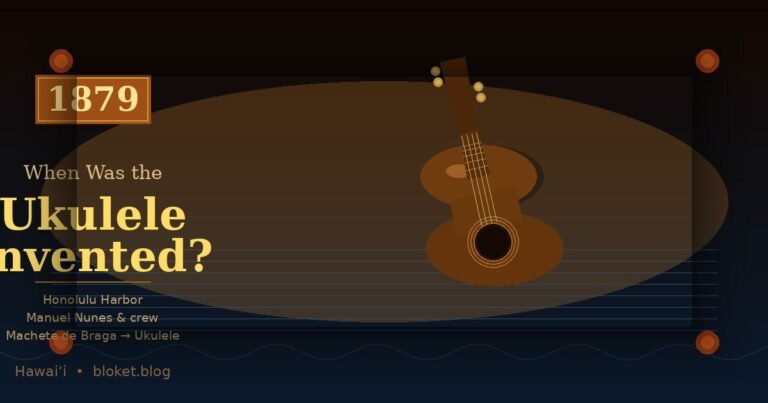
- Three Madeiran craftsmen — Manuel Nunes, Augusto Dias, and Jose do Espirito Santo — arrived in Honolulu Harbor on August 23, 1879, aboard the Ravenscrag.
- King Kalākaua of Hawaii adopted and promoted the instrument at the royal court, giving it cultural legitimacy it couldn’t have earned through plantation use alone.
- The word “ukulele” is Hawaiian and most commonly translated as “jumping flea,” though the precise etymology is still debated.
- The 1915 Panama-Pacific International Exposition in San Francisco introduced the ukulele to mainland American audiences at scale — the moment that sparked its first global boom.
- The instrument descends from a different family than the guitar: its re-entrant tuning traces directly to the Portuguese rajão and machete, not the guitar lineage.
What is the true origin of the ukulele?
The ukulele originated in the Madeira Islands of Portugal. It was not invented in Hawaii. What happened in Hawaii was a transformation — Portuguese immigrants brought instruments they already knew how to build and play, and over the following decades those instruments absorbed Hawaiian materials, Hawaiian musical ideas, and a Hawaiian name until they became something genuinely new. The Portuguese root is documented, not disputed, and supported by ship records, early newspaper accounts, and surviving instruments held at the Bishop Museum in Honolulu.
The Portuguese ancestors: machete, braguinha, and rajão
Three instruments from the Madeiran folk tradition fed directly into the ukulele’s development. They’re often confused — even in sources that should know better.
The machete de braga (also called the braguinha) is the closest physical ancestor. It’s a small four-stringed instrument with a body shape that closely resembles a modern soprano ukulele. It used gut strings and was played in re-entrant tuning — meaning the string pitches don’t simply ascend from lowest to highest. That characteristic carries forward into the ukulele’s standard GCEA tuning today.
The rajão was slightly larger, with five strings, also tuned re-entrantly. Some organologists argue that the ukulele’s distinctive high-G fourth string descends specifically from the rajão’s tuning pattern rather than the machete. It’s a genuinely open question.
The cavaquinho is the broader Portuguese family that encompasses both the machete and braguinha as regional variants. It’s still actively played in Portugal and Brazil today, making it the closest living relative to the instrument Manuel Nunes would have carried aboard the Ravenscrag.
| Instrument | Strings | Tuning type | Body size | Likely influence on ukulele |
|---|---|---|---|---|
| Machete de braga (braguinha) | 4 | Re-entrant | Small (soprano-like) | Body shape, string count, construction method |
| Rajão | 5 | Re-entrant | Medium | High re-entrant G string in standard tuning |
| Cavaquinho | 4 | Re-entrant / linear variants | Small–medium | General form factor, gut string tradition |
Why Madeira, not mainland Portugal
Mainland Portugal has its own stringed instrument traditions, but the ukulele’s specific line of descent runs through Madeira. Madeiran musicians developed the machete as a distinct regional form, separate from mainland cavaquinho variants. When the Hawaiian Kingdom’s Board of Immigration recruited Portuguese labor in the 1870s to address plantation worker shortages, Madeirans made up the bulk of those migrants. They brought their instruments with them because the instruments were small, affordable, and central to their social and musical life.
How did the ukulele arrive in Hawaii?
The ukulele reached Hawaii through labor migration, not cultural exchange or deliberate introduction. Between 1878 and 1881, the Hawaiian government arranged the transport of several thousand Portuguese workers from Madeira and the Azores to work on sugar plantations. Three ships carried the first large groups: the Priscilla, the Monarch, and the Ravenscrag. The arrival of the Ravenscrag is the moment most music historians treat as the instrument’s Hawaiian beginning — and the documentation around it is specific enough to take seriously.
The Ravenscrag arrives: August 23, 1879
On August 23, 1879, the British sailing vessel Ravenscrag docked in Honolulu Harbor after a roughly four-month voyage from Madeira via the Cape of Good Hope — approximately 15,000 miles. The ship carried 419 Portuguese immigrants. Three of them, Manuel Nunes, Augusto Dias, and Jose do Espirito Santo, were instrument makers and musicians who had worked with the machete tradition back in Madeira.
Hawaiian newspaper accounts from the weeks following the arrival describe public musical performances by the new immigrants, noting the small, unfamiliar instruments with visible curiosity. The performances drew crowds. Within a few years, all three men had established instrument workshops in Honolulu. The transformation from machete to ukulele had begun.
Manuel Nunes, Augusto Dias, and Jose do Espirito Santo
These three craftsmen are the closest the ukulele has to inventors — though none created a new instrument from nothing. They transplanted a tradition and let Hawaii reshape it.
Manuel Nunes is the most extensively documented. His Honolulu workshop became one of the most active instrument shops on the islands, and multiple period sources credit him as a central figure in establishing ukulele-making as a local craft. The Bishop Museum holds instruments attributed to Nunes that confirm his construction methods closely parallel Madeiran machete technique. The wood, though, is Hawaiian koa — the specific detail that marks the point where the Portuguese instrument started becoming something else.
Augusto Dias appears consistently in Hawaiian newspaper archives from the early 1880s as a skilled machete player whose public performances introduced Honolulu audiences to the instrument in the months after the Ravenscrag docked.
Jose do Espirito Santo is the least documented of the three in surviving records, but he appears alongside Nunes and Dias often enough in early accounts of Hawaiian instrument-making that his presence was clearly significant.
King Kalākaua and royal patronage
The ukulele’s adoption by the Hawaiian royal court wasn’t accidental. King Kalākaua, the last reigning king of Hawaii, who held the throne from 1874 to 1891, was a committed patron of Hawaiian music and culture. He played the ukulele himself and incorporated it into court performances and official entertainments. That royal association did something plantation use couldn’t: it gave the instrument cultural legitimacy.
Queen Liliʻuokalani, Kalākaua’s sister and successor, was also a musician and composer. Her composition “Aloha ʻOe” remains one of the most recognized pieces in Hawaiian music. Between the two of them, royal patronage elevated the ukulele from immigrant folk instrument to a symbol of Hawaiian identity in roughly one generation.
How did Hawaiian culture reshape the instrument?
The ukulele that arrived in Honolulu in 1879 was not the instrument that left Hawaii for the world stage in the 1910s and 1920s. The intervening decades changed it — in material, in sound, and in name.
The sound of koa: how Hawaiian wood changed everything
Koa (Acacia koa) is a hardwood native to the Hawaiian Islands, used in traditional Hawaiian woodworking long before the ukulele existed. When Madeiran craftsmen like Manuel Nunes began building instruments from koa instead of the spruce and cedar typical of European lutherie, the sonic result was different.
Koa produces a tone that is warmer than mahogany, with a darker midrange and a natural sustain that suits fingerpicking patterns. It responds differently to humidity, which matters in Hawaii’s climate. A machete de braga built from Madeiran wood and a ukulele built from Hawaiian koa are not the same instrument acoustically — even if the construction technique is nearly identical. The material is part of the identity.
What does “ukulele” actually mean?
The name is Hawaiian, and it almost certainly predates widespread English documentation of the instrument. The most commonly cited translation is “jumping flea,” derived from the Hawaiian words uku (flea) and lele (to jump or fly). The image refers to the rapid finger movements of early players — fingers jumping across the strings like a flea.
One popular origin story attributes the nickname to Edward Purvis, a British royal officer and one of King Kalākaua’s court attendants, said to be a small, energetic man whose enthusiastic ukulele playing earned him the “jumping flea” comparison. Whether Purvis actually coined the term or simply inspired it, the name stuck.
Historian’s note: The exact date the word “ukulele” first appeared in print remains genuinely debated. Most credible references to Hawaiian newspaper archives point to the 1890s as the decade when the name entered regular written use — by which point the instrument already had a distinctly Hawaiian identity, separate from its Portuguese origin.
The cultural transformation: from immigrant artifact to national symbol
It’s worth being direct about what happened. The ukulele didn’t become Hawaiian gradually through passive absorption. It became Hawaiian because Hawaiian royalty decided it should, because Hawaiian craftsmen built it from Hawaiian wood, and because Hawaiian musicians developed the specific techniques and repertoire that made it their own. The Portuguese craftsmen who built the first ones in Honolulu were, within a generation, building for a Hawaiian market, not a Madeiran one.
The four eras of ukulele evolution
Most histories treat the ukulele’s trajectory as one continuous arc from 1879 to the present. The actual pattern is more interesting than that: four distinct periods, each with a different geographic center, different repertoire, and different global footprint. Recognizing these eras makes the instrument’s history easier to understand — and explains why the ukulele has “come back” multiple times without ever having fully disappeared.
Era 1 — Madeiran roots (before 1879)
The machete de braga and related instruments develop in the Madeira Islands as regional Portuguese folk instruments. Luthiers establish the body shape, string count, gut strings, and re-entrant tuning that will define the ukulele’s character. The instrument has no global profile. It’s working-class, local, and largely undocumented outside Madeira.
Era 2 — Hawaiian adoption (1879–1914)
Portuguese immigrants arrive in Hawaii. Three craftsmen from the Ravenscrag establish Honolulu workshops. King Kalākaua integrates the instrument into royal culture, and Queen Liliʻuokalani follows. Local builders shift to koa wood. The machete acquires a Hawaiian name and a Hawaiian identity. By the early 1900s, it’s no longer understood as a Portuguese import — it’s Hawaiian.
Era 3 — Global expansion (1915–1959)
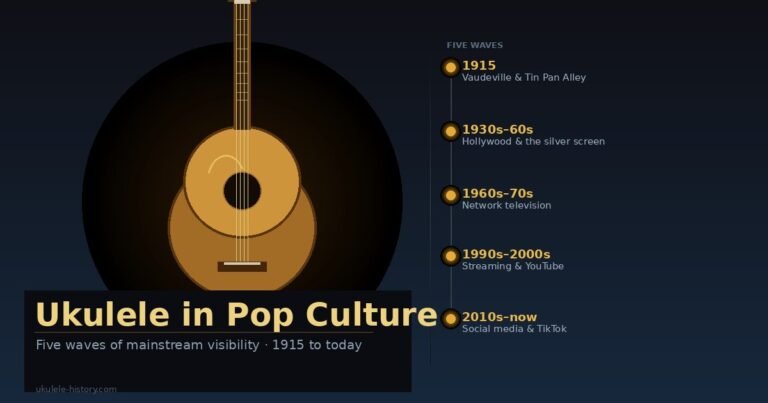
The 1915 Panama-Pacific International Exposition brings the ukulele to mainland American audiences in San Francisco. Sheet music publishers and vaudeville acts respond immediately. The 1920s see the instrument’s first global boom: affordable, portable, requiring no formal instruction, it fits the decade’s popular entertainment culture perfectly. C.F. Martin & Co. and other American manufacturers begin producing ukuleles. It reaches the UK and Europe through recordings and radio. Post-war, the ukulele’s popularity contracts but doesn’t collapse — Arthur Godfrey’s television appearances in the 1950s keep it in living rooms.
Era 4 — Modern revival (1960s–present)
Tiny Tim’s 1968 television performances on The Tonight Show reintroduce the ukulele to American audiences, though as novelty rather than serious instrument. The more significant moment came in 1993: Israel Kamakawiwoʻole recorded his medley of “Somewhere Over the Rainbow” and “What a Wonderful World” in a late-night Honolulu studio session. Released on his album Facing Future, the recording eventually became one of the most-recognized pieces of music in the world, and it brought the ukulele with it. Jake Shimabukuro’s 2005 YouTube performance of a solo ukulele arrangement of “While My Guitar Gently Weeps” demonstrated a technical range few people believed the instrument had. The digital era’s combination of affordable instruments and online tutorial culture then sustained the growth.
| Era | Approximate dates | Geographic center | Key development |
|---|---|---|---|
| Madeiran roots | Pre-1879 | Madeira Islands, Portugal | Machete de braga and rajão traditions established |
| Hawaiian adoption | 1879–1914 | Honolulu, Hawaii | Ravenscrag craftsmen, koa wood, royal patronage |
| Global expansion | 1915–1959 | USA, UK, Europe | Panama-Pacific Exposition, Tin Pan Alley, recording era |
| Modern revival | 1960s–present | Global | Kamakawiwoʻole, Shimabukuro, digital learning platforms |
On August 23, 1879, a British sailing vessel docked in Honolulu Harbor after a four-month voyage covering roughly 15,000 miles from Madeira via the Cape of Good Hope. Among the 419 Portuguese immigrants aboard were three instrument makers. Within a decade, their workshops had produced the first instruments Hawaiians would name, adapt, and claim as their own. One ship. Three craftsmen. A tradition that had no Hawaiian word for itself yet — it would get one within a few years.
What most people get wrong about the ukulele’s origin
Misconception 1 — The ukulele is just a small guitar
This is the most common misunderstanding, and it’s wrong in a technically specific way. The ukulele doesn’t descend from the guitar — it descends from a different instrument family entirely, the Portuguese machete and rajão. And its tuning reflects that distinct lineage.
A standard guitar uses linear tuning, where string pitches ascend from lowest to highest (E A D G B E). The ukulele uses re-entrant tuning: in standard GCEA, the fourth string (G) is tuned higher in pitch than the third string (C). That G is not a bass note. It’s a high note. This produces a completely different harmonic profile when strumming — the bright, chiming quality that defines the ukulele’s sound isn’t a smaller version of a guitar sound. It’s a different sound that comes from a different tradition.
The re-entrant tuning traces directly to the rajão and machete traditions Manuel Nunes would have known from Madeira. A guitar player picking up a ukulele isn’t picking up a smaller guitar. They’re picking up a different instrument that happens to have frets and strings.
Misconception 2 — The ukulele is a purely Hawaiian invention
Hawaii shaped the ukulele in real and documented ways. The name is Hawaiian. The koa wood is Hawaiian. The royal patronage was Hawaiian. The specific musical techniques — the fingerpicking patterns, the hula accompaniment style, the chord vocabulary that developed around the instrument — are Hawaiian.
But the physical form, the string count, the tuning logic, and the construction method all came from Madeira. Crediting Hawaii alone with inventing the ukulele erases the three craftsmen who stepped off the Ravenscrag in 1879. Crediting Portugal alone erases everything that happened in Hawaiian workshops and royal courts over the following decades. The honest answer: the ukulele is a product of both traditions. A Madeiran instrument remade in Hawaii until it became something neither tradition had seen before.
FAQs
Where did the ukulele originally come from? The ukulele originated in the Madeira Islands of Portugal, brought to Hawaii in August 1879 by labor immigrants. Three Madeiran instrument makers — Manuel Nunes, Augusto Dias, and Jose do Espirito Santo — arrived aboard the Ravenscrag and established the first ukulele workshops on the islands. The instrument they built descended from the Portuguese machete de braga.
What does “ukulele” mean in Hawaiian? The most widely accepted translation is “jumping flea,” from the Hawaiian words uku (flea) and lele (jump or fly). The name refers to the rapid finger movements of early players. One origin account connects the nickname to Edward Purvis, a small, energetic British court attendant known for enthusiastic playing at King Kalākaua’s court, though the exact etymology remains debated among scholars.
Who invented the ukulele? No single person invented the ukulele. It evolved from the Portuguese machete de braga, which Madeiran craftsmen adapted in Hawaii after 1879. Manuel Nunes, Augusto Dias, and Jose do Espirito Santo are the figures most closely associated with that adaptation. But King Kalākaua’s active promotion at the royal court was equally important in establishing the instrument’s Hawaiian identity and cultural reach.
Is the ukulele a Hawaiian instrument? It’s both Hawaiian and Portuguese in origin. The physical form and re-entrant tuning came from Portuguese folk instruments, specifically the machete de braga from the Madeira Islands. The name, the use of koa wood, the musical traditions that developed around it, and its identity as a symbol of Hawaii were all established on the islands after 1879. Both traditions shaped the instrument in ways that can’t be separated.
When did the ukulele become popular outside Hawaii? The 1915 Panama-Pacific International Exposition in San Francisco was the first large-scale introduction of the ukulele to mainland American audiences. Hawaiian musicians performed daily at the Hawaiian pavilion. Within two years, American instrument manufacturers including C.F. Martin & Co. were producing ukuleles, and Tin Pan Alley songwriters were writing material specifically for it. The 1920s saw the first genuine global boom.
What is re-entrant tuning, and why does the ukulele use it? Re-entrant tuning means the strings don’t ascend from lowest to highest pitch, as they do on a guitar. On a standard GCEA ukulele, the fourth string (G) is tuned higher than the third string (C), which creates the bright, chiming sound associated with the instrument. This tuning traces directly to the Portuguese machete de braga and rajão traditions that preceded the ukulele by generations.
Conclusion
The ukulele’s origin isn’t a single event. It’s a chain of migrations, adaptations, and decisions made by specific people in specific places — Madeiran workshops, a Honolulu harbor, royal courts, and eventually a late-night recording session in 1993 that introduced the instrument to a generation who’d never thought about it.
What’s striking about that chain is how unlikely any one link was. Sugar plantation labor contracts don’t usually produce global musical traditions. A labor ship’s cargo manifest isn’t usually the starting point for an instrument played by tens of millions of people. But Manuel Nunes, Augusto Dias, and Jose do Espirito Santo brought their instruments with them because that’s what musicians do, King Kalākaua heard something worth promoting, and Hawaiian koa added a voice that machete de braga never quite had.
The instrument that came out of that process is genuinely its own thing. Not a small guitar. Not a simplified instrument for beginners. A four-stringed, re-entrantly tuned descendant of two traditions that happened to meet in Honolulu Harbor on August 23, 1879.
For the complete documented history — the craftsmen, the instruments, the musical eras, and the people who carried the ukulele across the world — Ukulele History is an independent editorial archive dedicated to getting all of it right.
Upgrade your daily routine with our habit-building content guides.