
Rajão Instrument: The Forgotten Ukulele Ancestor
Most ukulele histories start in Hawaii and never look back across the Atlantic. That leaves out the instrument that actually gave the ukulele its voice: the rajão, a five-string Madeiran folk guitar most players have never heard of. The rajão is a traditional Portuguese cordophone from the island of Madeira, strung with five courses and tuned D-G-C-E-A, the same reentrant pattern that makes a modern ukulele sound like a ukulele rather than a small guitar. Guides on this connection contradict each other constantly, crediting the rajão with the ukulele’s size, its shape, even its name. Most of that credit is misplaced. This page sorts out what the rajão really contributed, and closes with a Honolulu newspaper clipping from September 1879 that most histories skip past entirely.
Key takeaways:
- The rajão is a five-string Madeiran folk guitar tuned D-G-C-E-A (reentrant), not a small guitar and not a ukulele variant.
- Portuguese immigrants carried the rajão to Honolulu aboard the ship Ravenscrag in August 1879.
- The rajão supplied the ukulele’s reentrant tuning; a separate Madeiran instrument, the machete (also called the braguinha), supplied its compact shape.
- Three Madeiran woodworkers, Manuel Nunes, Augusto Dias, and José do Espírito Santo, combined those two inheritances into the instrument Hawaiians later named the ukulele.
- Hawaiians nicknamed the rajão the “taro-patch fiddle,” a name that later attached itself to an eight-string ukulele variant.
- The rajão is still built and played in Madeira today, mostly to accompany the bailinho folk dance.
What is the rajão?
The rajão, in Portuguese machete de rajão, is a five-string folk guitar native to the Madeira archipelago. It runs about 70 centimeters long, uses five courses of strings, and is tuned in a reentrant pattern, D-G-C-E-A, where the third string sits lower in pitch than the fourth. It belongs to Portugal’s cavaquinho family of small guitars, a group that also includes the braguinha and the mainland cavaquinho.
Origins in Madeira’s folk tradition
There isn’t much documentation of exactly when the rajão first appeared. What’s clear is that it grew up inside Madeira’s folk dance tradition, not as a concert instrument. It’s considered the oldest string instrument still used in the island’s musical practices, older than its cousin the viola de arame. Musicians strum it in chordal accompaniment behind singers and dancers, backing genres such as the bailinho da Madeira, the chamarrita, the charamba, and the despiques.
It’s rarely a solo or melodic voice. Its job has always been rhythm and harmony, driving a dance rather than carrying a tune on its own.
Anatomy, size, and tuning
A modern rajão is strung with metal strings across five courses, sometimes with the first course doubled for extra bite. Body length runs close to 70 centimeters, with a scale length around 44.5 centimeters, noticeably larger than a soprano ukulele.
The tuning is D4-G4-C4-E4-A4, reentrant, meaning the third string (C) rings lower than the strings on either side of it rather than following a simple low-to-high order. A six-string version exists too, adding a doubled top A string for extra volume. That reentrant logic, low-high-low-high-high, is the exact pattern a modern ukulele still uses, just shifted up and trimmed to four strings.
Quick checklist: how to tell a rajão from a ukulele at a glance
- Count the strings: five courses on a rajão, four on a ukulele.
- Listen for the extra low string: the rajão’s third course rings lower than anything on a soprano uke.
- Check the size: a rajão runs several centimeters longer than a standard soprano ukulele.
- Ask what it’s backing: a rajão usually supports dancers and singers in a folk ensemble, rather than carrying a solo melody.
Rajão vs. cavaquinho vs. braguinha
Portugal’s cavaquinho family includes several regional cousins, and people mix them up constantly. The mainland cavaquinho has four strings and its own tuning tradition. The braguinha, also known as the machete de braga, has four strings and a smaller body than the rajão. The rajão, Madeira’s largest member of the family, adds a fifth course and the lower, guitar-like reentrant tuning that neither of its four-string relatives shares.
From Funchal to Honolulu Harbor
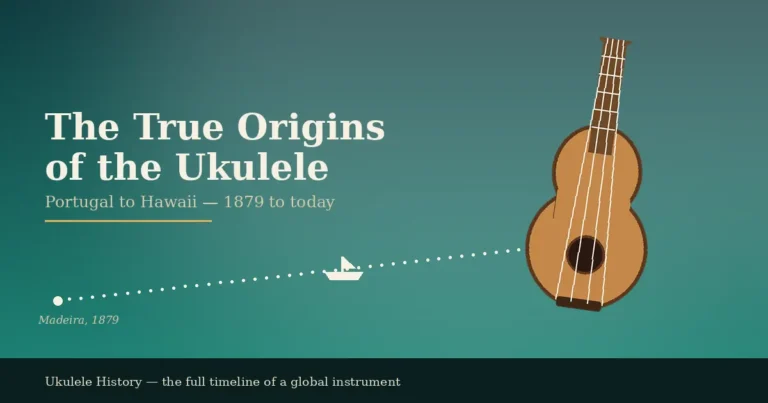
Here’s the direct version of the story: on August 23, 1879, the British sailing ship Ravenscrag docked in Honolulu Harbor carrying 419 Portuguese immigrants from Madeira, recruited to work Hawaii’s sugar plantations after a four-month, roughly 12,000-mile voyage around Cape Horn from the port of Funchal. Among the instruments the immigrants brought with them were the machete and the rajão, and within a decade those two instruments would be fused into something new.
The 1879 voyage of the Ravenscrag
Among the passengers were three woodworkers from Funchal: 40-year-old Manuel Nunes, 37-year-old Augusto Dias, and 28-year-old José do Espírito Santo, each traveling with a wife and four children. A fourth passenger, João Fernandes, had only a seven-month-old daughter to look after, which left him free to borrow a machete from a fellow traveler the moment the ship docked. He stepped onto the wharf and broke into song, celebrating the safe end of a hard crossing.
The scene stuck. Word of the “strange instruments” the Madeirans played spread through Honolulu within days, and it wasn’t long before three of Fernandes’s shipmates started building the instruments themselves.
Three woodworkers, three workshops
Nunes, Dias, and Espírito Santo worked their labor contracts on plantations across Hawaii, Maui, and Kauai before relocating to Honolulu to return to woodworking. Dias opened a shop in the city’s Chinatown district around 1884. By 1888, all three men were advertising themselves in local newspapers as makers of guitars, machetes, and stringed instruments generally, and by 1889 Honolulu’s city directory listed each of them simply as a guitar maker.
None of the three built rajãos for a living. What they built, working from memory and instinct rather than formal training, combined the compact shape of the machete with the reentrant tuning logic of the rajão. Nunes later advertised himself, without much modesty, as the instrument’s inventor. Historians still can’t say with certainty which of the three built the very first one.
Royal patronage and a new name
The new instrument found a powerful fan in King Kalākaua, who took it up during the 1880s. His stepdaughter recalled him picking up a ukulele or a guitar to sing a favorite Hawaiian song at family gatherings, and royal patronage did more for the instrument’s status than any single sales pitch could have. Queen Liliʻuokalani, herself an accomplished composer, kept the instrument woven into the musical life of the royal court as well.
Where the name “ukulele” actually came from is one of the genuine unsolved questions in this history. The most repeated legend credits Edward Purvis, a small, quick-moving royal chamberlain nicknamed “ukulele,” or “jumping flea,” for his energetic playing style, with lending his nickname to the instrument he loved. It’s a good story, and it might even be true, but there isn’t enough surviving evidence to confirm it over competing explanations. Before “ukulele” caught on, Hawaiians had already been calling an early version of the instrument the “taro-patch fiddle.”
The taro-patch fiddle: the rajão’s eight-string legacy
That “taro-patch” nickname started as a name for the rajão itself. Over the following years, it migrated to a different instrument: an eight-string, double-course ukulele that borrowed the rajão’s five-course logic and adapted it into four doubled pairs, producing a fuller, chorus-like sound. Mainland manufacturers eventually picked up on the trend. C.F. Martin & Co., the Pennsylvania guitar maker, added taro-patch and standard ukulele models to its catalog during the instrument’s boom years in the early twentieth century, a sign of how far the rajão’s tuning DNA had traveled from a Madeiran dance hall.
How the rajão lives in Hawaiian and Madeiran music
The short answer: the rajão still does today almost exactly what it did in the nineteenth century, backing folk dancers on Madeira, while its tuning logic lives on inside every ukulele built anywhere in the world. The two traditions run in parallel rather than one replacing the other.
A tale of two woods, two rooms
In Madeira, a rajão’s top is typically spruce, with walnut or rosewood back and sides, chosen for volume and projection in an outdoor folk ensemble. When Nunes, Dias, and Espírito Santo started building in Honolulu, they turned to native koa wood instead. Koa produces a warmer, more complex tone than spruce, with a compressed midrange that suits fingerstyle playing and close, intimate listening rather than open-air dance accompaniment. Same tuning family, two very different rooms to fill.
Rajão, machete, and modern ukulele compared
| Instrument | Strings | Tuning | Approx. length | What it gave the ukulele |
|---|---|---|---|---|
| Rajão | 5 (metal) | D-G-C-E-A, reentrant | ~70 cm | The reentrant tuning pattern |
| Machete (braguinha) | 4 | Reentrant, distinct from the rajão | Smaller body than the rajão | The compact size and four-string layout |
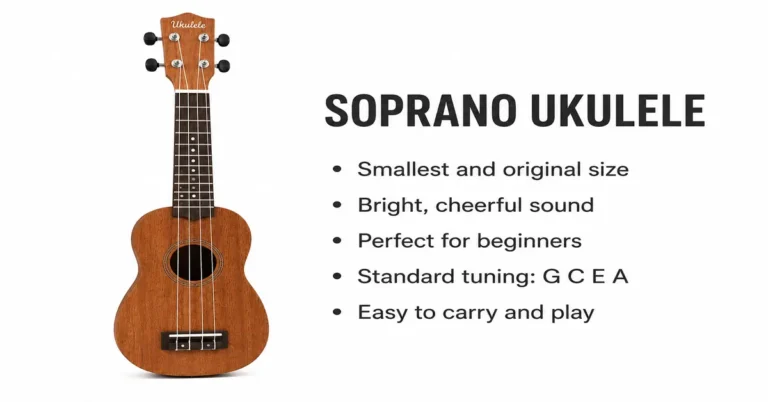
| Modern soprano ukulele | 4 (nylon) | G-C-E-A (GCEA), reentrant | ~53 cm, 13 in. (33 cm) scale | Combines both ancestors’ contributions |
Key dates from Madeira to the mainland
| Year | Milestone |
|---|---|
| Pre-1879 | Rajão develops as a folk accompaniment instrument tied to Madeiran dances such as the bailinho |
| August 23, 1879 | The Ravenscrag docks in Honolulu with 419 Madeiran immigrants, carrying the rajão and the machete |
| 1884-1888 | Nunes, Dias, and Espírito Santo open Honolulu workshops building machetes, guitars, and the new instrument |
| 1880s | King Kalākaua and the royal court help popularize the instrument at court gatherings |
| 1889 | All three luthiers listed as guitar makers in Honolulu’s city directory |
| 1915 | The Panama-Pacific International Exposition introduces the ukulele to mainland audiences through the Hawaiian Pavilion |
| 1916 | Samuel Kamaka, a former Nunes apprentice, opens his own ukulele shop in Honolulu |
| 1968 | Tiny Tim’s recording of “Tiptoe Through the Tulips” brings novelty attention to the ukulele |
| 1993 | Israel Kamakawiwoʻole records his medley built around “Somewhere Over the Rainbow,” reviving global interest |
| Present day | Luthiers such as Aaron Keim build historically accurate rajão reproductions to study the ukulele’s roots |
Historian’s note: Instrument maker Aaron Keim traveled to Hawaii to study surviving instruments built by Nunes, Dias, and Espírito Santo in the 1880s and 1890s before hand-building his own rajão reproduction, a project supported by a grant from Mortise & Tenon magazine. Work like his is close to primary-source archaeology for an instrument family with very few written records of its own.
The Shape-and-Song framework: what the rajão actually gave the ukulele
Nearly every ukulele origin story tries to credit one Madeiran instrument with the whole invention. The historical record points to two, and untangling their separate contributions is the single biggest gap in most existing guides. Call it the Shape-and-Song framework.
The machete, also called the braguinha, is where the ukulele got its shape: a compact four-string body scaled down to fit comfortably in smaller hands. The rajão is where it got its song: the reentrant D-G-C-E-A tuning that, shifted up and trimmed from five strings to four, became the G-C-E-A pattern every modern soprano ukulele still uses. Neither instrument alone explains the ukulele. Shape from one parent, song from the other, together they do.
On September 3, 1879, just eleven days after the Ravenscrag reached Honolulu Harbor, the Hawaiian Gazette ran a short item about the new arrivals’ nightly street performances. The paper described their instruments as “a kind of cross between a guitar and a banjo,” played by skilled Portuguese musicians the writer clearly hadn’t encountered before. Within a decade, three of those Madeiran passengers, Manuel Nunes, Augusto Dias, and José do Espírito Santo, would each be running his own Honolulu instrument shop, and the small guitar the newspaper struggled to describe would finally have a name of its own.
Common misconceptions about the rajão
“Isn’t the rajão just a small ukulele?”
It’s actually the other way around, and it’s older. The rajão has five strings, not four, runs several centimeters longer than a soprano ukulele, and is still played on Madeira today as its own independent instrument, not as a novelty or a museum piece.
“Didn’t the rajão give the ukulele its size and shape?”
No. That credit belongs to a different Madeiran instrument, the machete, also called the braguinha. The rajão’s contribution was tuning logic, not dimensions. Conflating the two is probably the single most common error in casual ukulele history writing.
“Isn’t the ukulele just a small guitar?”
Not really. Its Portuguese ancestors descend from a distinct branch of the cavaquinho family, and the reentrant tuning it inherited from the rajão, where a middle string rings higher than a string next to it, has no equivalent on a standard guitar. That reentrant quirk is exactly what gives ukulele chords their bright, chiming character.
FAQs
Is the rajão the same as a ukulele? No. The rajão has five strings and a larger body, and it developed in Madeira centuries before the ukulele existed in Hawaii. It gave the ukulele its reentrant tuning pattern, not its size or shape.
How is a rajão tuned? A rajão is tuned D-G-C-E-A, reentrant, with the third string ringing lower in pitch than the string next to it. A six-string version adds a doubled top A string.
Is the rajão still played today? Yes. Musicians on Madeira still build and play rajãos to accompany folk dances such as the bailinho, usually alongside accordion and percussion in a small strolling ensemble.
What’s the difference between a rajão and a cavaquinho? The rajão is Madeira’s five-string, larger-bodied member of the cavaquinho family. The mainland Portuguese cavaquinho has four strings and its own separate tuning tradition.
Did the rajão give the ukulele its name? Not directly. The name “ukulele” is most often linked to a nickname for royal chamberlain Edward Purvis, though the evidence for that story is thin. The rajão’s real legacy is tuning, not naming.
Can you play ukulele chords on a rajão? Mostly, yes, with an adjustment. Because both instruments share the same reentrant tuning logic, common ukulele chord shapes translate to a rajão once you account for the extra fifth string.
Nearly a century and a half after a handful of Madeiran woodworkers stepped off a sailing ship into Honolulu Harbor, their instrument’s fingerprint is still audible in every ukulele chord played anywhere in the world, from a beginner’s first strum to Jake Shimabukuro’s fastest runs. The rajão didn’t invent the ukulele on its own, but without its reentrant tuning, the instrument simply wouldn’t sound like itself. If this deep dive into Madeira’s folk instruments left you wanting more of the ukulele’s full story, from koa wood craftsmanship to the players who carried it worldwide, Ukulele History has the rest of that archive waiting.
Think bigger, act smarter—our growth mindset posts will show you how.