Koa Wood Ukulele History: How Hawaii Found Its Sound
Koa wood ukulele history begins not in a workshop but on a harbor. When Portuguese immigrants anchored in Honolulu in 1879 with small four-stringed instruments called braguinhas, Hawaiian craftsmen made one decisive choice: they reached for the wood growing in their own highlands. That substitution — koa instead of imported Portuguese tonewoods — is why the ukulele sounds the way it does, and why its sound is so specifically Hawaiian.
Most accounts of the ukulele’s origins stay fixed on the Portuguese connection and stop there. They miss what happened after the ships unloaded: how native koa wood and Hawaiian hands transformed a Portuguese folk instrument into something irreversibly different. This page traces koa’s role across four distinct eras, from its pre-contact status as a sacred resource to the conservation pressures shaping today’s instrument market. The event that sealed koa’s cultural significance happened in a Honolulu palace, not a luthier’s workshop.
Key takeaways:
- Koa (Acacia koa) is endemic to Hawaiʻi and has been a valued cultural resource for centuries before the ukulele arrived on the islands
- Hawaiian craftsmen began building ukuleles from koa in the 1880s, replacing imported Portuguese tonewoods with a native alternative
- King Kalākaua’s patronage of the koa ukulele at the Hawaiian royal court gave the wood lasting cultural prestige
- Koa produces a warm, midrange-rich tone that opens up and grows more complex as the instrument ages with regular playing
- Significant 19th and 20th-century deforestation reduced koa forest coverage substantially, making premium koa scarce and expensive today
- Kamaka Ukulele, founded in Honolulu in 1916, remains the oldest continuously operating Hawaiian ukulele manufacturer
What is koa wood and why does it matter to the ukulele?
Koa (Acacia koa) is a hardwood endemic to the Hawaiian islands — found nowhere else on earth in its wild state. Growing in mid-elevation forests between roughly 3,000 and 6,000 feet, koa entered ukulele making in the 1880s and became the instrument’s defining tonewood because of its warm, complex acoustic character and its deep roots in Hawaiian cultural life.
Acacia koa — Hawaii’s warrior tree
The Hawaiian word koa translates as warrior or brave. Long before Portuguese craftsmen set foot in Honolulu, koa was among the most valued materials in Hawaiian society. Native Hawaiians shaped it into waka (outrigger canoes) capable of crossing open ocean, into papa heʻe nalu (surfboards), and into the hafts of weapons and ceremonial objects. Access to the finest trees was controlled by the aliʻi, the chiefly class — this was not a material for common use.
Koa grows in distinctive forms. Some specimens produce boards with a heavily figured grain — wavy, three-dimensional patterns that shimmer and shift when viewed from different angles. This figuring, called curly or tiger koa, results from genetic variation combined with specific growing conditions. It was prized aesthetically long before any luthier considered it for a soundboard.
What made koa valuable in canoe building — its density, workability, and resilience in the Hawaiian climate — also turned out to suit instrument construction. The same properties that allow a koa hull to handle the Pacific Ocean let a koa ukulele body hold precise dimensions and respond cleanly to vibration across many decades of use.
The acoustic character of koa
Luthiers and players describe koa’s tonal character as warm and complex, with a strong midrange presence and overtones that develop over time. It doesn’t project aggressively in the high frequencies the way maple or spruce does. Instead, koa produces a full, rounded sound that expands outward rather than cutting forward — closer in character to mahogany, but with more complexity in the upper midrange and a slightly drier, more textured quality.
New koa instruments often sound somewhat restrained. With regular playing, the wood’s cellular structure responds gradually to vibration — a process players call “opening up.” A well-played koa ukulele from decades past will typically sound richer than when it was new. This aging quality explains why vintage koa instruments from early Hawaiian makers attract serious collectors, and why a well-maintained example commands prices far above its original cost.
How koa became the ukulele’s defining wood
Koa became the dominant ukulele tonewood through a combination of practical availability and cultural alignment. When Portuguese craftsmen arrived in Honolulu in 1879, their imported tonewoods were scarce on the islands. Hawaiian luthiers turned to what grew in their own forests — and koa produced something the Portuguese originals couldn’t match.
The Portuguese arrival and the first adaptations
On August 23, 1879, the British ship Ravenscrag completed a four-month crossing from the Madeiran archipelago and anchored in Honolulu Harbor. Among the Portuguese immigrants aboard were three craftsmen who would shape Hawaiian musical history: Manuel Nunes, Augusto Dias, and José do Espírito Santo. Their braguinhas — small four-stringed instruments related to the machete de braga — drew crowds in Honolulu’s streets within days of landing.
The braguinha was built from Portuguese tonewoods: mahogany, spruce, and cedar. But sourcing those materials in Hawaiʻi required importation, which made them expensive and unpredictable in supply. Hawaiian craftsmen working in the new ukulele trade began building from koa in the 1880s. The instrument’s character shifted with the wood. What they produced wasn’t a Portuguese copy. It was something new — and it was made from Hawaiian soil.
King Kalākaua and the royal seal of approval
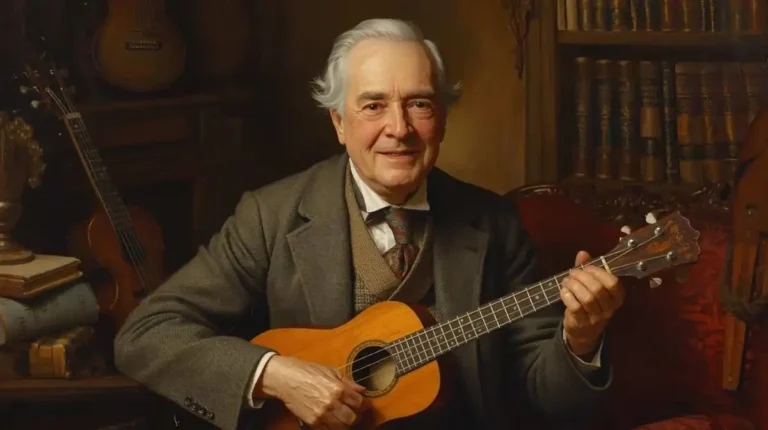
No figure did more to establish the koa ukulele as a cultural object than King David Kalākaua, who reigned from 1874 to 1891. Known as the Merrie Monarch, Kalākaua championed Hawaiian culture at a time when it faced intense pressure from Western commercial and missionary forces. He played the ukulele himself, performed with it at his royal court, and encouraged the use of native Hawaiian materials in the instruments his musicians played.
Kalākaua’s endorsement carried real weight. When the king played a koa ukulele, koa became the material of cultural prestige — not simply practical preference. His patronage shifted the instrument from a novelty arrived on Portuguese ships into something identifiably Hawaiian: built from Hawaiian wood, played in a Hawaiian royal court, expressing a Hawaiian musical aesthetic.
Queen Liliʻuokalani, who succeeded him and was herself a gifted composer and musician, continued to sustain Hawaiian musical culture through the turbulent years of the late 19th century. The Bishop Museum in Honolulu holds documentation and artifacts from this period, tracing how the ukulele moved from the streets of Honolulu to the palace and back into common hands.
The first koa ukulele workshops
Manuel Nunes established the first dedicated ukulele workshop in Honolulu, working alongside Hawaiian craftsmen and incorporating koa into his builds. By the 1890s, several workshops had formed — some run by Portuguese craftsmen, others by Hawaiian luthiers who had learned the trade alongside them. Koa became increasingly standard as the preferred primary wood for the body, neck, and headstock of locally made instruments.
This was partly practical. Koa was available, workable, and relatively abundant in that era. But it was also cultural. An instrument built entirely from Hawaiian koa carried a meaning that an imported-wood instrument simply didn’t.
Koa ukulele makers and the sound of the golden era
The early decades of the 20th century produced koa ukulele craftsmanship that set the standard still referenced by luthiers today. Beginning with Honolulu workshops in the 1910s and extending to mainland manufacturers who imported Hawaiian koa, this period defined what the instrument could sound like when builders genuinely understood the wood’s specific qualities.
Kamaka and the koa tradition
Samuel Kaialiʻi Kamaka Sr. founded Kamaka Ukulele in Honolulu in 1916. It remains family-owned — making it the oldest continuously operating Hawaiian ukulele manufacturer. Kamaka built its reputation on koa: Hawaiian koa bodies, koa necks, careful quarter-sawing to maximize tonal response, and close attention to wood selection that distinguished their instruments from cheaper competitors.
Kamaka introduced the pineapple-shaped ukulele body in 1928 — a design that produces a louder, rounder sound profile than the traditional figure-eight shape. The pineapple’s wider lower bout suited koa’s natural midrange warmth particularly well, reinforcing the wood’s tonal character rather than working against it.
How mainland manufacturers responded to koa
The 1915 Panama-Pacific International Exposition in San Francisco brought Hawaiian music — and specifically the koa ukulele — to mainland American audiences at genuine scale. Hawaiian musicians performed for millions of exposition visitors, and interest in the instrument spread across the country. Mainland manufacturers moved quickly to meet demand.
C.F. Martin & Co., based in Nazareth, Pennsylvania, began producing koa ukuleles in significant quantities during the 1910s and 1920s, importing Hawaiian koa specifically for their ukulele lines. Gibson also produced koa-bodied models. These instruments gave mainland buyers access to the Hawaiian tonewood — assembled thousands of miles from the forests where the koa had grown. Vintage Martin koa ukuleles from this period are now collected seriously, valued for both the quality of early Hawaiian koa and the precision of Martin’s construction.
Koa versus other ukulele tonewoods — a direct comparison
| Tonewood | Tonal character | Sustain | Relative cost | Notes |
|---|---|---|---|---|
| Koa | Warm, complex, midrange-rich | Medium-high | Premium to very high | Opens up with age; endemic to Hawaiʻi |
| Mahogany | Warm, focused, even response | Medium | Mid-range | Most common alternative; predictable and reliable |
| Spruce | Bright, clear, highly articulate | High | Mid-range | Strong for fingerpicking; less tonal complexity |
| Cedar | Dark, soft, immediately responsive | Medium | Mid-range | Suits gentle dynamics; can become muddy under heavy attack |
| Maple | Bright, punchy, percussive | Medium-high | Mid-range | Favored by strummers; effective in pop and folk styles |
| Mango | Warm-bright blend, good projection | Medium | Budget to mid | Common in entry-level Hawaiian-made instruments |
The Four Eras of Koa — a framework for the wood’s history
Koa’s relationship with the ukulele spans four distinct eras, each shaped by different pressures and priorities. Mapping them clarifies something most histories blur: the koa ukulele wasn’t born as a cultural icon. It became one — through royal patronage, commercial demand, ecological strain, and deliberate revival — across more than 140 years.
| Era | Period | Key forces | Koa availability |
|---|---|---|---|
| Sacred resource | Pre-1879 | Aliʻi control; canoe building; ceremonial use | Abundant, tightly managed |
| Royal patronage | 1880–1915 | Ukulele adoption; Kalākaua’s court; first koa workshops | Widely available |
| Commercial peak and near-loss | 1916–1970s | Mainland demand; Kamaka founded; Martin imports koa; deforestation | Increasingly scarce |
| Conservation and revival | 1980s–present | Cultural renaissance; sustainable sourcing; global market growth | Scarce, premium-priced |
A quick timeline of key moments:
- Pre-1879: Koa used for waka (canoes), papa heʻe nalu (surfboards), and sacred objects by Native Hawaiians
- August 23, 1879: Ravenscrag anchors in Honolulu Harbor; Portuguese craftsmen arrive
- 1880s: Hawaiian luthiers begin building ukuleles from koa, replacing imported tonewoods
- 1891: King Kalākaua dies; the koa ukulele already established as a symbol of Hawaiian identity
- 1915: Panama-Pacific Exposition introduces koa ukuleles to mainland American audiences at scale
- 1916: Kamaka Ukulele founded in Honolulu by Samuel Kaialiʻi Kamaka Sr.
- 1928: Kamaka introduces the pineapple-shaped ukulele body
- 1920s–1940s: Peak commercial production; C.F. Martin imports Hawaiian koa for mainland ukulele lines
- 1950s–1970s: Ukulele popularity declines; koa forests already significantly reduced
- 1980s–1990s: Hawaiian cultural renaissance; koa conservation and reforestation programs expand
- Late 1980s–1990s: Israel Kamakawiwoʻole’s recordings return global attention to the Hawaiian ukulele
- Mid-2000s: Jake Shimabukuro’s performances expand the instrument’s international audience
Era 1 — sacred resource (pre-1879)
Before the ukulele existed in Hawaiʻi, koa was a rigorously managed cultural resource. The aliʻi controlled access to the finest trees. Koa built the canoes that carried Hawaiian civilization across the Pacific and the boards that caught Hawaiian waves. Nothing about this era suggested the wood would become a musical material — but its status as the island’s most prestigious hardwood prepared it perfectly for that role once the right instrument arrived.
Era 2 — royal patronage (1880–1915)
The Ravenscrag’s arrival in 1879 set this era in motion. Koa entered ukulele making in the 1880s and gained cultural authority through Kalākaua’s court and the workshops of Honolulu’s early luthiers. By 1915, a koa ukulele was unmistakably Hawaiian — an object of cultural identity, not merely a musical tool. The Panama-Pacific Exposition marked the era’s peak and the beginning of its transition into something broader and more commercial.
Era 3 — commercial peak and near-loss (1916–1970s)
Demand soared after 1915. Mainland manufacturers bought Hawaiian koa in volume. Forests already reduced by 19th-century cattle ranching and agricultural conversion faced increased harvesting pressure. The ukulele’s decline in mainstream popularity from the 1950s onward eased some of that pressure — but by then the forests had contracted significantly. By the 1970s, koa had shifted from a broadly accessible building material to a genuinely scarce one.
Era 4 — conservation and revival (1980s–present)
The Hawaiian cultural renaissance of the 1970s and 1980s — combined with growing environmental awareness — brought serious attention to koa conservation. Reforestation programs began planting koa at meaningful scale. Some instrument makers committed to certified sustainable sourcing; others turned to reclaimed koa salvaged from old structures and fallen trees.
Israel Kamakawiwoʻole’s recordings in the late 1980s and early 1990s — particularly his medley of “Somewhere Over the Rainbow” and “What a Wonderful World” — returned global attention to the ukulele and, by extension, to the Hawaiian sound koa produces. Jake Shimabukuro’s performances in the mid-2000s extended that reach further into new international audiences. Both artists, playing koa instruments, made audible arguments for what the wood can do in practiced hands.
Historian’s note: The vignette most histories underplay is this: on August 23, 1879, the British ship Ravenscrag anchored in Honolulu Harbor after a four-month crossing from Madeira. Among the Portuguese immigrants aboard were three craftsmen — Manuel Nunes, Augusto Dias, and José do Espírito Santo — who had built braguinhas from imported tonewoods. Within months, Hawaiian luthiers working alongside them made a discovery that changed the instrument forever: koa wood, dense and richly figured, responded to a luthier’s plane differently from anything the Portuguese craftsmen had worked before. It sang in a fuller, warmer register. It held pitch through the islands’ humidity. And it was growing in the highlands above Honolulu. That discovery shaped the koa ukulele more than any royal proclamation or exposition stage ever did.
What most players get wrong about koa ukuleles
Two misconceptions follow the koa ukulele wherever it appears: that all Hawaiian ukuleles are made from koa, and that koa automatically produces the best possible sound. Both claims deserve a closer look. Understanding where they come from — and where they fall short — leads to better instrument choices.
Misconception 1 — all Hawaiian ukuleles are made from koa
They aren’t. This is probably the most common assumption buyers carry into their first instrument purchase. Many Hawaiian-made ukuleles use mahogany, mango, or other tonewoods — particularly at entry and mid-range price points. Some respected Hawaiian luthiers work primarily in mahogany by preference, not compromise. Koa is the prestige tonewood of the Hawaiian ukulele tradition, but it has never been the only one.
The confusion is understandable. Koa is so closely associated with Hawaiʻi that many buyers assume any Hawaiian-made instrument must use it. The word “Hawaiian” on a ukulele label refers to where it was built — not necessarily what it was built from. A well-made mahogany instrument from a skilled Hawaiian luthier will outperform a poorly constructed koa ukulele without question.
Misconception 2 — koa automatically sounds better than other woods
It doesn’t. Not automatically, and not for every player or style. Koa’s warmth and complexity suit specific musical contexts — fingerpicking, traditional Hawaiian strumming patterns, gentle dynamics — better than others. Players who favor aggressive strumming in pop or folk styles sometimes find koa’s midrange warmth less satisfying than a brighter spruce top or a more percussive maple body.
The “koa is best” claim is partly acoustic reality and partly decades of accumulated marketing. What’s accurate is that koa sounds distinctly Hawaiian — and for players seeking that quality specifically, no other tonewood reliably replicates it. But “distinctly Hawaiian” and “objectively superior” are not the same claim. The best ukulele tonewood is the one that matches your playing style and musical goals.
FAQs
Why is koa wood only found in Hawaiʻi? Koa (Acacia koa) is endemic to the Hawaiian islands — it evolved in geographic isolation over millions of years and doesn’t grow naturally anywhere else on earth. Its unique ecological origin is part of what gives koa ukuleles their cultural specificity: you can source the wood only from Hawaii, and no other region can replicate its full ecological and human history.
Why is koa wood so expensive? Koa forests were substantially reduced by 19th and 20th-century deforestation, cattle ranching, and agricultural conversion. Supply is now constrained by both ecology and conservation regulations. Premium figured koa — the highly grained wood prized for instrument tops and backs — is especially scarce. The price reflects genuine rarity, sustainable harvesting costs, and the wood’s cultural weight in the instrument market.
How do I know if a ukulele is solid koa or koa laminate? Solid koa ukuleles show continuous grain patterns that wrap around the body edges. Laminate instruments have a thin koa veneer bonded over a different core wood — the edge of a laminate body typically reveals a layered cross-section. Solid koa costs significantly more and generally sounds better over time, though well-made laminates offer a reasonable entry point for new players.
Did Martin Guitar make koa ukuleles? Yes. C.F. Martin & Co. produced koa ukuleles in significant quantities from the 1910s through the 1940s, importing Hawaiian koa specifically for their ukulele lines. Vintage Martin koa ukuleles from this period are now highly collectible, valued for both the instruments’ age and the quality of early Hawaiian koa used before significant deforestation reduced the supply.
What is figured or curly koa? Figured koa — also called curly koa — refers to specimens with a pronounced wavy or rippled grain pattern that creates a three-dimensional effect when viewed under light. This figuring results from genetic variation and specific growing conditions, not a distinct wood species. Heavily figured koa is rare, visually distinctive, and commands a significant price premium over plain-grained koa in the instrument market.
Does a koa ukulele sound better with age? Players and luthiers widely report that koa instruments improve with regular playing as the wood responds to vibration over time. This process — often called “opening up” — produces richer overtones and greater tonal complexity than a new instrument displays. It’s one reason well-played vintage koa ukuleles are valued well above comparable new instruments.
How to choose a koa ukulele
Choosing a koa ukulele means navigating a market that ranges from entry-level laminates at a modest price to hand-crafted solid-koa instruments built to last multiple lifetimes. Knowing three key distinctions — wood construction, koa grade, and body size — turns what can feel like a confusing purchase into a clear decision.
Solid koa versus koa laminate — understanding what you’re buying
Solid koa instruments use a single piece of koa wood (or book-matched sections of koa) for the top, back, and sides. Laminate instruments use a thin koa veneer bonded over a different core wood — often a lightweight tonewood or composite material. Both can look similar in photographs. They don’t sound similar over time.
Solid koa responds to vibration directly, which is why its tone improves with age. A laminate’s core material dampens that response; the tonal ceiling is lower and the wood doesn’t “open up” in the same way. For a first koa ukulele on a limited budget, a well-made koa laminate from a reputable builder is a reasonable starting point. If you’re buying for the long term, solid koa is worth the additional cost.
To tell them apart: examine the binding edge where the top meets the sides, or look into the sound hole at the bracing. Solid koa shows continuous grain across the full depth. A laminate reveals thin distinct layers — the koa veneer is typically 1–2mm thick over a noticeably different core.
Understanding koa grades and figuring
Not all koa sounds or looks the same. Luthiers and suppliers grade koa primarily by the degree of figuring in the grain:
- Plain koa: Consistent, straight grain with minimal figuring. Still genuine koa, still produces koa’s tonal character. More affordable and structurally predictable.
- Lightly figured koa: Some curl or ripple visible in the grain. A middle tier — the aesthetics are more interesting and tonal complexity is generally slightly higher.
- Heavily figured / curly koa: Pronounced, three-dimensional grain patterns that shimmer under light. The rarest category. Premium-priced, visually striking, and prized by collectors. The acoustic difference between figured and plain koa from the same tree is debated among luthiers — most agree that visual grade alone doesn’t determine the best-sounding board.
Buy the grade your budget genuinely supports. A plain-koa instrument from a skilled Hawaiian luthier will outperform a heavily figured koa instrument from a mass-production build almost every time.
Choosing the right body size
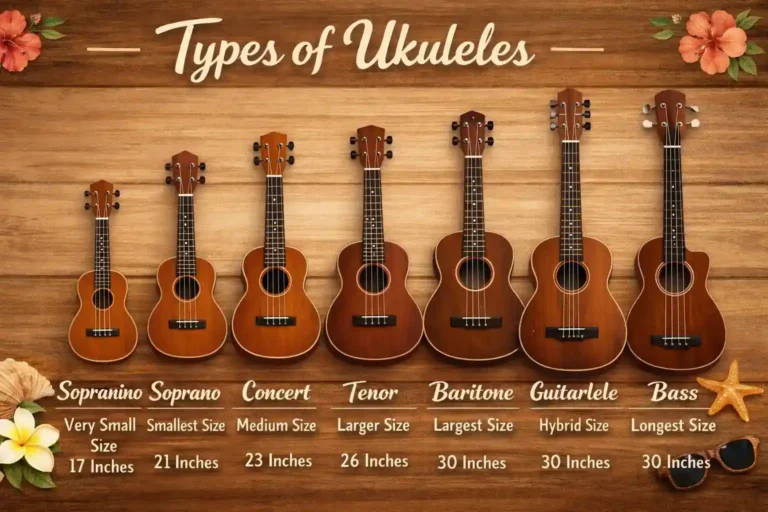
Koa ukuleles come in the standard four sizes, and the choice affects both sound and playability:
- Soprano: Scale length of roughly 13 inches (33 cm), 12–15 frets. The smallest and most traditionally Hawaiian size. Produces a bright, punchy sound that suits koa’s midrange character well.
- Concert: Scale length of roughly 15 inches (38 cm). More fret access and a slightly fuller sound than soprano. A solid middle ground for most players.
- Tenor: Scale length of roughly 17 inches (43 cm). Richer low end, greater sustain. Koa’s midrange warmth is particularly pronounced on tenor-scale instruments.
- Baritone: The largest size, tuned to DGBE rather than the standard GCEA. Less common in traditional Hawaiian koa builds; chosen more often by players with a guitar background.
For most players seeking the classic Hawaiian koa sound, soprano and concert sizes are the natural starting points.
What to look for before you buy — a checklist:
- Confirm solid versus laminate construction at the binding edge or sound hole interior
- Check the neck joint for any gaps or uneven seams — these signal assembly issues that affect tone and longevity
- Tune the instrument and play every fret on every string — buzzing or dead notes point to setup problems
- Ask about koa origin and whether the builder sources from sustainable or reclaimed Hawaiian stock
- Examine the finish for bubbling, unevenness, or cloudiness, which indicates poor curing or rushed production
- Play it whenever possible, or find recorded demos of the specific model — individual koa boards vary enough that no two instruments from the same maker sound identical
Hawaiian koa ukulele makers worth knowing
The koa ukulele tradition is carried by a small number of dedicated Hawaiian builders. Kamaka is the oldest, but it isn’t the only workshop keeping the craft alive. Several other family-run operations, most of them based in Honolulu, work primarily in Hawaiian koa and have built genuine reputations among players and collectors.
The Honolulu workshop tradition
What connects the most respected Hawaiian koa ukulele makers isn’t their size or their age — it’s a consistent commitment to sourcing koa from within Hawaiʻi, building in smaller runs, and treating wood selection as a craft skill rather than a supply chain decision. The best Hawaiian builders visit koa suppliers in person, reject boards that don’t meet their standards, and often know the specific forest region a piece of koa came from.
KoAloha Ukulele, also based in Honolulu, has built a following for instruments with a distinctly bright and projecting tone that differs from Kamaka’s warmer profile. Both use Hawaiian koa; both produce excellent results. The difference demonstrates something worth understanding: the same tonewood, worked with different construction philosophies, produces genuinely different sounds. Kanile’a Ukulele, another Honolulu family operation, is known for carefully graded figured koa tops and a construction approach that produces strong volume and clear note separation across all four strings.
The existence of multiple distinct Hawaiian voices in the koa ukulele market is itself a sign of the tradition’s health. Players who try instruments from two or three reputable Hawaiian builders often discover that their preferred maker aligns with a specific tonal signature — not just a brand.
What separates a Hawaiian-made koa ukulele from an imported one
Several large manufacturers outside Hawaiʻi produce ukuleles labeled as “koa” — using Hawaiian koa imported in raw form and worked in factories elsewhere. These instruments aren’t fraudulent if the koa is genuine. But they differ from Hawaiian-made instruments in ways that matter to many buyers.
Hawaiian builders typically work in smaller batches, hand-select individual boards, and apply finishing and setup standards developed over decades of working specifically with koa. The labor cost is higher. So is the final price. But the instrument also carries a traceable connection to the material, the culture, and the craft tradition the koa ukulele emerged from. For collectors and serious players, that provenance matters as much as the tone — because with koa, the two aren’t really separable.
Conclusion
The koa wood ukulele isn’t just an instrument built from a local material. It’s the record of how Hawaiian craftsmen took a Portuguese folk instrument and, by choosing one wood over another, made it irreversibly Hawaiian — using the same material their ancestors had shaped into canoes capable of crossing the Pacific. For something small enough to hold in one hand, it carries a long history.
What keeps koa relevant isn’t tradition for its own sake. It’s that the wood continues to produce a sound players around the world recognize as distinctly Hawaiian — warm, layered, and complex in ways that take years to fully understand.
If you want to keep following the instrument’s history — its players, its makers, its music — explore the rest of the archive at Ukulele History.
Every article here earns your attention—start with our quality-first blog posts.