Ukulele in Pop Culture: From Elvis to TikTok
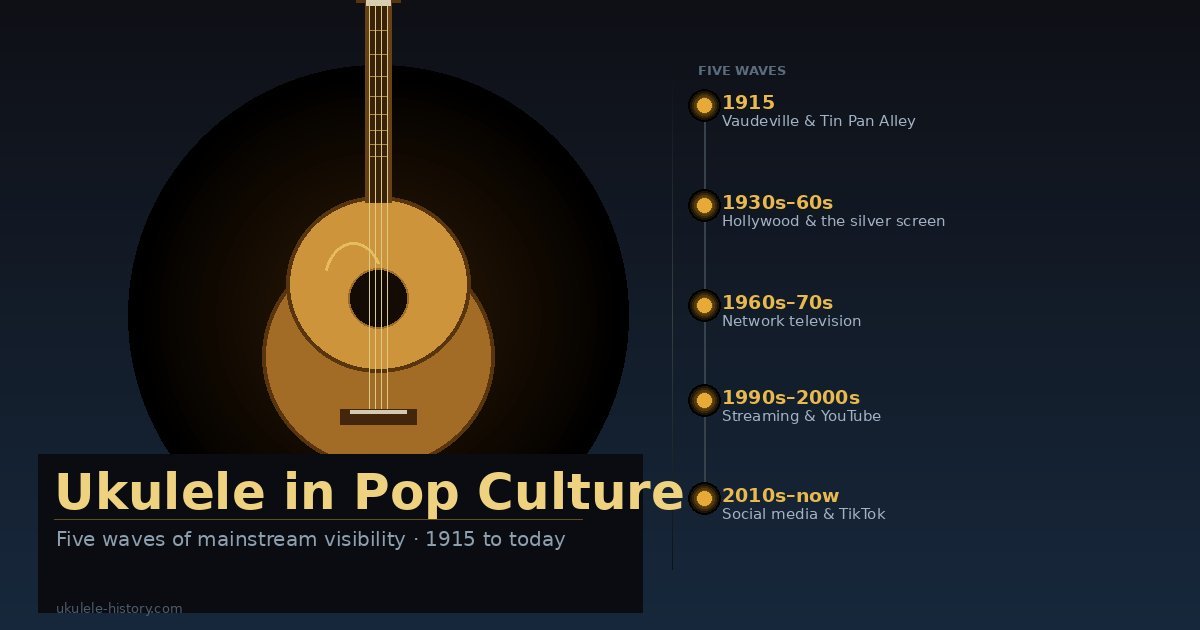
Ukulele in pop culture didn’t arrive as one trend. It spread across five distinct eras, each carried by a different medium: vaudeville stages, Hollywood films, national television, YouTube, and then the smartphone camera. Most accounts skip the mechanics — why some appearances triggered genuine mass adoption while others simply faded. That gap matters, because the mechanisms were different every time.
One of those waves almost didn’t happen. It required a late-night phone call in Honolulu, a cleared studio session, and a single unrepeated take. For years, almost no one outside Hawaiʻi knew the recording existed.
This page maps all five waves using documented cultural history, from the 1915 world’s fair that sparked the first mainland American boom to the TikTok generation recording in their bedrooms today.
Key takeaways:
- The 1915 Panama-Pacific International Exposition in San Francisco triggered the first mainland US ukulele boom — social media had nothing to do with it
- Cliff Edwards (“Ukulele Ike”) established the instrument as a viable recording and film vehicle decades before Elvis or Tiny Tim
- Israel Kamakawiwoʻole’s 1988 Honolulu recording session produced a medley that became one of the most-streamed recordings in history, fundamentally resetting the ukulele’s emotional image in pop culture
- Jake Shimabukuro’s 2006 YouTube video showed that a solo ukulele performance could go globally viral without any label or network behind it
- TikTok accelerated a revival already in motion; it didn’t build the foundation
What does “ukulele in pop culture” actually mean?
Pop culture visibility for a musical instrument means reaching audiences who weren’t looking for the instrument to begin with. A dedicated ukulele ensemble performing for enthusiasts doesn’t qualify. Marilyn Monroe playing ukulele in a film seen by tens of millions of people who hadn’t thought about ukuleles since childhood does.
That distinction matters because the mechanism driving each era of mass adoption was different. Sheet music distribution drove the first wave. Film distribution drove the second. Broadcasting drove the third. Streaming and YouTube carried the fourth. An algorithmic platform drove the fifth. The ukulele’s repeated cycles of visibility track almost perfectly with the rise of each new mass medium.
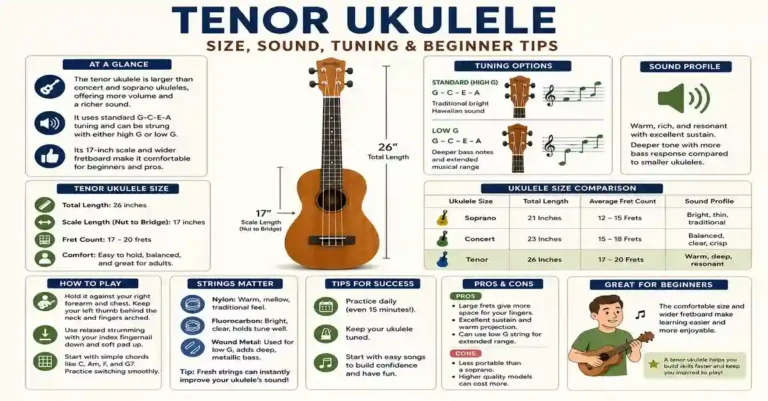
The instrument itself — four strings in standard GCEA tuning, available in soprano, concert, and tenor sizes — has properties that made it attractive across all five eras: compact enough for a stage or a screen, audible without amplification, and fast enough to learn that newcomers can participate within weeks of picking it up.
The five waves of ukulele pop culture
Five identifiable eras define how the ukulele moved through mainstream culture. Each wave had its own dominant medium, its own gatekeepers, and its own reason for eventually cresting. Together they form a complete picture of an instrument that has alternated between obscurity and visibility more times than most music histories acknowledge.
| Wave | Era | Key figure(s) | Primary medium | What drove it |
|---|---|---|---|---|
| 1 | 1900s–1930s | Cliff Edwards (“Ukulele Ike”) | Vaudeville, phonograph, sheet music | 1915 Exposition; Tin Pan Alley chord diagram boom |
| 2 | 1930s–1960s | George Formby, Marilyn Monroe, Elvis Presley | Film | Hollywood as the dominant global mass medium |
| 3 | 1950s–1970s | Tiny Tim | Network television | Tonight Show audience scale; novelty coding |
| 4 | 1990s–2010s | Israel Kamakawiwoʻole, Jake Shimabukuro | Streaming audio, YouTube | Emotional sincerity; early internet virality |
| 5 | 2010s–present | Grace VanderWaal; TikTok creators | Social media | Platform algorithm; low cost of entry and learning |
Wave 1: Tin Pan Alley and vaudeville (1900s–1930s)
The first wave began with a world’s fair. Hawaiian performers appeared at the 1915 Panama-Pacific International Exposition in San Francisco, and sustained direct exposure gave mainland audiences something genuinely new: a small, strummed instrument producing a bright, sustained chord that cut cleanly through a crowd. Tin Pan Alley publishers recognized the opportunity immediately. Within months, sheet music editions began including ukulele chord diagrams alongside standard notation, making the instrument accessible to anyone who could manage a handful of basic chord shapes.
Cliff Edwards was the era’s defining figure. Performing as “Ukulele Ike,” this vaudeville artist born in Hannibal, Missouri in 1895 carried the instrument into recording studios and onto stages with real commercial success. He later voiced Jiminy Cricket in Walt Disney’s 1940 animated feature “Pinocchio,” connecting the ukulele to one of the most-watched films of the twentieth century. Edwards didn’t treat the instrument as a novelty. He played it because it worked in the format he occupied: portable, audible without amplification, and visually engaging for a live crowd.
Hawaiian-made ukuleles of this period were often crafted from koa, a native hardwood that produces a warm, bright tone with natural resonance in the midrange. Mainland manufacturers quickly scaled up using mahogany and spruce to meet demand. Sheet music with ukulele diagrams reached American households in the millions.
The wave faded as radio shifted audiences from live performance to passive listening. But the instrument was now embedded in American domestic music culture in a way it had never been before.
Wave 2: Hollywood and the silver screen (1930s–1960s)
Film was the first truly global mass medium, and the ukulele found a recurring place in it. In Britain, George Formby built a career through the 1930s and 1940s around his banjolele — a banjo-ukulele hybrid — appearing in a run of comedy films that reached wide audiences across the UK and Commonwealth countries. His screen persona attached the instrument to a specific brand of cheerful working-class humor, making it immediately recognizable to British viewers.
In the United States, the defining screen moment came in 1959. Marilyn Monroe played ukulele in Billy Wilder’s “Some Like It Hot,” one of the most commercially successful comedies of its era. The scene is brief — her character Sugar Kane performs in the film’s fictional all-female jazz ensemble — but it placed the instrument inside a glossy, mainstream production with global distribution.
Elvis Presley’s 1961 film “Blue Hawaii” carried the ukulele into a postwar fantasy of the Hawaiian Islands: ocean romance, relaxed elegance, and unhurried music. The film’s soundtrack became one of Elvis’s best-selling albums. But the cultural consequence was complicated. The ukulele gained enormous visibility, at the cost of being embedded in a version of Hawaiʻi constructed largely for mainland entertainment — a framing that flattened the instrument’s actual cultural origins into background atmosphere.
Wave 3: Television, Tiny Tim, and the novelty ceiling (1950s–1970s)
Television outpaced both radio and cinema in per-household reach by the early 1960s, and the ukulele eventually found its most watched single broadcast moment there. Herbert Khaury, performing as Tiny Tim, released “Tiptoe Through the Tulips” in 1968 — an unusual pop record built on his distinctive falsetto vocals and ukulele accompaniment that genuinely reached mass radio audiences.
The defining event came on December 17, 1969. Tiny Tim married Victoria May Budinger, televised live on “The Tonight Show Starring Johnny Carson,” in front of tens of millions of viewers. It was one of the most-watched single television broadcasts of its era. The ukulele was central to the performance, and it reached more households in that one evening than it had in any previous decade. But the association with an act that mainstream culture read as intentionally eccentric created a ceiling. The instrument’s widest single-night audience was also the moment it became most strongly coded as prop and novelty rather than serious musical tool.
What mainland audiences largely missed during this period was the Hawaiian Renaissance — a cultural revitalization movement beginning in the 1970s that returned Hawaiian music, language, and artistic tradition to the center of cultural life in Hawaiʻi itself. Musicians like Eddie Kamae and the Sons of Hawaii were restoring the ukulele to its deeper indigenous musical context. That work happened largely outside the networks and recording infrastructure that drove pop culture on the mainland.
Wave 4: The internet-era revival (1990s–2010s)
The fourth wave has a specific, documented beginning. Late one evening in 1988, Israel Kamakawiwoʻole — known throughout Hawaiʻi as “Brother Iz” — called producer Jon de Mello and asked to come into the studio that night. De Mello cleared a session. Kamakawiwoʻole sat down with his tenor ukulele in a Honolulu studio and recorded, in a single take, a medley combining “Somewhere Over the Rainbow” and “What a Wonderful World.” The track appeared on the 1993 album “Facing Future.” Over the years that followed, it accumulated placements in films, television episodes, and advertising — building a global audience through the emerging infrastructure of cable, satellite, and then digital streaming. It eventually became one of the most-streamed recordings in history. No single performance did more to reset the emotional register of the ukulele in mainstream culture, shifting it from novelty to something closer to tenderness.
Jake Shimabukuro extended that shift through an entirely different channel. In 2006, a YouTube video of Shimabukuro performing a solo ukulele arrangement of “While My Guitar Gently Weeps” spread across the platform and reached a global online audience. It demonstrated that a solo ukulele performance could go viral without any label, any network, or any institutional backing. The performance succeeded entirely on its own terms, and a generation of players saw what the instrument could do at a high technical level.
Train’s 2009 single “Hey, Soul Sister” returned ukulele to mainstream commercial radio without any novelty framing — simply as an instrument driving a pop hook. Other artists incorporated it similarly through the 2000s. Ukulele clubs and societies grew substantially during this period in the US, UK, Japan, and elsewhere, building the grassroots infrastructure that would eventually feed the fifth wave.
Wave 5: TikTok and the bedroom pop generation (2010s–present)
The fifth wave is structurally different from all the previous ones. Instead of depending on a single dominant figure or moment, it’s been driven by volume: thousands of creators posting ukulele content to a platform optimized for short, audibly clear, easily discoverable video.
Grace VanderWaal’s 2016 win on “America’s Got Talent” was the clearest single inflection point. She was twelve years old, performing original compositions on ukulele, and she won the competition on the merits of her songwriting and performance. That framing mattered. It placed the instrument not as a prop or an eccentricity but as a singer-songwriter’s first tool.
Billie Eilish has discussed writing early songs on ukulele in interviews. Tyler Joseph of Twenty One Pilots incorporates ukulele regularly in the band’s live shows and recordings. Neither artist defines themselves as a ukulele act, but both contribute to a pop-rock context in which the instrument is taken seriously as a compositional starting point.
TikTok’s algorithm rewards content that performs well at low production cost: visually compact, acoustically clear in a phone recording, engaging in the first few seconds. Ukulele fits all three. It’s learnable quickly enough that a new player can post watchable content within weeks of starting. But this wave didn’t start on TikTok. It started on YouTube around 2006, grew through streaming placements through the 2010s, and found its compressed, visible peak when short-form video scaled.
Pop culture milestones: reference timeline
| Year | Moment | Medium | What shifted |
|---|---|---|---|
| 1915 | Panama-Pacific International Exposition, San Francisco | World’s fair | First mass mainland US exposure to Hawaiian ukulele |
| 1920s | Cliff Edwards records and performs as “Ukulele Ike” | Vaudeville, phonograph | Establishes ukulele as a viable recording instrument |
| 1940 | Cliff Edwards voices Jiminy Cricket in “Pinocchio” | Animated film | Ukulele player reaches global audience through Disney animation |
| 1959 | Marilyn Monroe plays ukulele in “Some Like It Hot” | Film | Instrument enters mainstream American cinema |
| 1961 | Elvis Presley in “Blue Hawaii” | Film | Ukulele tied to postwar Hawaiian romance narrative |
| 1968 | Tiny Tim releases “Tiptoe Through the Tulips” | Radio | Ukulele reaches pop charts; novelty coding intensifies |
| 1969 | Tiny Tim marries Miss Vicki on “The Tonight Show,” December 17 | Network television | Tens of millions see ukulele performance in single broadcast |
| 1970s | Hawaiian Renaissance movement | Cultural | Reconnects ukulele to indigenous Hawaiian musical tradition |
| 1988 | Israel Kamakawiwoʻole records “Somewhere Over the Rainbow” medley in Honolulu | Studio recording | Emotional reset; eventually becomes global streaming phenomenon |
| 1993 | “Facing Future” album released | Album | IZ’s medley reaches a wider audience for the first time |
| 2006 | Jake Shimabukuro’s “While My Guitar Gently Weeps” spreads on YouTube | Online video | First major ukulele virality in the internet era |
| 2009 | Train releases “Hey, Soul Sister” | Radio, streaming | Ukulele returns to mainstream pop charts without novelty framing |
| 2016 | Grace VanderWaal wins “America’s Got Talent” | Television | Ukulele reframed as a serious young songwriter’s instrument |
| 2010s–present | TikTok ukulele content grows across millions of accounts | Social media | Democratized creation; instrument becomes entry point for new players |
Why the ukulele keeps coming back: the adoption pattern
Across all five waves, one structural pattern holds: mass adoption requires a trusted medium, a compelling figure, and a low barrier to participation. Remove any one of the three and the wave doesn’t form.
The 1915 Exposition provided the medium — a world’s fair with sustained foot traffic — and the cultural authority, through Hawaiian performers with direct connection to the instrument’s origins. Cliff Edwards provided the compelling figure for the recording and vaudeville era. Tiny Tim served that role for network television, however awkwardly. Israel Kamakawiwoʻole and Jake Shimabukuro together covered the streaming and YouTube eras. And TikTok is the first wave in which the platform’s recommendation algorithm functionally replaces the single dominant figure, routing viewers to whoever is playing well regardless of prior industry connections.
The most instructive case is Kamakawiwoʻole’s 1988 session. His Honolulu recording initially had no medium behind it — no planned film placement, no network push. It reached mass audiences slowly, through accumulating streaming placements over more than a decade. What that session demonstrates is that the medium can find the recording rather than the other way around, given enough time and enough emotional resonance in the original performance.
The third element — low barrier to participation — explains why the ukulele specifically cycles back while other instruments don’t. A standard soprano ukulele requires a week or less to develop basic GCEA chord shapes, costs significantly less than most acoustic guitars, and produces no feedback, no amplifier noise, and no neighbor complaints at midnight. Every time a new medium has lowered the cost of musical participation — sheet music, phonograph records, YouTube tutorials, TikTok duets — the ukulele has benefited disproportionately.
Documenting precise sales figures from the 1920s boom is difficult; contemporary industry records from that era weren’t maintained systematically. What the historical record preserves clearly is cultural visibility: sheet music archives, newspaper coverage, and recorded output from the period confirm that the first wave was substantial and sustained.
Historian’s note:
The 1969 “Tonight Show” moment is routinely framed as a cultural high-water mark for the ukulele, but it functioned more as a ceiling than a launch pad. The association between the instrument and Tiny Tim’s deliberately eccentric persona made it harder for other musicians to use the ukulele sincerely for roughly two decades afterward. Kamakawiwoʻole’s recording didn’t just revive the instrument. It first had to clear away what “Tiptoe Through the Tulips” had attached to it.
What most histories get wrong
Misconception 1: TikTok invented the modern ukulele revival
The ukulele’s mainstream resurgence predates TikTok by at least fifteen years. Jake Shimabukuro’s YouTube video went viral in 2006. Train’s “Hey, Soul Sister” reached radio in 2009. Ukulele clubs and societies had already grown substantially through the 2000s before short-form video existed. What TikTok did was compress an already-moving trend, shifting it from a gradual growth curve to something more vertical. It didn’t build the foundation. That work was done by a generation of YouTube educators, singer-songwriters, and community organizers through the early 2000s — infrastructure that rarely appears in pop culture histories because it doesn’t resolve into famous names.
Misconception 2: the ukulele’s mainstream identity was built by novelty acts
The novelty framing is historically real but consistently overweighted. Cliff Edwards used the instrument to record genuine popular hits in the 1920s. Israel Kamakawiwoʻole’s “Somewhere Over the Rainbow” is not ironic. Jake Shimabukuro’s arrangement of “While My Guitar Gently Weeps” is technically demanding regardless of the instrument performing it. Grace VanderWaal won a national television competition on the strength of her songwriting, not on eccentricity. The novelty associations were real — Tiny Tim most prominently — and they had genuine lasting effects on how the ukulele was perceived through the 1970s and 1980s. But across a full century of documented pop culture appearances, most of the people who made the instrument visible were playing it straight.
FAQs
Why did Elvis play ukulele in Blue Hawaii? “Blue Hawaii” (1961) was set in Hawaiʻi and drew on Hawaiian instrumentation throughout its story and soundtrack. Elvis performed several numbers with ukulele accompaniment, suited to the film’s Hawaiian setting. The film’s enormous commercial success, including one of his best-selling soundtracks, introduced that sound to a mainstream audience with little prior direct contact with the instrument or its cultural context.
What TikTok content helped popularize the ukulele? Rather than a single viral moment, TikTok’s ukulele growth has come from thousands of short performance videos, tutorials, and original songs across millions of accounts. The platform’s algorithm rewards acoustically clear, visually compact content, and ukulele fits both criteria naturally. Several creators built substantial followings specifically through ukulele content, creating cycles of discovery that kept pushing the instrument further into the platform’s mainstream.
When did the ukulele first become popular outside Hawaiʻi? The first significant wave of mainstream popularity on the US mainland followed the 1915 Panama-Pacific International Exposition in San Francisco. Hawaiian performers introduced the instrument to a massive sustained audience during the fair’s run, and Tin Pan Alley publishers quickly began printing sheet music with ukulele chord diagrams. Instrument sales climbed substantially through the late 1910s and into the 1920s.
Who made the ukulele famous outside of Hawaii? Different figures drove different eras. Cliff Edwards (“Ukulele Ike”) was most influential in the first mainland US wave, through vaudeville performance and early recording in the 1920s. In Britain, George Formby carried it through film comedy in the 1930s and 1940s. Israel Kamakawiwoʻole and Jake Shimabukuro drove global recognition in the internet era, through streaming placements and YouTube respectively.
Is the ukulele a serious instrument or mainly a novelty? It’s a serious instrument that’s been periodically coded as novelty through association with specific performers. Jake Shimabukuro’s repertoire requires real technical ability. The ukulele’s Hawaiian roots predate its Western pop culture appearances by generations. The novelty framing is documented in the historical record, but it represents a specific cluster of moments — not the instrument’s overall cultural use across more than a century.
Did Billie Eilish write songs on ukulele? Eilish has discussed using ukulele in her early songwriting process in interviews. Some of her earliest compositions were developed on the instrument before being expanded into fuller arrangements. She’s one of several prominent contemporary artists who began writing on ukulele, which has contributed to the instrument’s presence in serious pop songwriting without defining her public identity or career narrative.
Conclusion
The ukulele’s pop culture story runs in five distinct waves, each powered by a different medium and a different set of cultural conditions. The 1915 Exposition seeded the first one. Cliff Edwards, Marilyn Monroe, and Elvis carried the instrument through recording and film. Tiny Tim delivered it to its widest single television audience and accidentally made it harder to use sincerely for two decades afterward. Israel Kamakawiwoʻole and Jake Shimabukuro reset what the instrument could mean, through a late-night recording session in 1988 and a YouTube upload in 2006. TikTok then compressed the fourth wave into the fifth, accelerating a gradual acoustic revival into something with much sharper visible momentum.
Each wave required a different medium. Most required someone who played the instrument without irony. And each eventually faded — until the next medium arrived and the cycle started again.
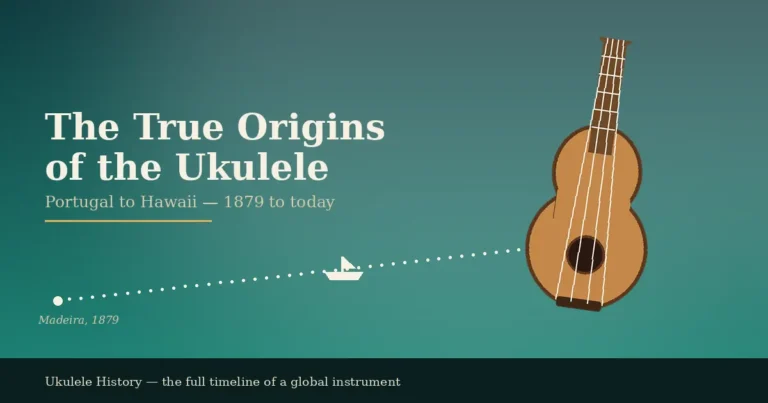
For the complete story of where the ukulele came from before any of this happened, the Ukulele History archive covers the full timeline from the Madeiran craftsmen who arrived in Honolulu Harbor in 1879 to the instrument you’ll find on virtually every continent today.
Made for curious minds—our deep-dive content series never runs shallow.