History of Soprano Ukulele: The Size That Started It All
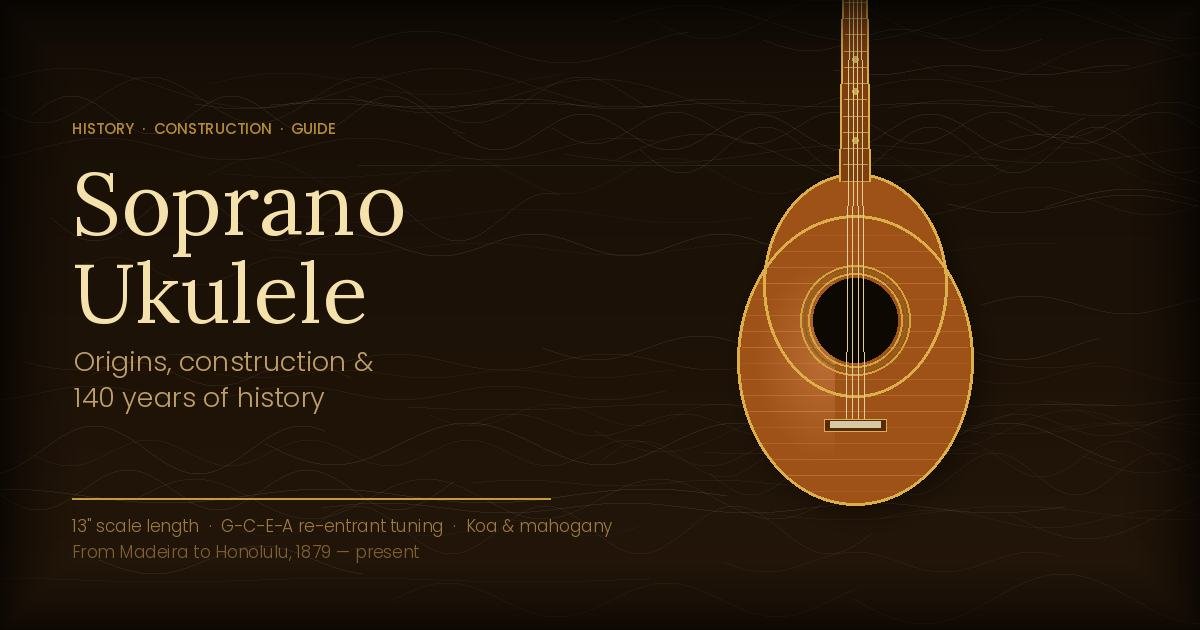
The soprano ukulele is the original. Every other size — concert, tenor, baritone — came later, built to answer a demand the soprano had already created. This small instrument, with a scale length of roughly 13 inches (33 cm) and four gut or nylon strings tuned to G-C-E-A, arrived in Hawaiʻi in 1879 aboard a Portuguese immigrant ship. Within three decades, it had become the defining sound of Hawaiian music. Within four, it was selling in Sears catalogs.
Most histories credit the soprano’s popularity to the 1915 Panama-Pacific Exposition in San Francisco. That’s true, but it skips the harder question: why did this particular shape — small enough to fit under an arm, cheap enough for working families — take hold the way it did, when the islands already had guitars? The answer is more specific than most sources admit, and it starts on the island of Madeira.
Key takeaways:
- The soprano ukulele is the original ukulele size, developed in Hawaiʻi by Portuguese immigrant craftsmen from Madeiran instruments in the 1880s
- Its standard scale length is approximately 13 inches (33 cm), with four strings tuned G-C-E-A (re-entrant tuning, with the G string higher than the C)
- King Kalākaua’s royal patronage in the 1880s established the soprano as a prestige instrument, not just a folk one
- The 1915 Panama-Pacific Exposition brought the soprano ukulele to mainland American audiences and triggered a manufacturing boom
- Martin, Kamaka, and Lyon & Healy were among the first makers to standardize soprano dimensions, shaping the instrument’s modern form
- The soprano’s compact body produces a brighter, more percussive tone than larger ukulele sizes — a quality that defined the “ukulele sound” for most of the 20th century
What is the soprano ukulele?
The soprano is the smallest standard ukulele size. It typically measures 21 inches (53 cm) in total length, with a body about 11 inches (28 cm) long and a scale length — the vibrating string distance from nut to saddle — of 13 to 13.5 inches (33–34 cm). Most sopranos have 12 to 15 frets, with the 12th fret falling at the body joint.
Its standard tuning is G-C-E-A with a re-entrant G string. That means the G sits above the C in pitch, rather than below it, giving the soprano a characteristic “ringy” top end when strummed open. This tuning descends from the Madeiran rajão, a five-string instrument that Portuguese immigrants brought to Hawaiʻi, though the rajão’s exact influence on soprano tuning is still debated among instrument historians.
The soprano’s body is typically made from koa wood in traditional Hawaiian instruments, or from mahogany, spruce, or laminate in contemporary production models. Koa produces a warmer, more complex tone with natural sustain; mahogany leans brighter and drier. The soprano’s small internal volume naturally amplifies higher frequencies, which is why even a mahogany soprano tends to sound brighter than a mahogany tenor of the same construction.
How the soprano ukulele developed: from Madeira to Hawaiʻi
The soprano ukulele didn’t arrive fully formed. It evolved over roughly two decades from a cluster of Portuguese string instruments into something genuinely new.
The Madeiran roots
The instruments Portuguese immigrants brought to Hawaiʻi in the late 19th century included the machete de braga (also called the braguinha), a small four-string guitar from Braga and Madeira with a scale length similar to the modern soprano, and the rajão, a five-string instrument in re-entrant tuning. Neither was the ukulele. But craftsmen trained in Madeiran instrument-making traditions adapted these forms to local Hawaiian materials — primarily koa — and the result was something distinct enough to earn a new name.
The Ravenscrag arrival
On August 23, 1879, the British merchant ship Ravenscrag docked in Honolulu Harbor after a four-month voyage from Madeira via the Cape of Good Hope. Among the 419 immigrants aboard were three men who would become the founding figures of Hawaiian ukulele making: Manuel Nunes, Augusto Dias, and José do Espírito Santo. All three had trained as instrument makers on Madeira. All three eventually opened workshops in Honolulu. The debate over which of them “invented” the ukulele is largely beside the point — what they created together, through parallel workshops and shared craft knowledge, was an instrument culture. By the 1890s, Honolulu had a small but active trade in locally made small-bodied string instruments.
Royal patronage and the instrument’s name
King Kalākaua, who reigned from 1874 to 1891, was a serious musician and an active supporter of Hawaiian cultural arts. He incorporated the ukulele into royal performances and reportedly played the instrument himself. His patronage mattered. It moved the soprano from immigrant folk music into the formal culture of the Hawaiian court, which gave it social legitimacy that a purely working-class instrument might never have achieved. Queen Liliʻuokalani, who succeeded him in 1891 and was herself a gifted composer, continued this association.
The word “ukulele” — often translated from Hawaiian as “jumping flea,” a reference to the quick finger movements of players — appears in Hawaiian-language newspapers by the 1890s, though the exact date of first print use remains uncertain.
Early standardization
By the early 1900s, the soprano form had stabilized into something recognizable as the modern instrument. Makers had settled on four strings, the G-C-E-A tuning, and a body shape closer to the figure-eight guitar outline than to the rounder machete. The 21-inch overall length wasn’t yet a firm industry standard, but instruments in the 20–22-inch range dominated production.
The golden age: mainland America discovers the soprano
The soprano ukulele’s transformation from a Hawaiian regional instrument into a global phenomenon happened in a specific, traceable sequence of events between 1915 and the early 1930s.
The 1915 Panama-Pacific Exposition
The Panama-Pacific International Exposition ran in San Francisco from February to December 1915. The Hawaiian Pavilion featured daily ukulele performances — players demonstrating the instrument for mainland visitors who, for the most part, had never seen one. The Pavilion drew enormous crowds. Instrument manufacturers, particularly on the mainland, tracked the response closely. Within months of the Exposition closing, companies including C.F. Martin & Co. had begun producing their own soprano ukuleles for the American market. Martin’s soprano models, which used mahogany and spruce rather than Hawaiian koa, brought production quality and brand recognition to an instrument that had previously been made mostly by small independent workshops.
The Tin Pan Alley era
Through the late 1910s and 1920s, Tin Pan Alley’s music publishers actively promoted the soprano ukulele as an accessible home instrument. Song sheets sold with basic chord diagrams. Vaudeville performers carried sopranos on stage. The instrument’s affordability — a decent soprano cost less than most guitars — and its quick learning curve made it the guitar’s democratic alternative during a decade when amateur home music-making was at its cultural peak.
Roy Smeck, one of the most technically gifted performers of the era, played soprano ukulele in short films and on the vaudeville circuit. His speed and precision directly shaped how audiences understood what the instrument was capable of.
The first ukulele boom and its collapse
Ukulele sales peaked in the late 1920s. Then two things happened: the Great Depression collapsed disposable income, and the guitar — amplified, increasingly associated with swing and jazz — pulled young players away from the parlor instrument their parents had played. Soprano ukulele production dropped sharply through the 1930s. Some manufacturers exited the market entirely.
What remained was a smaller, more committed audience of players, and the Hawaiian music tradition that had always been the instrument’s cultural center.
The soprano through the mid-20th century
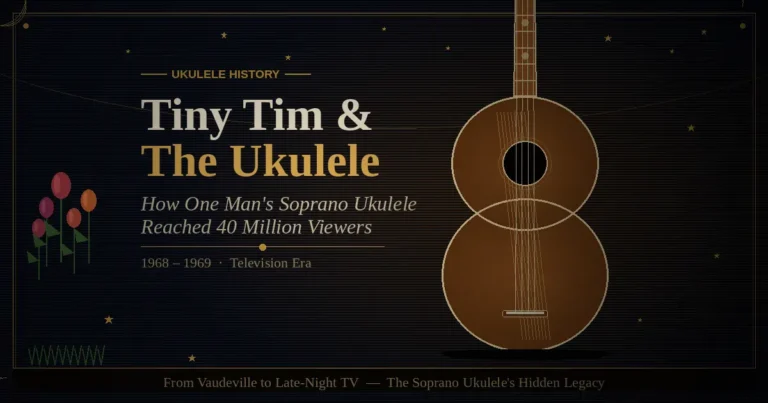
Arthur Godfrey’s television appearances in the 1950s gave the soprano ukulele a brief second wind in American popular culture. Godfrey was a genuine player, not just a prop act, and his casual, good-humored performances introduced the instrument to a television generation. Tiny Tim’s falsetto rendition of “Tiptoe Through the Tulips” with a soprano ukulele on The Tonight Show in 1968 was culturally significant in a different way — campy and deliberately retro, it fixed the soprano in many viewers’ minds as an eccentric novelty rather than a serious instrument.
That perception would take decades to shake.
Soprano ukulele construction: what makes the size
The original data: soprano ukulele specifications
| Specification | Standard soprano |
|---|---|
| Total length | ~21 in / 53 cm |
| Body length | ~11 in / 28 cm |
| Scale length | 13–13.5 in / 33–34 cm |
| String spacing at nut | ~35 mm |
| Frets to body | 12 |
| Typical fret count | 12–15 |
| Standard tuning | G4-C4-E4-A4 (re-entrant) |
| Common tonewoods | Koa, mahogany, spruce (top), cedar |
| String type | Nylon or fluorocarbon |
Koa versus mahogany in soprano construction
Koa has been associated with the Hawaiian soprano since the 1880s for practical as well as tonal reasons. It grows natively in Hawaiʻi, which made it the logical choice for early Honolulu workshops. It’s also exceptionally resonant for its weight: koa’s grain structure produces warmth in the low-mids and clarity in the high frequencies simultaneously, which suits the soprano’s small body well. Aged koa becomes more transparent-sounding over time, which is partly why vintage koa sopranos carry a premium among collectors.
Mahogany became the standard for mainland production in the 20th century because it’s stable, widely available, and consistent across cuts. It produces a drier, brighter tone than koa — less complex, but clean and cutting. For a soprano, where the fundamental tone is already bright due to the short scale, mahogany works well in affordable production instruments.
Historian’s note:
The soprano’s re-entrant tuning is one of its most distinctive and least-understood features. Most string instruments are tuned in ascending pitch order from the lowest string to the highest. The soprano’s standard G-C-E-A tuning breaks this: the G string (closest to the player’s chin) is tuned higher than the adjacent C string. This creates the “chiming” quality that defines soprano tone when strumming open chords. The rajão, the Madeiran instrument most likely to have influenced early ukulele design, also used re-entrant tuning — a link that connects the modern soprano to its 19th-century Portuguese ancestors more directly than any physical feature.
The four eras of soprano ukulele history
No single framework captures the soprano’s development completely, but its history divides cleanly into four phases distinguished by who was making it, who was playing it, and what they were playing it for.
| Era | Approximate dates | Defining characteristic | Key makers / players |
|---|---|---|---|
| I. Hawaiian formation | 1879–1914 | Immigrant craft tradition meets koa; royal patronage establishes cultural status | Nunes, Dias, Espírito Santo; Kalākaua |
| II. American boom | 1915–1929 | Mainland manufacturing, Tin Pan Alley promotion, mass-market sales | Martin, Lyon & Healy, Roy Smeck |
| III. Long recession | 1930–1985 | Decline after Depression; guitar dominance; soprano as novelty | Arthur Godfrey, Tiny Tim |
| IV. Contemporary revival | 1986–present | Global interest; Japanese market drives quality; Jake Shimabukuro changes perception | Kamaka, Kanile’a, Ko’olau; Shimabukuro |
The historical vignette: Manuel Nunes’s workshop, 1890
By 1890, Manuel Nunes had established a workshop on Fort Street in Honolulu, where he made string instruments for sale to both the Hawaiian and growing haole (non-native) communities. A notice in the Hawaiian Gazette from this period advertised his instruments as “ukuleles” — one of the early documented commercial uses of the name. Nunes was making instruments that had already diverged from the Madeiran machete in meaningful ways: the body shape was broader, the bracing adapted to koa’s properties, and the tuning reflected Hawaiian playing practice rather than Madeiran tradition. He wasn’t recreating what he’d known on Madeira. He was making something new from the pieces he’d brought with him.
What most histories get wrong about the soprano ukulele
Misconception 1: The soprano descended from the guitar
The soprano ukulele is not a small guitar. Its closest physical ancestor is the machete de braga, a Portuguese instrument from the Minho region and Madeira, which was itself descended from earlier Iberian lutes and the cavaquinho tradition. The guitar and the soprano share a common remote ancestry but diverged long before either arrived in Hawaiʻi. Their tuning systems are entirely different — the guitar uses a linear E-A-D-G-B-E tuning in ascending order; the soprano’s G-C-E-A uses re-entrant tuning with no bass register. Playing techniques, body proportions, and bracing traditions also differ. When 19th-century Hawaiian players picked up the soprano, they weren’t adapting guitar technique — they were adapting machete and rajão technique to a new instrument.
Misconception 2: The ukulele’s American popularity began with the 1960s folk revival
The ukulele’s first and largest American popularity wave was in the 1910s and 1920s, not the 1960s. The Panama-Pacific Exposition of 1915 triggered mainland sales that lasted more than a decade. By the time the folk revival was introducing American audiences to the banjo, autoharp, and mountain dulcimer, the ukulele had already had its golden age and decline. The 1960s folk movement didn’t rediscover the soprano — if anything, the era’s emphasis on guitar overshadowed it further. The genuine contemporary revival came later, driven partly by the Japanese ukulele market in the 1980s and 1990s and then by online video and performers like Jake Shimabukuro in the 2000s.
FAQs
What is the difference between a soprano and a concert ukulele? The concert ukulele is larger: typically 23 inches total length versus 21 for the soprano, with a scale length of 15 inches versus 13. The concert has more frets, slightly more string spacing, and a fuller, warmer tone. Both use the same G-C-E-A tuning, so chord shapes and songs transfer directly between them.
Why is the soprano ukulele so small? The soprano’s size reflects its origins in Madeiran instruments like the machete de braga, which were themselves compact by design — easy to carry, affordable to build, and suited to rhythmic chord-strumming rather than single-note melodic playing. The Hawaiian makers who developed the ukulele in the 1880s stayed close to that proportional template because it worked musically.
What wood is best for a soprano ukulele? Koa is the traditional choice and produces a tone well suited to the soprano’s short scale — warm in the mids with clear high frequencies. Mahogany is the most common alternative and works well for beginners and budget builds. Spruce tops can add brightness and projection. For a first instrument, solid mahogany is more reliable than laminate at the same price point.
When did the soprano ukulele get its name? The term “soprano” as a size designation came into common use after larger ukulele sizes — concert, tenor, and baritone — were developed in the 1920s and 1930s. Before that, there was simply “the ukulele.” Once manufacturers began producing multiple sizes, the original needed a name to distinguish it.
Is the soprano ukulele good for beginners? Yes, though with a caveat. Its smaller size and lighter string tension make it physically easy to handle, particularly for younger players. The drawback is fret spacing: fingers that are large relative to the fretboard can find it difficult to fret cleanly on the 12th fret and above. Players with large hands often find the concert size more comfortable while still getting a comparable ukulele experience.
Did King Kalākaua actually play the ukulele? Multiple contemporary Hawaiian-language accounts and later historical records suggest Kalākaua was genuinely musical and associated with the ukulele’s early development in the Hawaiian court. The precise nature of his playing — how seriously, how frequently — is less documented than the broader fact of his patronage. What is clear from the historical record is that his court gave the instrument cultural legitimacy that shaped how it was perceived across Hawaiian society.
Conclusion
The soprano ukulele is 140-plus years old, and it still sounds like itself. That’s not a small thing. Instruments come and go; the soprano survived a Depression, a guitar boom, decades of novelty-act association, and its own cultural saturation — and came out the other side with a committed global following and a manufacturing tradition that spans Honolulu, Japan, and beyond.
It started on a dock in Honolulu in 1879. Three Madeiran craftsmen, a Hawaiian king who understood cultural currency, and an instrument small enough to carry anywhere did the rest. If you want the full story of where the ukulele came from and how it spread, the soprano is where every thread begins.
Ukulele History covers the complete arc of the instrument’s development, from its Portuguese origins to its contemporary makers. If the soprano’s history brought up questions — about the concert’s rise, the baritone’s origins, or the craftsmen who shaped the form — the archive has them.
Your smartest read of the day is hiding inside our expert article collection.