Evolution of Ukulele: How 4 Strings Shaped Music
The evolution of the ukulele is one of music history’s quieter revolutions. Four strings, a body small enough to tuck under your arm, and a tuning borrowed from a Portuguese instrument most people have never heard of — and yet this instrument has redirected mainstream pop culture not once but three times. Most histories rush through the Portuguese roots and land straight in Waikiki. This one doesn’t. Because the instrument’s real story lies in the gaps between those familiar landmarks: the exact moment a ship docked and changed everything, the world’s fair that nobody went to for the ukulele but everyone left talking about it, and a 3 a.m. recording session in Honolulu that sat unreleased for five years before reshaping how the world hears the instrument.
Key takeaways:
- The ukulele descends directly from the machete de braga, a four-string Madeiran folk instrument — not from the guitar, and not from any Hawaiian instrument
- Three Madeiran woodworkers — Manuel Nunes, José do Espírito Santo, and Augusto Dias — are credited with developing the modern ukulele after arriving in Honolulu on the SS Ravenscrag in August 1879
- The instrument’s characteristic GCEA tuning derives from the top four strings of the Portuguese rajão, not the machete itself
- King Kalākaua’s royal patronage in the 1880s and 1890s turned the ukulele from an immigrant novelty into a Hawaiian cultural symbol
- The 1915 Panama-Pacific International Exposition in San Francisco — not a music event but a world’s fair — launched the ukulele into American mainstream consciousness
- Israel Kamakawiwoʻole’s medley recorded in a single take at 3 a.m. in 1988, then released in 1993, remains the most influential ukulele recording since the Exposition
- The instrument comes in four standard sizes: soprano, concert, tenor, and baritone — each with distinct tonal properties
What is the ukulele and where does it actually come from?
The ukulele is a small, four-string chordophone tuned G–C–E–A (standard soprano, concert, and tenor) or D–G–B–E (baritone), descended from Portuguese folk instruments introduced to the Hawaiian Islands in the late 19th century. It belongs to the lute family, uses nylon or fluorocarbon strings, and typically has 16 to 22 frets depending on size. The body is usually figured-eight shaped — similar to a small acoustic guitar — though oval “pineapple” shapes exist and produce a noticeably warmer, more rounded tone.
What the instrument is not is equally important. It’s not a miniature guitar, and it’s not Hawaiian in origin. Its Portuguese ancestors predate the modern guitar’s mass popularization, and its tuning descends from a completely different instrument family. Understanding both of those points is the foundation of understanding the ukulele’s evolution.
The Portuguese instruments that made the ukulele possible
Two instruments from Madeira, a Portuguese island in the Atlantic, are the ukulele’s direct parents. The machete de braga — also called the braguinha or cavaquinho — was a small, four-string instrument tuned in the DGBD range, played at folk dances and festive gatherings throughout Madeira. Compact, loud for its size, and built from whatever tonewood was available, it was the instrument poor workers carried on long journeys.
The rajão was its slightly larger cousin: a five-string instrument whose top four strings, tuned G–C–E–A, would become the ukulele’s standard tuning. This is the part most histories glide past. The ukulele’s sound — that high, bright, unmistakably cheerful ring — comes from the rajão’s string register, not from any Hawaiian precedent. The machete gave the ukulele its body size and four-string format. The rajão gave it its voice.
How did the ukulele arrive in Hawaii?
The ukulele arrived in Hawaiʻi as a direct consequence of sugar economics. In the 1870s, Madeira was suffering severe agricultural hardship, and the Kingdom of Hawaii needed plantation labor. The resulting immigration brought culture as much as it brought workers.
The Ravenscrag, August 1879: the moment that started everything
On August 23, 1879, the British sailing ship SS Ravenscrag docked in Honolulu Harbor after a four-month, roughly 15,000-mile voyage from Madeira via the Cape of Good Hope. Among the 423 passengers were three Madeiran woodworkers who would reshape Hawaiian music: Manuel Nunes, José do Espírito Santo, and Augusto Dias. All three were skilled cabinet makers and instrument builders.
Within two weeks of disembarkation, the Hawaiian Gazette reported that “Madeira Islanders recently arrived here, have been delighting the people with nightly street concerts.” One passenger, João Fernandes, is said to have begun playing his machete on the dock before the ship had fully unloaded — an act of joy at completing the crossing that proved immediately captivating to Honolulu’s residents.
Nunes, do Espírito Santo, and Dias soon opened workshops and began adapting their machete-making craft to local conditions. They worked with Hawaiian koa wood rather than the European tonewoods they knew from Madeira. Koa, an endemic Hawaiian acacia with an unusually interlocked grain pattern, produces a tone warmer and more complex than mahogany — with a midrange sustain that suited the open-air playing conditions of the islands. The instrument they produced was smaller than the machete, tuned in the higher G–C–E–A register borrowed from the rajão, and built to project clearly over the sounds of outdoor gatherings. It wasn’t the machete. It wasn’t the rajão. It was something new.
King Kalākaua and the ukulele’s rise to cultural status
The instrument might have remained a working-class immigrant novelty were it not for royal patronage. King David Kalākaua, who ruled the Kingdom of Hawaii from 1874 to 1891, was an active musician and a passionate defender of Hawaiian arts at a moment when missionary influence was actively suppressing indigenous cultural practices. He heard the new four-string instrument and immediately incorporated it into royal gatherings at ʻIolani Palace.
Kalākaua played the ukulele himself and required it at official functions. His sister, Queen Liliʻuokalani — who would later compose “Aloha ʻOe,” Hawaii’s most recognized song — was equally devoted to the instrument. Royal endorsement was the mechanism that moved the ukulele from the immigrant labor camps into Hawaiian cultural life more broadly. By the 1890s, Hawaiian-born craftsmen were building their own versions, and the word “ukulele” — translating roughly to “jumping flea,” a reference to the rapid finger movement of skilled players — had entered the Hawaiian press.
Historian’s note: The exact etymology of “ukulele” remains genuinely contested. One tradition attributes the name to Edward William Purvis, a small, quick-moving British officer in Kalākaua’s court who was nicknamed “ukulele” for his fidgety demeanor and nimble playing. Another links it to Queen Liliʻuokalani’s description of a player’s fingers dancing across the strings. A third reading translates it as “the gift that came here.” Most credible sources date the word’s first appearance in Hawaiian-language print to the 1890s. What’s not debated is that the instrument had fully absorbed a Hawaiian identity by then — the name, the koa wood construction, and the tuning were all established.
The four eras of ukulele evolution
Mapping the instrument’s 145-year history against cultural forces reveals four distinct eras, each driven by a specific catalytic event rather than a gradual drift.
Era I — The Hawaiian Formation (1879–1914): roots and royal endorsement
From the Ravenscrag’s arrival through the first decade of the twentieth century, the ukulele was almost entirely a Hawaiian phenomenon. Manuel Nunes, the most commercially active of the three original makers, trained apprentices including Samuel Kaialiilii Kamaka Sr., who would go on to found the Kamaka Ukulele and Guitar Works in 1916 — still operating today as Hawaii’s oldest ukulele manufacturer. The instrument’s design stabilized during this period: four nylon strings, a soprano-scale body of approximately 13 inches (33 cm), and the GCEA tuning that remains standard.
Politically, this era coincided with Hawaii’s annexation by the United States in 1898. Playing a koa-wood ukulele became, for many Hawaiians, an act of cultural resistance — an assertion of indigenous identity under pressure. The instrument carried weight beyond its size.
Era II — The American Craze (1915–1940): world’s fair to vaudeville
The single event that most histories underweight is not a concert, not a hit record, and not a celebrity endorsement. It’s a world’s fair. The 1915 Panama-Pacific International Exposition in San Francisco — organized to celebrate the completion of the Panama Canal and San Francisco’s recovery from the 1906 earthquake — drew nearly 19 million visitors over nine months. The Territory of Hawaii appropriated significant funding to build a pavilion showcasing its products and culture.
The Hawaiian Pavilion featured George E. K. Awai and his Royal Hawaiian Quartet performing daily shows that drew up to 34,000 visitors in a single day, according to period estimates, making it one of the most popular attractions at the entire fair. Ukulele maker Jonah Kumalae, who produced as many as 300 instruments a month at his peak, won a gold award at the Exposition and used it to break into mainland distribution. Within a year, Tin Pan Alley produced more Hawaiian-themed songs than ever before. Victor Recording Company’s 1916 catalog listed 146 Hawaiian records — outselling every other category the label offered.
Martin Guitars entered the ukulele market, manufacturing in significant volume through the 1920s. Cliff “Ukulele Ike” Edwards performed to national radio audiences. Roy Smeck, billed as “The Wizard of the Strings,” recorded extensively. The instrument crossed the Atlantic, where English music-hall comedian George Formby built an entire career on it. By 1926, C.F. Martin & Co. was building more ukuleles per year than in any previous year of the company’s history.
The Depression and the rise of electric guitar culture ended this era. By the mid-1930s, sales had collapsed and mass-market interest had moved on.
Era III — The Mid-Century Pause and Revival (1940–1992): decline, education, and roots
This is the era most histories skip. The ukulele didn’t die between 1940 and the early 1990s — it retreated into specialist communities and educational programs. Tiny Tim’s 1968 television performance of “Tiptoe Through the Tulips” on The Tonight Show Starring Johnny Carson briefly re-introduced the instrument to mainstream audiences, though primarily as a novelty.
More durable was the Canadian classroom movement. In the 1960s, educator J. Chalmers Doane introduced the ukulele as a primary music-education tool in Nova Scotia schools, eventually reaching an estimated 50,000 students and adults. Doane’s argument — that the ukulele’s four strings, low string tension, and immediate chord accessibility made it uniquely effective for teaching musical literacy — anticipated by decades the reasoning behind contemporary ukulele education programs worldwide. His “Ukulele in the Classroom” program, revised with James Hill in 2008, remains a Canadian school music staple.
In Hawaii itself, the instrument never lost its cultural centrality. The Kamaka factory continued handcrafting koa ukuleles through lean decades. The Ukulele Festival Hawaii, which grew from informal Saturday gatherings at the Kamaka store in 1971, kept a community alive. And in 1979 — exactly one hundred years after the Ravenscrag docked — a young Hawaiian singer named Israel Kaʻanoʻi Kamakawiwoʻole performed his first public ukulele set at a graduation party with his older brother.
Era IV — The Global Renaissance (1993–present): from a 3 a.m. studio to the internet
The fourth era begins not with the internet but with a specific hour: 3 a.m. on a night in 1988, when Israel Kamakawiwoʻole called a Honolulu recording studio and asked if he could come in. Engineer Milan Bertosa, who was closing up for the night, agreed and gave him fifteen minutes. Kamakawiwoʻole arrived with his ukulele, took a large steel chair that building security found for him, and recorded a medley of “Somewhere Over the Rainbow” and “What a Wonderful World” in a single, unedited take. Bertosa later recalled rolling tape, watching Kamakawiwoʻole play, and knowing immediately the recording was something unusual.
The tape sat unreleased until Bertosa remembered it while working with producer Jon de Mello on Kamakawiwoʻole’s 1993 solo album Facing Future. Added at the last moment, the medley became the most-heard Hawaiian recording in history. It has been used in dozens of film and television soundtracks — including Meet Joe Black, 50 First Dates, and Scrubs — and spent 375 weeks at the top of Billboard’s World Digital Songs chart, the longest-running number one on any Billboard song chart. In 2020 it was selected for preservation in the United States National Recording Registry by the Library of Congress as “culturally, historically, or aesthetically significant.”
Kamakawiwoʻole’s medley did more for global ukulele awareness than any single event since the 1915 Exposition — precisely because it demonstrated emotional range that the instrument’s “cheerful beach toy” reputation had never suggested. A four-string soprano in the hands of a Hawaiian sovereignty activist produced something that moved audiences to tears across languages and cultures. That reframing was the catalyst the fourth era needed.
Jake Shimabukuro extended it. Born in Honolulu in 1976, he received his first ukulele lesson from his mother at age four. In April 2006, a video of Shimabukuro performing George Harrison’s “While My Guitar Gently Weeps” on a custom Kamaka tenor — filmed at Central Park for a New York television program — was posted to YouTube without his knowledge and became one of the platform’s earliest viral videos, accumulating millions of views within weeks. The performance demonstrated technical vocabulary — hammer-ons, tapped harmonics, chord melody at speed — that many viewers had simply not associated with the instrument. His collaborations over the following years with Yo-Yo Ma, Jimmy Buffett, Bette Midler, and Ziggy Marley, along with a 2012 PBS documentary on his career, built a new international audience for serious ukulele performance.
The internet-era ukulele is genuinely global. School music programs across Japan, Australia, Germany, and the United Kingdom have adopted it at scale. Luthiers from Lisbon to Seoul build instruments. Online communities teach millions of self-directed learners. The four-string format that arrived in Honolulu Harbor in 1879 now spans genres from classical to metal.
The instrument’s construction and tonal evolution
How size determines sound: the four standard types
The ukulele’s four standard sizes aren’t just different scales — they represent genuinely different sonic identities. Understanding how each developed helps explain why the instrument spread so broadly.
| Size | Scale length | Total length | Standard tuning | Tonal character |
|---|---|---|---|---|
| Soprano | 13 in / 33 cm | 21 in / 53 cm | G–C–E–A (high G) | Bright, percussive, classic “uke” sound |
| Concert | 15 in / 38 cm | 23 in / 58 cm | G–C–E–A | Warmer, more sustain, easier fretting |
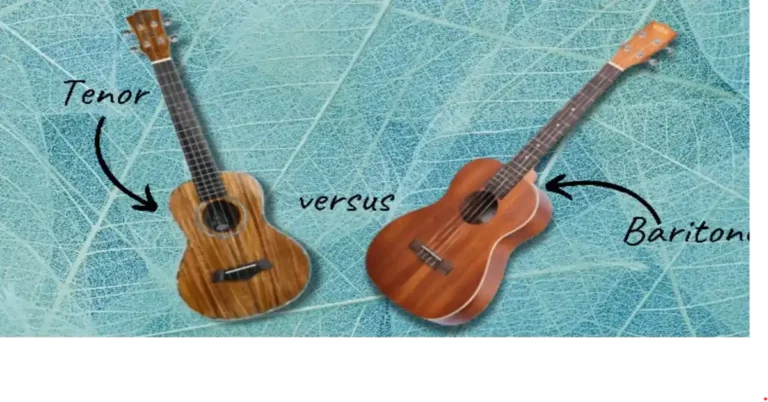
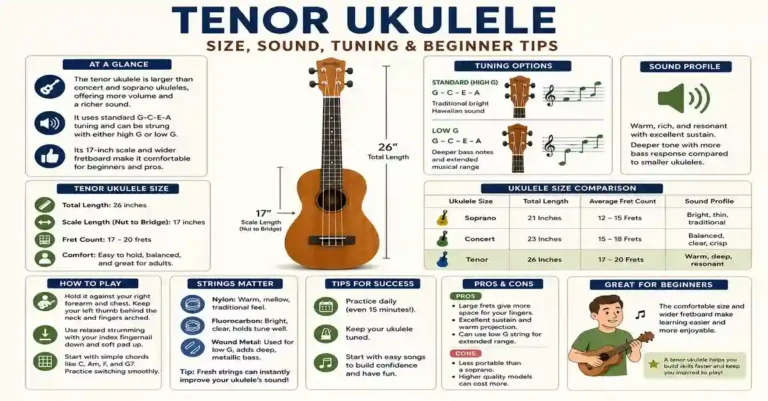
| Tenor | 17 in / 43 cm | 26 in / 66 cm | G–C–E–A or low G | Richer low end, suited to fingerpicking |
| Baritone | 19 in / 48 cm | 29 in / 74 cm | D–G–B–E | Guitar-like warmth, least “ukulele” tone |
The soprano is the original format — closest in scale to the machete de braga and to the instruments Nunes, do Espírito Santo, and Dias first built in the 1880s. The concert size emerged in the 1920s as players and manufacturers sought a slightly larger body that maintained the GCEA tuning while improving projection in larger venues. The tenor followed, offering greater volume and sustain without retuning. The baritone arrived last, essentially positioning the ukulele at the upper end of the guitar family’s acoustic range — same tuning as a guitar’s top four strings.
The twentieth century also saw the development of the six-string and eight-string tenor ukuleles (often called “taropatch” configurations, with doubled strings on each course), and the pineapple soprano, patented by Samuel Kamaka Sr. in 1928. The pineapple’s oval body produces a fuller, more sustained tone than the figure-eight soprano at the same scale length, because the larger internal air volume amplifies the lower partials of each string’s vibration.
Wood, materials, and tone
Hawaiian koa is the tonal benchmark against which other ukulele tonewoods are measured. Chemically, koa is an acacia species (Acacia koa) found only in the Hawaiian Islands. Its interlocked grain — which creates the characteristic “curly” or “figured” appearance — generates a tone that is warm in the midrange, clear in the upper register, and notably complex in sustain. New koa instruments often sound somewhat closed or bright; most players describe a break-in period of several months during which the wood opens up and the tone deepens.
Mahogany produces a drier, more focused sound with less midrange complexity than koa. Spruce tops — common on higher-end models from mainland manufacturers like C.F. Martin — tend toward a brighter, more articulate response. Modern materials including carbon fiber and ABS polymer have produced instruments that perform well in temperature-variable environments, and the ukulele’s shift toward these materials in the twenty-first century has expanded its reach into climates where wood instruments require constant humidity management.
String evolution: from gut to fluorocarbon
The earliest ukuleles used strings made of catgut — the same material used on early violins and classical guitars. By the mid-twentieth century, nylon replaced catgut as the standard. Contemporary instruments use nylon polymers, synthetic gut, fluorocarbon, or wound strings (a nylon or metal core wrapped with aluminum, silver-plated copper, or other metals). Fluorocarbon strings, developed for fishing line and adopted by ukulele players in the 1990s, are denser than nylon and produce a brighter, more focused tone with faster attack and longer sustain — qualities that suit the tenor size in particular.
What most people get wrong about the ukulele
Misconception 1: “The ukulele is a Hawaiian instrument”
It isn’t — at least not in the sense that it originated there. The instrument’s body design, construction techniques, and four-string format all derive directly from Portuguese folk instruments that existed decades before the first ukulele was built in Honolulu. What Hawaii contributed was the synthesis: a new tuning register (borrowed from the rajão), a new tonewood (koa), a new cultural context, and a new name. The result is genuinely distinct from either Portuguese ancestor — but its origins are Madeiran, not Hawaiian.
This distinction matters historically because it explains why the country of Portugal — where the ukulele’s ancestors are still played as the cavaquinho and braguinha — has almost no contemporary ukulele community, despite being where the lineage began.
Misconception 2: “The ukulele is just a beginner’s instrument, or a novelty”
This perception dates to the mid-twentieth century, when mass-produced plastic ukuleles flooded the market and the instrument’s association with Tiny Tim’s falsetto novelty act dominated its public image. It ignores three things: the technical demands of serious ukulele performance (Shimabukuro’s arrangements require the same finger independence as advanced guitar technique); the instrument’s classical repertoire (composers including Roy Smeck produced serious concert works for ukulele in the 1920s and 1930s); and the fact that the instrument has produced number-one recordings across multiple Billboard chart categories.
The ukulele is as deep as any player cares to make it. Its accessibility is a design feature, not a ceiling.
FAQs
Why does the ukulele have 4 strings? The four-string format came directly from the machete de braga, the Portuguese folk instrument that Madeiran immigrants brought to Hawaii in 1879. The machete was itself a four-string instrument derived from earlier Iberian traditions. Four strings provide enough harmonic range for melody and chord accompaniment while keeping the instrument compact and physically accessible — a balance that has proven durable across 145 years.
What is the correct ukulele tuning? Standard tuning for soprano, concert, and tenor ukuleles is G–C–E–A, called GCEA or “re-entrant” tuning because the G string is tuned higher than the C string rather than lower as on a guitar. This tuning derives from the top four strings of the Portuguese rajão. Baritone ukuleles are tuned D–G–B–E, identical to the top four strings of a standard guitar. Players also use “low G” tuning on tenors, replacing the high G with a lower-octave G string for a fuller, more guitar-like bottom end.
Who invented the ukulele? No single person invented the ukulele. Manuel Nunes, José do Espírito Santo, and Augusto Dias — three Madeiran cabinet makers who arrived in Honolulu in August 1879 — are credited as the first ukulele builders. They adapted the Portuguese machete to Hawaiian conditions and materials over the following decade. Of the three, Nunes remained the most commercially active and later trained Samuel Kamaka Sr., the founder of Kamaka Hawaii.
What wood is a ukulele made from? Traditional Hawaiian ukuleles are made from koa, an endemic Hawaiian acacia that produces a warm, complex tone that deepens as the instrument ages. Modern ukuleles use a wide range of tonewoods including mahogany, spruce, maple, cedar, and walnut, as well as synthetic materials like carbon fiber and ABS polymer. Koa instruments from makers like Kamaka Hawaii represent the premium tier of the market; quality entry-level instruments are typically built from laminate mahogany or spruce.
What is the difference between a soprano and tenor ukulele? The soprano has a scale length of roughly 13 inches (33 cm) and produces the bright, percussive tone most people associate with the ukulele. The tenor has a scale length of roughly 17 inches (43 cm), a larger body with greater internal air volume, and a noticeably warmer, more sustained tone with stronger low-end response. The tenor also has more fret spacing, making complex chord shapes easier to finger. Both use standard GCEA tuning; the tenor is often played with a low G string for additional bass range.
Why did the ukulele become popular again in the 21st century? Three factors converged. Israel Kamakawiwoʻole’s recording of “Somewhere Over the Rainbow” — released in 1993 and placed in dozens of film and television productions through the 2000s — introduced the instrument’s emotional range to a global audience. Jake Shimabukuro’s 2006 YouTube video demonstrated its technical depth to a new generation. And the rise of online video platforms gave self-taught players an unprecedented supply of free instruction, removing the barrier of finding a local teacher. The result was a wave of adoption that began in the mid-2000s and has not substantially receded.
Conclusion
Four strings from a Portuguese folk instrument, carried across the Pacific by sugar-trade immigrants, adapted with koa and a borrowed tuning, endorsed by a king, launched by a world’s fair, revived by a 3 a.m. recording session, and spread to every continent by the internet. The evolution of the ukulele is the story of how a small object can accumulate meaning across cultures and generations without losing the simplicity that made it accessible in the first place.
The Ravenscrag docked. Three woodworkers opened workshops. And 145 years later, the four-string instrument they built is played in classrooms from Nova Scotia to Seoul, in concert halls from Carnegie to the Sydney Opera House, and in bedrooms by millions of people who started with a cheap soprano and found something they didn’t expect.
For deeper research into the instrument’s construction history, maker biographies, and the musical traditions that shaped each era, Ukulele History maintains an ongoing archive of primary-source documentation and editorial analysis.
Your next smart move begins with reading our strategy-driven featured content.