Ukulele Name Meaning: The Jumping Flea Legend Explained
The ukulele name meaning has puzzled players and historians for over a century. In Hawaiian, ʻukulele (ʻuku = flea, lele = jumping) translates roughly as “jumping flea” — a vivid description of a skilled player’s fingers darting across the frets. But the full story involves a fidgety British officer at King Kalākaua’s royal court, a Portuguese musician who leapt off a ship in Honolulu Harbor, and Hawaiʻi’s last monarch offering a completely different translation entirely. Most histories pick one explanation and stop there. This page lays all three out, tests each against the evidence, and explains why two of them might both be true at the same time.
Key takeaways:
- ʻUkulele comes from Hawaiian ʻuku (flea) and lele (jumping), most likely describing the rapid motion of a player’s fingers
- The most widely cited origin story links the name to Edward Purvis, a small, energetic British officer at King Kalākaua’s court in the 1880s
- A competing theory, attributed to Queen Liliʻuokalani, reads the word differently: uku (gift or reward) + lele (to come) = “the gift that came here”
- A third explanation — that the word ʻukulele existed in Hawaiian before the instrument arrived — is supported by an 1865 dictionary defining it simply as “a cat flea”
- The earliest known printed use of ʻukulele to mean a musical instrument appeared in a Hawaiian newspaper in 1888
- Modern scholars, including historians John King and Jim Tranquada, have argued that all three theories are plausible and that the Purvis story is probably the most widely credited, though it can’t be fully verified
What does ukulele mean in Hawaiian?
ʻUkulele is a compound Hawaiian word built from two roots: ʻuku, meaning flea or louse, and lele, meaning to jump, fly, or leap. Word-for-word, it translates as “jumping flea.” The Online Etymology Dictionary traces the word in English back to 1896, noting it was “noted earlier in English as the Hawaiian word for flea” and that “the instrument [was] so called from the rapid motion of the fingers in playing it.”
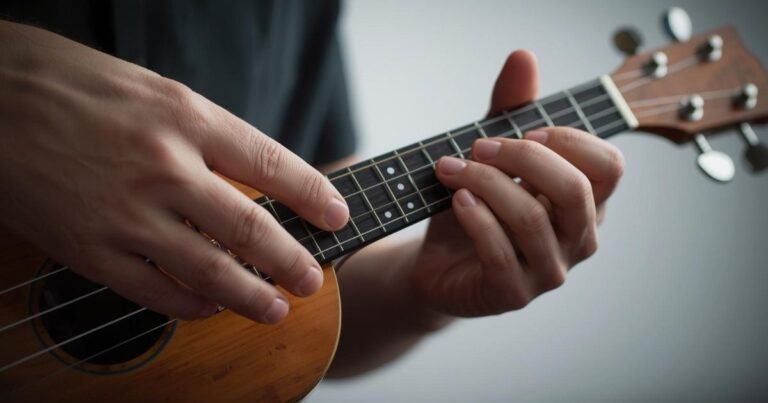
That last phrase is important. It was the playing style — not the instrument’s shape, sound, or origin — that gave it the name. Watch any fast strummer work across all four strings and you’ll see why Hawaiians reached for that particular image. The left hand skips and hops across the fretboard in quick, unpredictable bursts. It does look a little like something biting and jumping.
But this translation only holds if you write the word with an ʻokina (the small reversed apostrophe that marks a glottal stop): ʻukulele. Remove that mark and you get a phonetically identical word spelled ukulele — which, according to Queen Liliʻuokalani, carries a different meaning entirely. More on that below.
How do you actually pronounce ʻukulele?
Most English speakers say “yoo-kuh-LAY-lee.” The Hawaiian pronunciation is “oo-koo-LEH-leh” — no leading Y sound, shorter vowels, stress on the third syllable. Both are in common use, but the Hawaiian form is the historically accurate one, and most players find it’s a small thing worth getting right.
The three origin theories behind the name
No single explanation for why the instrument ended up with this particular name has won complete scholarly consensus. Three theories circulate, and they’re not mutually exclusive.
Theory one: the jumping fingers
The simplest explanation is also the most intuitive. When Portuguese immigrants began playing their small machete guitar on the streets of Honolulu in 1879, local Hawaiians noticed how fast the players’ fingers moved. The left hand in particular hops around the neck in patterns that, if you squint, resemble a flea on skin. Around 1900, the novelist Jack London wrote that ukulele was the Hawaiian word for “jumping flea as it is also a certain musical instrument that may be likened to a young guitar.” Six years later, the virtuoso uke teacher Ernest Kaai confirmed the image in his 1906 instruction book, writing that “the Hawaiians have a way of playing all over the strings — hence the name ukulele.”
This theory has the advantage of being self-contained. It requires no specific person and no single coining event. A community sees something, names it, and the name sticks. The word ʻukulele also predates the instrument’s arrival in Hawaiʻi: an 1865 Hawaiian dictionary defined it as “a cat flea,” a pest that had reached the islands decades before the Portuguese did. So the name was already available and already vivid. The instrument simply borrowed it.
Theory two: Edward Purvis and the jumping flea nickname
The most colorful explanation — and the one Merriam-Webster describes as “the most probable” — involves a specific man. Edward William Purvis was a British army officer born on July 4, 1857, who arrived in Honolulu around 1879 and rose to serve as Vice-Chamberlain at King Kalākaua’s court. He was, by multiple accounts, a small and unusually energetic man. He also became an expert player of the Portuguese machete.
According to a pamphlet held at the Bishop Museum in Honolulu, Purvis heard the instrument one day, asked to be taught, and quickly became one of its most visible champions at court. Because of his small build and lively manner while performing, the Hawaiians nicknamed him ʻukulele — jumping flea. He became so associated with the instrument that his nickname transferred to the thing he was always playing.
The Metropolitan Museum of Art has noted this account in its own catalogue descriptions. Merriam-Webster favors it. But modern scholarship has added a caveat. Historians John King and Jim Tranquada, who spent seven years researching The ʻUkulele: A History (University of Hawaiʻi Press, 2012), concluded that “it is unlikely that the nickname of a man who sought to undermine” the royal court would later be honored by becoming the name of its most emblematic instrument. Purvis eventually turned against King Kalākaua and published political satires mocking the court. He died in Colorado Springs on August 16, 1888, at just 31 years old — the same year a Hawaiian newspaper first used the word ʻukulele in print to describe a musical instrument.
So the Purvis theory is credible, popular, and supported by named sources. It’s also contested. That’s an honest place to leave it.
Theory three: the queen’s translation
Queen Liliʻuokalani, Hawaiʻi’s last monarch and the composer of “Aloha ʻOe,” offered a different reading. She reportedly disliked the flea etymology and proposed that the word should be parsed without the ʻokina: as ukulele rather than ʻukulele. In that case, uku means “gift or reward” and lele means “to come.” The name becomes “the gift that came here” — a reference to the Portuguese instrument arriving as a cultural offering from across the ocean.
Jim Beloff, a noted uke historian, has described her meaning as translating to “a gift that came from afar.” The queen’s reading emphasizes welcome and exchange rather than insects and quick fingers. It also acknowledges the Portuguese contribution without framing it as foreign imposition.
From a purely etymological standpoint, the distinction is real. Hawaiian is a language where the ʻokina is a distinct phoneme that changes meaning. These genuinely are two different words. Whether the queen was offering a formal linguistic correction or a more poetic reinterpretation is something historians have continued to debate.
When did the word first appear in print?
This is one of the cleaner facts in an otherwise murky story. According to Ukulele Magazine, a Hawaiian newspaper first used the word ʻukulele to describe the small four-string instrument in 1888 — roughly nine years after the SS Ravenscrag brought the Madeiran immigrants (and their machetes) to Honolulu Harbor. The earliest known catalogue description of the instrument using that word in English appears in the Metropolitan Museum of Art’s Catalogue of the Crosby Brown Collection of Musical Instruments of All Nations, published in 1907. By then, the name was settled.
The 1865 dictionary reference to ʻukulele as “a cat flea” confirms the word existed in Hawaiian before the instrument did. This makes the jump from flea to instrument a natural metaphor, not a coinage from nothing.
The naming problem: why this matters for etymology
The ʻokina changes everything
Hawaiian spelling is precise in ways that English orthography isn’t, and the ʻokina (ʻ) is not decorative. It marks a glottal stop — a distinct consonant — that changes a word’s meaning completely. ʻUkulele and ukulele, written without diacritics, look identical to most English readers. But for a Hawaiian speaker, they are different words.
This is why Queen Liliʻuokalani’s interpretation isn’t simply wrong. She was describing a real alternative word with a real alternative meaning. Whether the instrument was named after the first word or the second — whether the ʻokina belongs in the name or not — turns out to be precisely the question that historical sources can’t settle definitively.
Historian’s note: The honest answer, which most popular histories skip past, is that we don’t know which coinage came first or who coined it. What we know is that Hawaiians were using the word ʻukulele for the instrument by the late 1880s, that the jumping-flea image fit the playing style vividly, and that multiple explanations existed within living memory of the instrument’s creation. Etymology rarely gives us a single clean origin. This one is no different.
The “Three Namings” framework: how ʻukulele probably got its name
Competitor pages typically present one theory as definitive. But the documentary evidence supports a more nuanced reading — what can be called the Three Namings model.
The name ʻukulele most plausibly came together through three overlapping moments, not one:
| Naming moment | When | Evidence |
|---|---|---|
| Pre-existing word | Before 1865 | Hawaiian dictionary defines ʻukulele as “cat flea” — the word exists before the instrument |
| Colloquial transfer | 1879–1888 | Hawaiian observers apply the vivid flea image to the finger-hopping playing style of Portuguese musicians |
| Royal crystallization | Early 1880s | Edward Purvis’s nickname (and possibly the playing-flea image) circulates at King Kalākaua’s court, anchoring the name to the instrument in royal and social contexts |
What this model shows is that no single person, event, or moment explains the name on its own. The word was already there. The image it conjured was already apt. A memorable performer at the royal court gave the name a face and a story. All three pieces reinforced each other, and the name stuck.
This is how a lot of folk etymology actually works. The “real” origin is almost never a single invention; it’s a convergence of available words, apt images, and the right person in the right place.
What competitors get wrong: two misconceptions about the ukulele name
Misconception one: the ukulele was a Hawaiian invention named in Hawaiian
This version of the story circulates widely, and it’s only half right. The instrument itself descended from the Portuguese machete de braga, brought to Honolulu by Madeiran immigrants aboard the SS Ravenscrag, which arrived in Honolulu Harbor in late August 1879. Three cabinet makers on that ship — Manuel Nunes, Augusto Dias, and José do Espírito Santo — are generally credited as the first ukulele makers.
The name is Hawaiian. The instrument is a Portuguese adaptation built on Hawaiian soil, typically from native koa wood. Calling the ukulele a Hawaiian invention collapses this distinction and erases the Madeiran contribution.
Misconception two: “the gift that came here” is just a pretty story Queen Liliʻuokalani made up
This framing dismisses the queen’s etymology as charming but linguistically baseless. That’s not accurate. The Hawaiian words uku (gift or reward) and lele (to come) are real. The distinction between ʻukulele and ukulele — with and without the ʻokina — is a genuine phonemic difference in the Hawaiian language. The queen wasn’t making something up; she was proposing a different parse of the same string of letters based on a real linguistic distinction.
Whether her reading reflects the name’s actual origin is debatable. But the reading itself is linguistically valid, and dismissing it without engaging the ʻokina distinction misses the point.
FAQs
What does ukulele mean literally? In Hawaiian, ʻukulele breaks down as ʻuku (flea) + lele (jumping), which gives the literal meaning “jumping flea.” The name most likely describes how a skilled player’s fingers dart rapidly across the strings. Queen Liliʻuokalani also proposed the reading “the gift that came here,” from uku (gift) + lele (to come), though most etymologists favor the flea translation.
Why is it called a jumping flea? The jumping-flea image describes the movement of the left hand during fast playing — quick, unpredictable hops across the fretboard. Jack London confirmed this meaning in writing around 1900, and ukulele teacher Ernest Kaai connected it directly to playing style in 1906. The word ʻukulele was already in use in Hawaiian as “cat flea” before the instrument arrived, making the metaphorical transfer a natural fit.
Who named the ukulele? No single person named the ukulele. The most widely told story credits the name to the nickname of Edward William Purvis, a British officer at King Kalākaua’s court who was known as “jumping flea” due to his small, energetic manner. But historians John King and Jim Tranquada have questioned whether Purvis was a likely honoree given his later estrangement from the court. The name may have developed organically from the instrument’s playing style rather than from any one individual.
Is the correct spelling ukulele or ʻukulele? In Hawaiian, the correct spelling includes the ʻokina: ʻukulele. In American English, both ukulele and the less common ukelele appear, with ukulele being standard. The ʻokina matters in Hawaiian because it marks a glottal stop that changes the word’s meaning — without it, the word can be read as Queen Liliʻuokalani proposed, meaning “the gift that came here.”
How do you pronounce ukulele in Hawaiian? The Hawaiian pronunciation is “oo-koo-LEH-leh” — four syllables, all vowels short, stress on the third. The common English pronunciation “yoo-kuh-LAY-lee” is widely understood but diverges from the Hawaiian original. Neither is incorrect in everyday use, but the Hawaiian form is more historically accurate.
What did the ukulele word mean before the instrument existed? An 1865 Hawaiian dictionary defined ʻukulele as “a cat flea” — more than a decade before the instrument arrived in Hawaiʻi. The word already existed in Hawaiian to describe a flea, and the rapid-finger playing style of Portuguese musicians arriving in 1879 apparently reminded Hawaiians of exactly that image. The instrument borrowed the existing word; the word didn’t wait for the instrument.
Conclusion
The ukulele name meaning sits in that interesting space between history and legend where most folk etymology lives. The jumping-flea image is real, linguistically grounded, and supported by the playing style that Hawaiians actually observed. The Purvis story is credible and widely cited, though modern scholars have reasons to hold it lightly. Queen Liliʻuokalani’s reading — the gift that came here — is not a rival myth but a genuine linguistic alternative rooted in the ʻokina distinction.
What’s clearest is that by the late 1880s, Hawaiians had a name for the instrument that fit it perfectly: four strings, four syllables, and a sound as quick and bright as a flea mid-jump. The word stuck because it was exactly right.
For more on the instrument’s arrival in Hawaiʻi and the three Madeiran craftsmen who built the first ukuleles, the Ukulele History archive covers the full story of the Ravenscrag voyage and its aftermath.
Less noise, more value—our editor-approved content filters the best for you.