
Ukulele History: Complete Story From Portugal to Hawaii
Most people assume the ukulele is Hawaiian. That assumption is half right — and it’s half the reason so many accounts of this instrument’s origins contradict each other. The ukulele was born in Portugal, adopted by Hawaiian royalty, spread across America by the entertainment industry, nearly abandoned for four decades, and then rescued by musicians whose names most histories half-spell. This page traces that complete arc, with the real dates, the correct names, and the primary sources that shorthand accounts skip over.
Ukulele history runs more than 140 years across three continents. It starts in 1879, when Portuguese craftsmen carried a small four-string instrument from the Madeira Islands to Honolulu Harbor — and it continues today with a participation boom no music industry analyst saw coming.
The single event that turned the ukulele from a regional Hawaiian sound into a global instrument is one most histories mention in a sentence, if at all.
Key takeaways:
- The ukulele descends from the machete de braga, a small four-string instrument native to the Madeira Islands of Portugal
- Three Madeiran craftsmen — Manuel Nunes, Augusto Dias, and Jose do Espirito Santo — arrived in Honolulu in August 1879 and are credited with establishing the instrument in Hawaii
- King Kalākaua, Hawaii’s last reigning king, played the ukulele and promoted it as a deliberate symbol of Hawaiian cultural identity
- The 1915 Panama-Pacific International Exposition in San Francisco introduced the instrument to millions of mainland Americans
- Standard soprano, concert, and tenor ukuleles use G-C-E-A tuning, with a distinctive re-entrant high G string
- Israel Kamakawiwoʻole’s early-1990s recordings triggered a worldwide revival that continues to shape the instrument’s global presence
What is the ukulele?
The ukulele is a small, four-string fretted instrument in the lute family, developed from Portuguese immigrant culture in 19th-century Hawaii. It typically uses nylon strings and is tuned G-C-E-A, with the G string pitched higher than the adjacent C — a feature called re-entrant tuning that gives the instrument its distinctive, bright sound. Four standard sizes exist: soprano, concert, tenor, and baritone, each producing a different tonal character and suited to different playing styles.
How the ukulele differs from the guitar
The ukulele isn’t a miniature guitar. Its four strings, re-entrant tuning, and Portuguese lineage separate it entirely from the guitar’s six-string, linear-pitch tradition. A guitar’s strings descend in pitch from the lowest to the highest; a soprano ukulele’s G string sits above middle C, inverting that logic and producing the characteristic “ping” that defines the instrument’s voice. The Portuguese ancestors of the ukulele — the machete de braga and the rajão — developed along a completely different organological path from the guitar, predating the guitar’s mass popularization by decades.
Portuguese roots: the machete, rajão, and cavaquinho
The ukulele’s direct ancestors are three small Portuguese string instruments from the Madeira Islands and mainland Portugal. Understanding all three is the only way to understand why the ukulele sounds and plays the way it does — and why it isn’t simply a Hawaiian invention.
The machete de braga
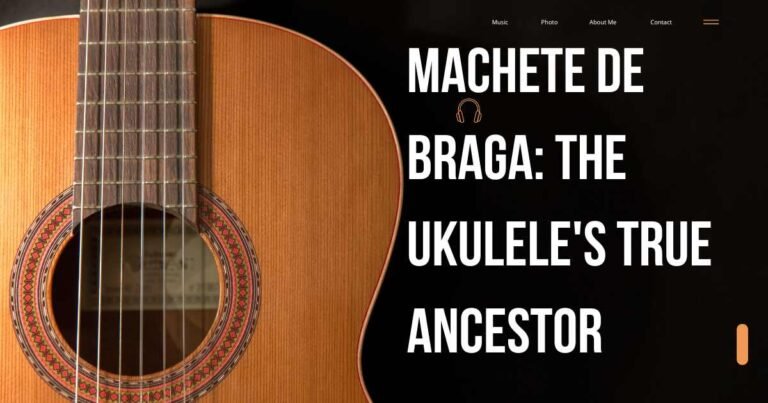
The machete de braga — also called the braguinha or simply machete — is the ukulele’s closest ancestor. Developed in the Braga region of northern Portugal and refined in Madeira, it’s a small four-string instrument tuned in a similar range to the modern soprano ukulele. Madeiran emigrants carried the machete with them across the Atlantic during the large labor migrations of the 19th century: to Brazil, to the Caribbean, and eventually to Hawaii. Its compact body, four gut strings, and bright tone translate almost directly into what Hawaiian craftsmen later called the ukulele.
The rajão
Less discussed but arguably more influential on the ukulele’s tuning is the rajão, a five-string Portuguese instrument. Its top strings sit in a higher register than the lower middle strings, and music historians trace this re-entrant tuning logic directly to the ukulele’s own high G string. Without the rajão’s structural influence, the ukulele might have developed a conventional linear tuning. It would sound fundamentally different from the instrument recognized today.
The cavaquinho
The cavaquinho, still played across Brazil and Cape Verde, shares the small-body, four-string form of the ukulele and the machete. It belongs to the same broad family of small Portuguese plucked instruments. Hawaiian craftsmen likely drew on all three traditions when adapting the form for local materials — in particular, the native koa wood that would become synonymous with premium Hawaiian ukulele-making.
The Ravenscrag voyage and the arrival in Hawaii
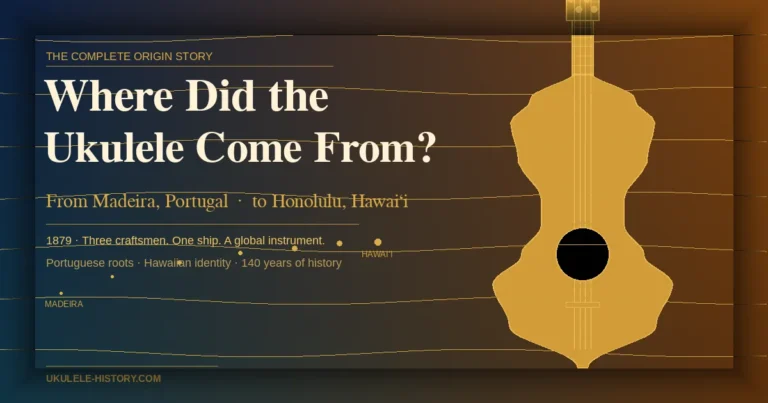
On August 23, 1879, a British merchant vessel named the Ravenscrag docked in Honolulu Harbor after a voyage of several months from Madeira. Among its passengers were Manuel Nunes, Augusto Dias, and Jose do Espirito Santo — craftsmen who had packed their woodworking tools alongside their belongings. This single crossing, documented in Hawaiian historical records held by the Hawaii State Archives, is the starting point of ukulele history in its modern form. Within a decade, Nunes had established a workshop in Honolulu and was building instruments that Hawaiians were adapting, naming, and absorbing into their own musical culture.
Why this voyage changed Hawaiian music
The Portuguese immigrants of the late 19th century weren’t the first skilled musicians to arrive in Hawaii. But they were the first to bring the machete in significant numbers — and, critically, with craftsmen capable of building and repairing it. Hawaiian-language newspapers from the 1880s and 1890s, held in the Hawaii State Archives, contain early references to the new instrument and document its rapid adoption into Hawaiian musical life. By the time King Kalākaua’s court had embraced it, the machete had become something else entirely.
Where the name “ukulele” comes from
The etymology of “ukulele” is genuinely contested, and any source presenting a single definitive answer is overstating what the evidence supports. The most widely cited explanation is Hawaiian: ukū (flea) combined with lele (jumping), thought to describe the rapid finger movement of a skilled player. A competing theory links the name to Edward Purvis, a British officer stationed in Hawaii who earned the nickname for his small stature and energetic playing style. A third reading translates it as “the gift that came here.” Hawaiian-language newspaper records from the 1890s confirm the word was in use by that decade. The precise origin remains an open question among researchers.
How King Kalākaua made the ukulele Hawaiian
King Kalākaua (1836–1891) is the most important single figure in the ukulele’s Hawaiian identity. As Hawaii’s last reigning king before the monarchy’s overthrow in 1893, Kalākaua made the promotion of Hawaiian arts, music, and language a deliberate political act — a counter to the growing influence of American commercial interests on the islands. He played the ukulele himself, composed songs, and featured the instrument prominently in formal court performances.
Historian’s note: Kalākaua’s patronage wasn’t passive admiration. He actively commissioned Hawaiian music, reinstated hula performances that had been suppressed under missionary influence, and used the ukulele as a cultural signal — a small instrument carrying significant political meaning. His reign is often called the First Hawaiian Renaissance, and the ukulele was one of its instruments, literally and symbolically.
Queen Liliʻuokalani (1838–1917), who succeeded Kalākaua and was Hawaii’s final monarch, was also an accomplished musician. She composed “Aloha ʻOe,” Hawaii’s most recognized song, and played multiple instruments including the ukulele. Her musical legacy reinforced the instrument’s association with Hawaiian identity at exactly the moment that identity faced its greatest external pressure.
The 1915 Panama-Pacific Exposition and the mainland spread
The ukulele might have stayed a regional Hawaiian instrument without a world’s fair held in San Francisco in 1915. The Panama-Pacific International Exposition drew an estimated 18.8 million visitors over nine months, and the Hawaiian pavilion — featuring live performances with ukulele, steel guitar, and traditional chant — introduced the instrument to a vast mainland American audience over a single extended public moment.
The timing worked in the ukulele’s favor. American popular music was searching for new sounds, and Tin Pan Alley — the New York-based songwriting and publishing industry — could transform a regional style into a national presence within months. Sheet music publishers rushed ukulele method books and song collections to press. Instrument manufacturers, including Martin Guitar Company, began producing ukuleles for a mass market. By the early 1920s, the ukulele had become one of the most popular instruments in American homes.
The five eras of ukulele evolution
Five distinct eras define the ukulele’s global arc. Each was driven by different forces — migration, royal patronage, commercial publishing, cultural shift, and digital media — and each left a different mark on the instrument’s identity and reach.
Era 1 — Portuguese origins (pre-1879): The machete de braga and rajão develop in Madeira and mainland Portugal. Madeiran emigrants begin carrying these instruments across Atlantic trade routes during the 19th-century labor migration era.
Era 2 — Hawaiian adoption (1879–1914): The Ravenscrag delivers Nunes, Dias, and do Espirito Santo to Honolulu. Hawaiian craftsmen adapt the machete using koa wood and local tuning preferences. King Kalākaua’s court embraces the instrument as a cultural symbol. Sam Kamaka Sr. founds Kamaka Hawaii in Honolulu in 1916, establishing one of the oldest continuously operating ukulele companies in history.
Era 3 — American explosion (1915–1945): The Panama-Pacific Exposition triggers mainland adoption. Tin Pan Alley and radio spread the ukulele nationally. Martin, Harmony, and other manufacturers produce affordable instruments for mass consumption. The ukulele becomes a symbol of accessible, amateur music-making across American households.
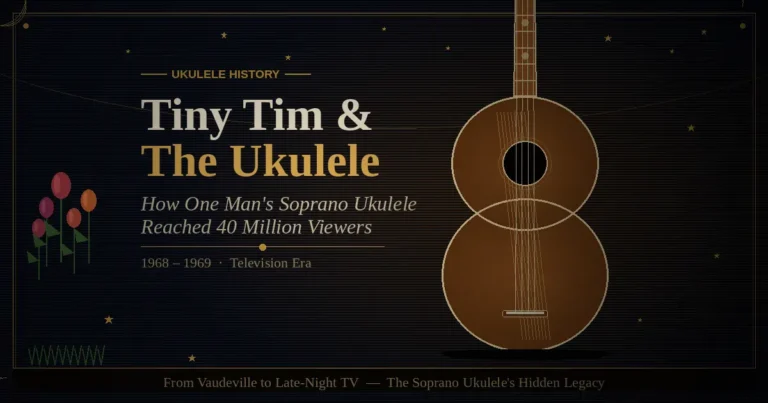
Era 4 — Decline and the Tiny Tim interlude (1946–1992): Post-war American music culture pivots toward electric guitars and eventually rock and roll. The ukulele’s mainstream popularity collapses over roughly a decade. Tiny Tim — the stage name of Herbert Butros Khaury — performs falsetto-voiced ukulele material to large television audiences in the late 1960s, deepening a novelty association that takes decades to shake. Small revival efforts continue in Hawaii, where the instrument never fully disappeared.
Era 5 — Global renaissance (1993–present): Israel Kamakawiwoʻole’s recordings reframe the ukulele as an instrument capable of genuine emotional weight. Jake Shimabukuro’s 2006 YouTube performance of “While My Guitar Gently Weeps” exposes the instrument’s technical range to an international audience. Online communities and affordable production combine to drive the largest sustained growth in ukulele participation in the instrument’s history.
Key dates in ukulele history
| Year | Event |
|---|---|
| Pre-1879 | Machete de braga and rajão develop in Madeira and mainland Portugal |
| August 23, 1879 | Ravenscrag docks in Honolulu; Nunes, Dias, and do Espirito Santo arrive |
| 1880s–1890s | Hawaiian-language press documents the ukulele; royal patronage established |
| 1915 | Panama-Pacific International Exposition held in San Francisco |
| 1916 | Sam Kamaka Sr. founds Kamaka Hawaii in Honolulu |
| 1920s–1930s | Tin Pan Alley and radio drive mass-market ukulele production on the mainland |
| Late 1960s | Tiny Tim performs ukulele-accompanied material on major television programs |
| 1993 | Israel Kamakawiwoʻole releases Facing Future; global revival begins |
| 2006 | Jake Shimabukuro’s “While My Guitar Gently Weeps” video spreads globally on YouTube |
| 2010s–present | Global ukulele community expands through social platforms and online instruction |
The cultural and musical character of the Hawaiian ukulele
The ukulele’s absorption into Hawaiian culture wasn’t passive. Hawaiian craftsmen actively reshaped the instrument — its proportions, its materials, and its role in musical life — to fit local traditions and aesthetics in ways that set it apart from anything built in Portugal.
Koa wood and the Hawaiian sound
Koa, a hardwood native to the Hawaiian Islands, became the defining material of premium Hawaiian ukulele-making. Experienced players and luthiers consistently describe koa’s tone as warmer and more complex than mahogany, with a sustain that opens further as the wood ages and vibrates. Koa instruments from established Hawaiian makers carry a tonal quality that imported tonewoods can approximate but don’t fully match. It’s one reason Hawaiian-made koa ukuleles remain sought by collectors and serious players, often commanding prices well above their utilitarian function.
Ukulele sizes and their characteristics
| Size | Scale length | Body length | Standard tuning | Character |
|---|---|---|---|---|
| Soprano | ~13 in / 33 cm | ~21 in / 53 cm | G-C-E-A | Bright, classic uke tone |
| Concert | ~15 in / 38 cm | ~23 in / 58 cm | G-C-E-A | Warmer, slightly fuller |
| Tenor | ~17 in / 43 cm | ~26 in / 66 cm | G-C-E-A | Richer, greater projection |
| Baritone | ~19 in / 48 cm | ~29 in / 74 cm | D-G-B-E | Closest to guitar tone |
The soprano remains the most historically significant size — the form Manuel Nunes and his Honolulu contemporaries built first, and the sound most listeners associate with traditional Hawaiian music.
Historian’s note: The baritone ukulele uses the same tuning as the top four strings of a standard guitar, which makes it a natural entry point for guitarists. But many players and instrument scholars argue it’s a different instrument in everything but name — removing the re-entrant G that defines the ukulele’s distinct voice and separates it from the guitar family.
Israel Kamakawiwoʻole and the global revival
No figure did more to restore the ukulele’s credibility as a serious instrument than Israel Kamakawiwoʻole (1959–1997). Known to Hawaiian music audiences as IZ, he recorded a medley of “Somewhere Over the Rainbow” and “What a Wonderful World” — solo ukulele and voice — that appeared on his 1993 album Facing Future. That recording went on to feature in films, television series, and global advertising campaigns across multiple decades, reaching audiences far beyond conventional music industry channels.
The effect on the ukulele’s perception was direct and lasting. Kamakawiwoʻole’s playing showed that the instrument could carry real emotional weight — that it wasn’t a comedic prop, but a vehicle for music that genuinely moves people. His recordings did more for global ukulele awareness than any single event since the 1915 Exposition, because they traveled through media those Exposition visitors never had access to: film soundtracks, streaming platforms, and international broadcast.
Jake Shimabukuro extended this shift into the digital era. A Honolulu-born player, he uploaded a solo performance of “While My Guitar Gently Weeps” to YouTube in 2006. The video spread through a platform with no equivalent in any prior era of ukulele history — and it introduced the instrument’s technical possibilities to a global audience with no prior frame of reference for what a ukulele could do.
What most people get wrong about ukulele history
Misconception 1: the ukulele is just a small guitar
This is the most persistent misunderstanding, and it’s wrong on multiple levels. The ukulele doesn’t descend from the guitar — it descends from the Portuguese machete and rajão, which developed along a separate organological path entirely. Its re-entrant G-C-E-A tuning has no equivalent in standard guitar tuning. Its four-string chord vocabulary, fingering logic, and music theory approach differ substantially from guitar. A guitarist picking up a ukulele for the first time isn’t playing a smaller version of a familiar instrument. They’re learning something that shares physical similarities but operates differently in almost every practical respect.
Misconception 2: the ukulele was always a light or novelty instrument
It wasn’t. At the Hawaiian royal court under Kalākaua, the ukulele was performed in formal settings alongside traditional chant and hula — not as entertainment, but as cultural expression. Early Hawaiian recordings from the acoustic era of the 1920s and 1930s reveal players of considerable technical range. The novelty framing arrived later, partly through American popular culture’s tendency to treat instruments outside the European classical tradition as inherently less serious, and partly through Tiny Tim’s late-1960s television appearances, which imprinted a campy association that took decades to shake. That association was always a cultural artifact. It was never a musical truth.
FAQs
Where did the ukulele originally come from? The ukulele originated in Portugal, specifically from the Madeira Islands. Portuguese immigrants brought the machete de braga to Hawaii in 1879, where local craftsmen adapted it using native koa wood and Hawaiian musical traditions. It was refined into its modern form in Honolulu over the following decades.
Who invented the ukulele? No single person invented the ukulele. Three Madeiran craftsmen — Manuel Nunes, Augusto Dias, and Jose do Espirito Santo — are credited with introducing the machete to Hawaii and adapting it into what became the ukulele. Nunes in particular established a dedicated workshop in Honolulu and continued building instruments for decades; he’s widely cited as the most influential of the three early makers.
What does the word “ukulele” mean? The most commonly cited translation is “jumping flea” in Hawaiian — ukū (flea) and lele (jumping) — thought to describe the rapid finger movement of a skilled player. Competing theories link the name to a British officer’s nickname or translate it as “the gift that came here.” Hawaiian records from the 1890s confirm the word was in use, but its precise origin isn’t fully settled.
Why is the ukulele associated with Hawaii if it came from Portugal? Because Hawaiian culture transformed the instrument. Hawaiian craftsmen rebuilt it using koa wood, shaped its tuning and proportions to suit local music, and royal patrons like King Kalākaua made it a symbol of Hawaiian identity. The Portuguese machete was the source material; the ukulele was the Hawaiian result.
What is the standard tuning for a ukulele? Soprano, concert, and tenor ukuleles use G-C-E-A tuning, with the G string pitched higher than the C in re-entrant style. The baritone uses D-G-B-E tuning, matching the top four strings of a guitar. The re-entrant G string is one of the features most responsible for the ukulele’s distinctive bright sound.
What role did the 1915 Panama-Pacific Exposition play in ukulele history? The Exposition in San Francisco was where the ukulele crossed from Hawaii to the American mainstream in a single concentrated moment. The Hawaiian pavilion featured live ukulele and steel guitar performances that reached millions of visitors. The commercial response that followed — method books, sheet music, mass-produced instruments from companies including Martin — created the ukulele’s first major wave of mainland American popularity.
Conclusion
Ukulele history isn’t the clean, linear story some accounts suggest. It runs from the craft workshops of Madeira, through the royal courts of Honolulu, across a San Francisco world’s fair, through decades of Tin Pan Alley popularity, into a long commercial decline, and back out through the work of musicians whose recordings outlasted every industry cycle around them.
The instrument’s persistence makes sense when you look at it plainly. It’s small enough to carry anywhere, accessible enough for beginners, and musically deep enough to reward players who go far. The Madeiran craftsmen who stepped off the Ravenscrag in 1879 didn’t know what they were starting. Neither did King Kalākaua, exactly, when he picked one up at court.
For deeper coverage of specific eras, key figures, and instrument construction, Ukulele History maintains the full archive — from the Madeiran machete to the modern luthier’s workshop.
Expert voices, real insights—our author-picked featured posts deliver both.