Where Did the Ukulele Come From? From Madeira to Hawaii
Most people think of the ukulele as a Hawaiian instrument. That’s not wrong — but it’s only half the story. The real answer reaches back to a small Portuguese archipelago in the Atlantic Ocean, a single immigrant ship, and three craftsmen who carried their tools across 15,000 miles of open ocean.
The ukulele came from Portugal. Its direct ancestors were small four-stringed folk instruments played in Madeira, a volcanic island group off northwest Africa. When Portuguese workers emigrated to Hawaiʻi in the late nineteenth century, they brought those instruments with them. Hawaiian musicians — and then Hawaiian royalty — adopted and rebuilt them. What emerged was something genuinely new.
And the single event that turned the ukulele from a Hawaiian curiosity into a global instrument is one most history pages skip entirely.
Key takeaways:
- The ukulele’s direct ancestor is the machete de braga, a four-stringed Portuguese folk instrument from the Minho region of mainland Portugal.
- Three Madeiran craftsmen — Manuel Nunes, Augusto Dias, and José do Espírito Santo — arrived in Honolulu on August 23, 1879, and built the first Hawaiian ukuleles.
- King Kalākaua publicly championed the instrument, giving it royal cultural status at a moment when Hawaiian identity was under pressure.
- The name “ukulele” is Hawaiian; the most widely accepted translation is “jumping flea,” though Queen Liliʻuokalani offered a different reading in her own memoirs.
- The 1915 Panama-Pacific International Exposition in San Francisco introduced the ukulele to mainland America on a massive scale.
- The instrument has passed through four distinct global eras, each reshaping who played it and what it meant.
What instrument did the ukulele come from?
The ukulele descended from Portuguese folk instruments — most directly the machete de braga, a small four-stringed instrument from northern Portugal, and the rajão, a five-stringed Madeiran guitar. The machete provided the body size and string count; the rajão contributed the re-entrant tuning that defines the ukulele’s bright, ringing sound. Together, these two instruments produced something neither could have become alone.
The machete de braga: the ukulele’s true ancestor
The machete de braga — also called the braguinha — is a compact, high-pitched instrument with four gut or nylon strings, played in northern Portugal for centuries before the first ukulele was ever built. Its body is roughly the size of a modern soprano ukulele. When Madeiran emigrants packed for Hawaiʻi, many brought their machetes. It wasn’t a luxury item. It was part of daily life, carried the way a person carries the music they grew up with.
Don’t confuse the machete de braga with the cavaquinho, though the two are closely related. The cavaquinho traveled to Brazil with Portuguese settlers and became central to choro music; it’s still played throughout Portugal and Brazil today. The braguinha is the instrument that maps most directly onto the Hawaiian ukulele in terms of body shape, string count, and playing technique.
The rajão’s tuning contribution
The rajão — a five-stringed Madeiran instrument historically tuned D G C E A — gave the ukulele something equally important: its unorthodox approach to pitch. On a rajão, the fourth string sits higher in pitch than the third. That inversion is called re-entrant tuning, and it’s the structural reason a ukulele sounds nothing like a small guitar.
Strip the rajão’s lowest string away and shift the remaining pitches slightly, and you arrive at G C E A — the standard ukulele tuning still used on soprano, concert, and tenor instruments. That high fourth string creates a bell-like, ringing quality that no guitar can replicate in the same register. It’s not a technical quirk. It’s the instrument’s whole voice.
How did the ukulele get to Hawaii?
Portuguese immigration brought the ukulele to Hawaiʻi. Between 1878 and 1913, roughly 17,000 Portuguese emigrants — most from Madeira and the Azores — arrived on the islands to work the expanding sugar plantations. They brought their language, their food, their Catholic faith, and their music. Among the instruments they carried were machetes and braguinhas. What happened next was neither planned nor predictable.
The Ravenscrag arrives: August 23, 1879
On August 23, 1879, a British immigrant ship called the Ravenscrag docked in Honolulu Harbor after roughly four months at sea from Madeira. Among the 423 passengers were three trained instrument makers: Manuel Nunes, Augusto Dias, and José do Espírito Santo. All three were luthiers by trade. All three would go on to establish instrument workshops in Honolulu within the following decade.
Contemporary Hawaiian newspaper accounts — including reports in the Pacific Commercial Advertiser — describe the Madeiran arrivals with genuine enthusiasm. At least one account notes that passengers were playing music and dancing on the docks, and that local Hawaiians watching were struck by the speed at which one musician’s fingers moved across the fretboard. Some historians trace the name “ukulele” — often translated as “jumping flea” — directly to that dockside performance.
Manuel Nunes is typically credited as the first of the three to establish a formal workshop. Records place his operation in active production in Honolulu by the early 1880s. He didn’t simply reproduce Portuguese instruments. He rebuilt them using local materials, which changed the instrument fundamentally.
Key dates in ukulele history:
- 1879 — The Ravenscrag arrives in Honolulu; Nunes, Dias, and Espírito Santo begin their work in Hawaiʻi.
- Early 1880s — First koa-wood ukuleles produced in Honolulu workshops.
- 1884–1891 — King Kalākaua publicly embraces the instrument; royal patronage establishes the ukulele as a symbol of Hawaiian culture.
- 1891 — Queen Liliʻuokalani succeeds Kalākaua; the ukulele remains central to court musical life.
- 1915 — The Panama-Pacific International Exposition introduces the ukulele to millions of mainland Americans.
- 1916–1920s — Martin Guitars begins producing ukuleles; Tin Pan Alley composers incorporate the instrument into popular song.
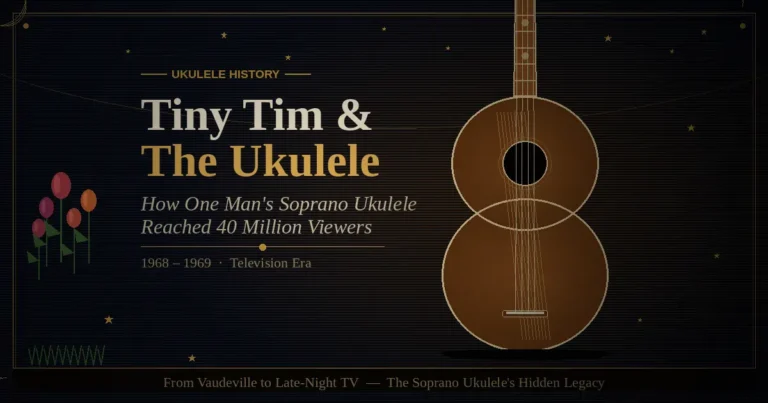
- 1968 — Tiny Tim performs on The Tonight Show, cementing a novelty association that would shadow the instrument for decades.
- 1993 — Israel Kamakawiwoʻole’s Facing Future is released; the “Somewhere Over the Rainbow” medley begins its slow spread into global consciousness.
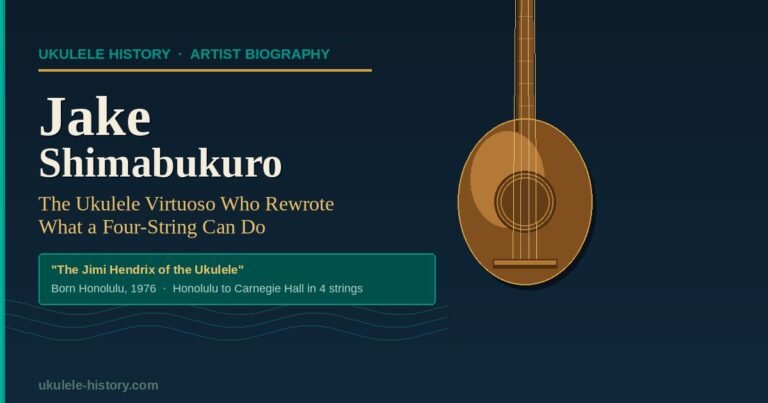
- 2000s onward — Jake Shimabukuro and internet video culture launch the modern ukulele revival.
Why koa wood changed the instrument
Koa — Acacia koa — grows exclusively in Hawaiʻi. When Manuel Nunes and his contemporaries began working with it, the ukulele stopped being a transplanted Portuguese instrument and became something Hawaiian in a meaningful material sense.
Koa is denser than mahogany, with a tighter grain structure that produces longer sustain and a more complex midrange resonance. A koa soprano ukulele doesn’t sound like a braguinha. The tone is warmer, fuller, with more depth in the overtones. You hear it immediately: the note rings and then lingers, where a European folk instrument of similar size would decay faster. That tonal shift made the Hawaiian ukulele identifiable to the ear as well as to the eye — and it’s why koa remains the prestige tone wood for the instrument to this day.
How did the ukulele become a Hawaiian cultural symbol?
Royal patronage transformed the ukulele from an immigrant folk instrument into a marker of Hawaiian identity. King Kalākaua — Hawaiʻi’s monarch from 1874 to 1891 — was himself a skilled musician and a deliberate advocate for Hawaiian cultural traditions at a time when American commercial and political interests were actively displacing them. His public embrace of the ukulele gave the instrument a prestige and a cultural meaning it couldn’t have earned through grassroots adoption alone.
King Kalākaua and the politics of music
Kalākaua understood music as cultural territory. His reign coincided with sustained American pressure on the Hawaiian Kingdom — economic, political, and eventually military — and he pushed back partly by reviving and championing Hawaiian artistic forms: hula, chant, and the instruments associated with them. When the king played a ukulele at a palace gathering, it stopped being a plantation worker’s pastime. It became something the whole kingdom could claim.
Queen Liliʻuokalani, who succeeded Kalākaua in 1891, extended that musical culture. She composed “Aloha ʻOe,” still Hawaiʻi’s most recognized song, and her court maintained the traditions Kalākaua had built. The ukulele was central to both reigns.
Historian’s note: The timing matters more than most accounts acknowledge. Kalākaua’s public embrace of the ukulele in the 1880s happened almost simultaneously with the political crisis that would eventually end Hawaiian sovereignty in 1893. The instrument became a marker of Hawaiian identity precisely because that identity was under threat. This is why the ukulele carries genuine cultural weight in Hawaiʻi — not as a tourist souvenir, but as something that was deliberately chosen and publicly defended during a period of real loss. Treating it as a novelty misses everything.
The four eras of ukulele evolution
The ukulele didn’t spread in a single wave. It moved through four distinct global eras, each driven by different forces and each leaving the instrument with a different cultural meaning. Understanding these eras is the clearest way to answer why the ukulele exists today in the form it does — and who plays it.
Era one: Hawaiian roots (1879–1914)
The first era belongs entirely to Hawaiʻi. Immigrant craftsmen built the instrument. Hawaiian musicians adopted it. Royal patronage raised its status. During this period, the ukulele was unknown outside the islands. It was played at home, at hula performances, and at court. The standard body was soprano-sized — roughly 53 centimeters (21 inches) long, with four strings in re-entrant GCEA. Koa dominated. Instruments came from small Honolulu workshops, most of them connected in some way to Nunes, Dias, or Espírito Santo.
Era two: the American discovery (1915–1940)
The 1915 Panama-Pacific International Exposition in San Francisco changed everything. The fair ran for ten months and drew nearly nineteen million visitors. Hawaiʻi had a dedicated pavilion, and ukulele performances ran continuously throughout the exposition’s run. Mainland Americans heard the instrument for the first time — live, loud, and impossible to ignore.
Sheet music publishers and instrument manufacturers responded within months. Martin Guitars was producing ukuleles by 1916. Tin Pan Alley composers were writing ukulele parts into their arrangements. By the mid-1920s, the ukulele was a mass-market American instrument, sold in department stores and taught by mail-order correspondence courses.
Era three: mid-century decline (1940–1992)
The Depression damaged instrument sales across the board, and the ukulele faded from mainstream prominence through the 1940s. It survived in Hawaiʻi, in folk settings, and in novelty performance. Tiny Tim’s 1968 appearance on The Tonight Show — performing “Tiptoe Through the Tulips” in falsetto — introduced the ukulele to a new generation as something eccentric rather than musical. He kept the instrument visible. But the novelty association was hard to shake, and it lingered for years.
Arthur Godfrey’s television appearances with a ukulele through the 1950s offered a slightly warmer image, but neither Godfrey nor Tiny Tim positioned the instrument as something for serious players. That gap would eventually close, but not for decades.
Era four: the global revival (1993–present)
Israel Kamakawiwoʻole recorded his medley of “Somewhere Over the Rainbow” and “What a Wonderful World” at a Honolulu studio in 1988. Released on his album Facing Future in 1993, the track spread slowly through film and television placements before the internet amplified it into something genuinely global. By the time streaming and YouTube took over music consumption, the recording had become one of the most recognized ukulele performances in history.
Jake Shimabukuro extended the revival into technical territory. His YouTube performances from the mid-2000s onward — playing everything from blues to Beethoven on a concert ukulele — demonstrated that the instrument was not limited by its size or its history of novelty association. Ukulele sales climbed steadily through the 2010s, making it the fastest-growing instrument category in several major markets.
Israel Kamakawiwoʻole’s medley did more for global ukulele awareness than any single event since the 1915 Exposition, because it reattached the instrument to genuine emotion at a moment when the culture was ready to hear it. The 1915 fair introduced people to a sound; Kamakawiwoʻole’s recording made them feel something.
Era comparison
| Era | Period | Key figures | Geographic reach | Cultural meaning |
|---|---|---|---|---|
| Hawaiian roots | 1879–1914 | Nunes, Dias, Espírito Santo, Kalākaua | Hawaiʻi only | Immigrant craft + royal symbol |
| American discovery | 1915–1940 | Martin Guitars, Tin Pan Alley composers | US mainland | Mass-market parlor instrument |
| Mid-century | 1940–1992 | Tiny Tim, Arthur Godfrey | US, UK | Novelty and comedy association |
| Global revival | 1993–present | Kamakawiwoʻole, Shimabukuro | Worldwide | Accessible folk + serious solo instrument |
Portuguese instruments that shaped the ukulele
Not every Portuguese stringed instrument contributed equally to what became the ukulele. Three instruments matter most — and each contributed something different.
| Instrument | Origin | Strings | Key contribution |
|---|---|---|---|
| Machete de braga (braguinha) | Minho, Portugal | 4 | Body size, string count, basic playing technique |
| Rajão | Madeira | 5 | Re-entrant tuning concept; the origin of GCEA |
| Cavaquinho | Portugal / Brazil | 4 | Shared ancestry, but evolved separately into Brazilian choro |
| Timple | Canary Islands | 5 | Parallel Iberian development; not a direct ancestor |
The machete de braga and the rajão are the instruments that matter for understanding the ukulele’s DNA. The cavaquinho is a close cousin that went its own way. And the timple — while often cited in casual histories because of its similar appearance — developed in parallel rather than as a precursor.
What does “ukulele” mean?
The word “ukulele” is Hawaiian, and the most widely accepted translation is “jumping flea.” It comes from the Hawaiian words uku (flea, or small) and lele (to jump or fly). The name almost certainly reflects something about how the instrument was played — specifically, the rapid, darting finger movements of early performers.
One origin story, referenced in late nineteenth-century Hawaiian newspaper accounts, attributes the name to a British officer named Edward Purvis, who played at the royal court with exceptional speed. Hawaiians watching him reportedly described his fingers as resembling a jumping flea.
But Queen Liliʻuokalani offered a different reading in her own memoirs. She translated “ukulele” as “the gift that came here,” from uku in the sense of reward or gift, and lele in the sense of arrival. Given that Liliʻuokalani was a native Hawaiian speaker, a trained musician, and a person who lived through the instrument’s early adoption at court, her interpretation carries serious weight.
Historian’s note: The exact date the word “ukulele” first appeared in print is not definitively established. Most credible sources place early written references in Hawaiian-language newspapers from the 1890s, with some evidence pointing to slightly earlier informal usage. Until primary source documentation from the Bishop Museum or the Hawaiʻi State Archives fixes a verified first appearance, both the “jumping flea” and “gift that came here” translations remain historically defensible. Choosing one over the other with false confidence serves no one.
What most histories get wrong about the ukulele
Two misconceptions follow the ukulele’s origin story through nearly every popular account. Both are persistent, and both get in the way of the actual history.
Misconception 1: the ukulele is a Hawaiian invention
This framing appears constantly in casual histories, travel writing, and souvenir packaging. The ukulele was not invented in Hawaiʻi. Its body shape, four-string configuration, and playing technique all derive from Portuguese folk instruments brought by Madeiran immigrants. The craftsmen who built the first Hawaiian ukuleles were trained luthiers from Madeira — not native Hawaiians.
What happened in Hawaiʻi was a genuine transformation, not an invention. Local craftsmen used koa instead of European tonewoods. Hawaiian musicians adapted the instrument to their own musical traditions. Royal patronage gave it cultural meaning specific to Hawaiʻi. That transformation is real and historically significant — and it justifies Hawaiʻi’s deep cultural claim on the instrument. But that claim is one of adoption and reinvention, not origination.
Misconception 2: the ukulele is just a small guitar
A guitar and a ukulele are different instruments. They’re related, the way a viola and a violin are related — similar family, distinct lineage and distinct sound. The guitar descends from Renaissance lute and vihuela traditions. The ukulele descends from the machete de braga, a Portuguese folk instrument from a completely different part of that same broad family tree.
More importantly: a guitar uses standard ascending tuning across all six strings. A ukulele in re-entrant G C E A tuning has its fourth string pitched higher than its third. The pitch doesn’t simply rise from string one to string four. That inversion creates a ringing, bell-like quality that no guitar can reproduce in the same register. It changes what chord shapes are possible, what voicings ring clearly, and what the instrument sounds like in a full arrangement. Playing guitar doesn’t automatically transfer to ukulele. The logic of the fretboard is different.
FAQs
Who invented the ukulele? No single person invented it. Three Madeiran craftsmen — Manuel Nunes, Augusto Dias, and José do Espírito Santo — are credited with building the first Hawaiian ukuleles after arriving in Honolulu on August 23, 1879. They adapted Portuguese machete de braga instruments using local Hawaiian koa wood. Nunes is most often cited as the leading figure; his Honolulu workshop was in active production by the early 1880s.
Is the ukulele from Hawaii or Portugal? Both, with precision. Its direct ancestors are Portuguese instruments, primarily the machete de braga, brought to Hawaiʻi by Madeiran immigrants in 1879. Hawaiian craftsmen, musicians, and royalty then transformed it into something distinct. The instrument’s roots are Portuguese; its cultural identity is Hawaiian. Both claims are accurate and neither cancels the other.
What is the ukulele related to? Its closest relatives are the machete de braga and the rajão, both from Portugal and Madeira. The cavaquinho is a near cousin that evolved separately toward Brazilian folk music. The guitar is a more distant relative from a different branch of European string instrument history — they share a broad family but not a direct lineage.
Why did the ukulele become popular in America? The 1915 Panama-Pacific International Exposition in San Francisco brought the ukulele to a mainland American audience for the first time. Hawaiian performers played continuously through the fair’s ten-month run; nearly nineteen million people attended. Publishers and manufacturers responded within months. By the mid-1920s, the ukulele was a mainstream American instrument taught by correspondence courses and sold in department stores.
What does “ukulele” mean in Hawaiian? The most accepted translation is “jumping flea,” from uku (flea) and lele (to jump). Queen Liliʻuokalani offered an alternative in her memoirs: “the gift that came here,” using uku in the sense of gift or reward. Both interpretations have genuine historical support. The definitive first written use of the word has not yet been established from primary sources.
What wood is a traditional Hawaiian ukulele made from? Koa — Acacia koa, a hardwood native to Hawaiʻi — was used in the earliest Hawaiian ukuleles and remains the prestige choice today. Its dense grain produces warm, sustained tone with strong midrange resonance. As production expanded beyond Hawaiʻi, makers introduced mahogany, spruce, cedar, and eventually laminate materials. None of them produce quite the same sound as solid koa.
Conclusion
The ukulele came from Portugal — carried across the Pacific by Madeiran craftsmen, rebuilt with Hawaiian timber, lifted into cultural symbol by a king who understood music as resistance, and then launched into global consciousness by an exposition, a recording made at 3 a.m., and millions of people who discovered that a four-stringed instrument with re-entrant tuning is genuinely unlike anything else they’d played.
That’s not a tidy story. It’s a collision of labor migration, royal politics, craft tradition, and musical accident spread across more than a century and two hemispheres. No single country owns it outright. But every thread of that story passes through Honolulu Harbor on August 23, 1879 — and the three men who walked off a ship carrying instruments and a trade.
For deeper research into the craftsmen, the instruments, and the waves of revival that followed, Ukulele History documents the full arc — backed by primary sources, museum records, and careful historical method.
Finding solutions just got easier—browse our problem-solving post library.