
Ukulele History: 140 Years From Madeira to Modern Day
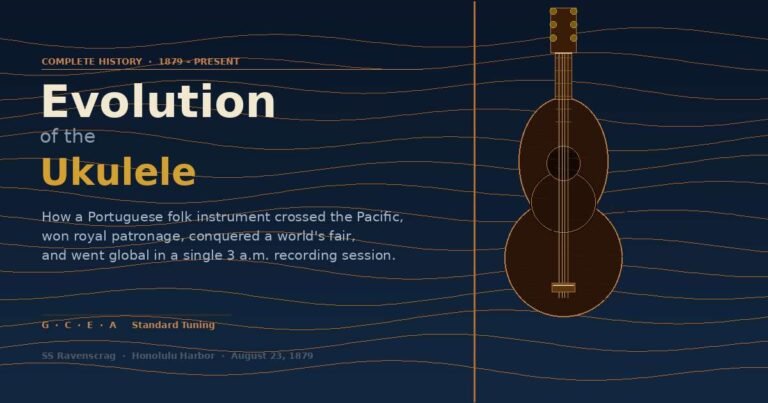
The history of the ukulele begins on August 23, 1879, when the British ship Ravenscrag docked in Honolulu Harbor carrying Portuguese immigrants from Madeira. Three of those passengers — craftsmen who would soon open instrument workshops in Honolulu — spent the following decade building the instrument we now call the ukulele, adapting their traditional Madeiran instruments with local Hawaiian materials. Over the 140 years that followed, the instrument moved from royal courts to Tin Pan Alley, survived near-extinction, and resurfaced as one of the most widely played instruments on earth.
Most accounts of ukulele history agree on the broad strokes, then diverge sharply on the details. Some misidentify the Portuguese ancestor instrument. Others skip the crucial distinction between the machete de braga and the rajão — the two Madeiran instruments whose combined features created the modern ukulele. This guide traces the full story with the specificity those accounts skip. And the single event that turned the ukulele from a regional Hawaiian instrument into a global phenomenon is one most histories mention only in passing.
Key takeaways:
- Ukulele history begins with two Portuguese instruments — the machete de braga and the rajão — not the cavaquinho alone
- Three Madeiran craftsmen, Manuel Nunes, Augusto Dias, and Jose do Espirito Santo, built the earliest ukuleles in Honolulu after arriving on the Ravenscrag on August 23, 1879
- King Kalākaua incorporated the ukulele into royal court culture, giving it a legitimacy no purely popular appeal could have achieved
- A Hawaiian pavilion at the 1915 Panama-Pacific International Exposition first brought the ukulele to a mass American audience
- Israel Kamakawiwoʻole’s 1988 recording of a “Somewhere Over the Rainbow/What a Wonderful World” medley was the single most important catalyst for the modern global revival
- Ukulele instruction now appears in school music programs across six continents, with hundreds of manufacturers producing instruments worldwide
What is the ukulele?
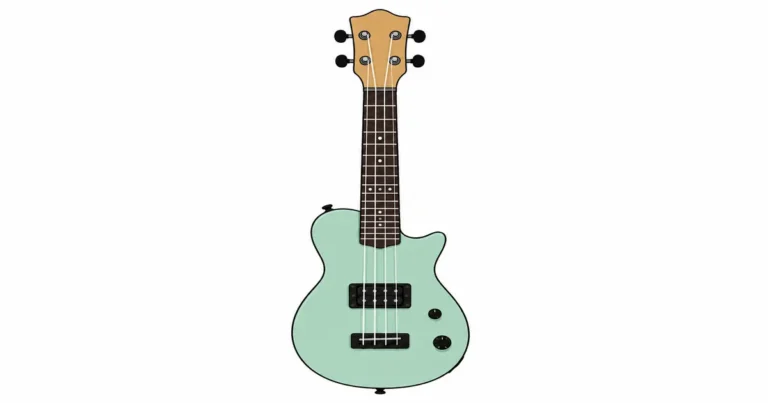
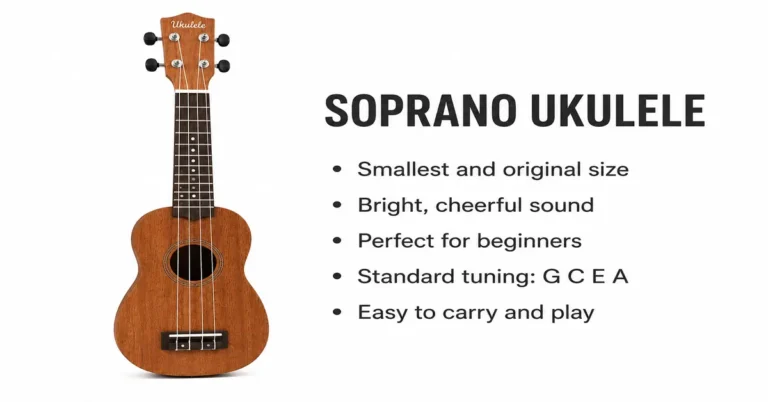
The ukulele is a small, four-stringed fretted instrument that originated in the Hawaiian Islands in the 1880s, developed by Madeiran craftsmen from Portuguese immigrant instrument traditions. Standard tuning is GCEA — sometimes called re-entrant tuning because the G string sits higher in pitch than the C string below it. Soprano models, the most historically common size, measure roughly 21 inches (53 cm) in total length and about 13 inches (33 cm) in scale length.
How the ukulele differs from its Portuguese ancestors
The ukulele didn’t come from a single Portuguese instrument. Its compact body draws from the machete de braga, a small four-string guitar from the Braga region of northern Portugal. Its tuning derives from the top four strings of the rajão, a five-string Madeiran folk instrument. The craftsmen who arrived in Hawaii combined elements of both, then built with local koa wood instead of European tonewoods. That combination produced something genuinely distinct — not a smaller Portuguese instrument, but a new one.
Portuguese origins: where ukulele history really begins
The roots of ukulele history lie in the mid-19th century folk music traditions of Madeira, a Portuguese island group in the Atlantic roughly 1,000 miles southwest of Lisbon. Musicians there played small plucked stringed instruments suited to festivals, communal gatherings, and home music-making. Two instruments mattered most to what came after.
The machete de braga and the rajão
The machete de braga — often called simply the machete — was a compact four-string instrument with a narrow body and a bright, percussive tone. It’s the closest physical ancestor of the soprano ukulele and shares its string count and approximate scale length. The rajão was slightly larger, with five strings, tuned D-G-C-E-A. Strip the bottom string away and you have exactly the C-E-A-G pitches that form the ukulele’s standard GCEA tuning — in reverse order. That’s not a coincidence. Madeiran players transposed the rajão’s top four strings directly onto the smaller machete body, and that hybrid logic is what arrived in Hawaii in 1879.
What many ukulele histories call a “cavaquinho” is actually a broader family term covering several small Portuguese fretted instruments. The machete de braga is a specific member of that family — narrower in build, different in scale length from mainland Portuguese varieties. Conflating them flattens a distinction that matters for understanding why the ukulele sounds the way it does.
Why Madeirans came to Hawaii
In the 1870s, Hawaii’s sugar industry was expanding rapidly under the Hawaiian-American Reciprocity Treaty of 1875, which opened US markets to Hawaiian sugar duty-free. Plantation owners needed labor. The Hawaiian government turned to Madeira and the Azores, where economic hardship made emigration attractive. Portuguese immigrants — most from Madeira — arrived in Hawaii by the tens of thousands over the following decades. They brought their instruments. The ukulele, in one sense, is a consequence of global sugar economics.
The Ravenscrag voyage and the birth of Hawaiian ukulele
On August 23, 1879, the British ship Ravenscrag completed a four-month voyage and docked in Honolulu Harbor. Among the passengers were three cabinetmakers and musicians: Manuel Nunes, Augusto Dias, and Jose do Espirito Santo. Contemporary Hawaiian newspaper accounts describe music breaking out on the ship as it entered the harbor — passengers playing and singing after the long crossing. Hawaiians watching from the docks were reportedly astonished by the speed at which one musician’s fingers moved across the fretboard. Some accounts suggest this gave rise to the name “ukulele,” most commonly translated as “jumping flea,” though the etymology remains genuinely debated.
Manuel Nunes, Augusto Dias, and Jose do Espirito Santo
All three men established instrument-making workshops in Honolulu in the years following their arrival. Manuel Nunes is frequently credited with the earliest documented ukulele production; his workshop and the family name persisted in Hawaiian instrument making for generations. Augusto Dias opened a shop on Fort Street. Jose do Espirito Santo also operated a Honolulu workshop. By the late 1880s, all three were producing instruments recognizably similar to the ukulele we know today — smaller and lighter than the machete they’d brought from Madeira, built with koa wood, and tuned to what would become the GCEA standard.
The Bishop Museum in Honolulu holds instruments attributed to these early makers, and Hawaii State Archives records document their presence and commercial activity in Honolulu during this period.
How King Kalākaua shaped the instrument’s destiny
King David Kalākaua reigned over the Hawaiian Kingdom from 1874 to 1891. He was a skilled musician and an active patron of Hawaiian cultural arts, and he incorporated the ukulele into royal court performances — playing it publicly, featuring it in court entertainment, and encouraging its use alongside traditional Hawaiian instruments. That royal endorsement changed the instrument’s trajectory. It lifted the ukulele out of the immigrant community and into the wider social fabric of Hawaiian life, giving it a cultural status that popular appeal alone couldn’t have established.
Queen Liliʻuokalani succeeded Kalākaua in 1891 and was herself a gifted composer who also played the ukulele. Her reign ended with the overthrow of the Hawaiian Kingdom in 1893, but the cultural foundation she and Kalākaua built for the instrument held.
The four eras of ukulele evolution
Understanding 140 years of ukulele history is cleaner with a framework. The instrument’s story falls into four distinct eras — plantation, exposition, decline, and revival — each shaped by specific historical forces that explain not just when things happened, but why.
Key moments in ukulele history:
- 1879 — Ravenscrag arrives in Honolulu; Nunes, Dias, and Espírito Santo begin building ukuleles
- 1874–1891 — King Kalākaua’s reign; royal patronage gives the ukulele cultural permanence
- 1891–1893 — Queen Liliʻuokalani continues royal patronage of Hawaiian music
- 1915 — Panama-Pacific International Exposition in San Francisco introduces the ukulele to mainland America
- 1916 — Kamaka Ukulele founded in Honolulu
- 1920s — C.F. Martin & Co. and other mainland makers produce ukuleles; Tin Pan Alley publishes ukulele songbooks
- 1968 — Tiny Tim’s ukulele performance on The Tonight Show cements the novelty association
- 1988 — Israel Kamakawiwoʻole records the “Somewhere Over the Rainbow” medley
- 1993 — Facing Future released; the medley begins its global spread
- 2006 — Jake Shimabukuro’s “While My Guitar Gently Weeps” YouTube video reaches millions worldwide
Era 1: The plantation years (1879–1914)
For its first 35 years, the ukulele was almost entirely Hawaiian. Workshop makers in Honolulu refined the design, Hawaiian musicians adapted the playing style, and the instrument spread across the islands through music schools, social clubs, and royal patronage. Koa wood became the preferred tonal material — a choice driven by availability, but one that also produced a warmth and complexity that mainland alternatives couldn’t match. By 1900, the ukulele was a distinctly Hawaiian instrument, even though its roots were Madeiran.
Era 2: The exposition boom (1915–1940)
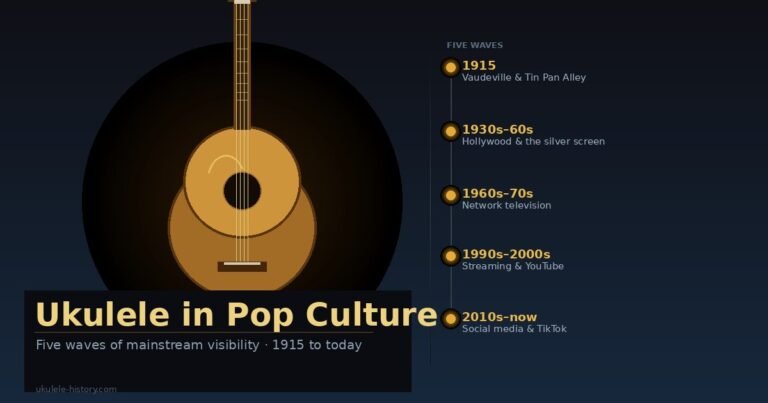
The 1915 Panama-Pacific International Exposition in San Francisco changed the trajectory of ukulele history. Hawaii had an official pavilion, and the Hawaiian performers there — including ukulele players — drew enormous crowds over the event’s nine-month run. Mainland Americans heard the instrument for the first time, and demand exploded. Music publishers rushed out ukulele songbooks. C.F. Martin & Co. added ukuleles to its catalog by the early 1920s. Tin Pan Alley composers wrote songs specifically arranged for ukulele. By the mid-1920s, the instrument was genuinely mainstream across North America and beginning to reach Europe.
Historian’s note: The 1915 Exposition is often described as a happy accident — Hawaiian musicians happening to charm audiences. But the Hawaiian Promotion Committee had been systematically positioning Hawaiian culture, including music, as aspirational since the early 1900s. The Exposition was a deliberate demonstration, not a spontaneous discovery. The commercial wave that followed was the result of careful cultural strategy.
Era 3: The long decline (1941–1990)
The electric guitar changed American popular music, and the ukulele suffered for it. As rock ‘n’ roll defined the 1950s and 1960s, the instrument’s bright, gentle sound seemed lightweight by comparison. Its reputation took further damage in 1968 when Tiny Tim’s falsetto performance of “Tiptoe Through the Tulips” — strumming a ukulele on The Tonight Show — landed as novelty rather than musicianship. That image proved stubborn. For nearly four decades, the ukulele occupied an awkward cultural space somewhere between children’s toy and punchline.
Era 4: The global revival (1991–present)
The revival didn’t begin with a marketing campaign. It started with a late-night phone call.
In 1988, Hawaiian musician Israel Kamakawiwoʻole called a Honolulu recording studio at 3 a.m. and asked if he could come in to record. He arrived alone with his ukulele and laid down a medley of “Somewhere Over the Rainbow” and “What a Wonderful World” in a single take. His album Facing Future, released in 1993, eventually sold more than a million copies — the first Hawaiian album to earn platinum certification. That medley reached a global audience through film placements, television use, and streaming platforms over the following decades. It didn’t just popularize a song; it repositioned the ukulele as an instrument of genuine emotional range.
Jake Shimabukuro’s YouTube performance of “While My Guitar Gently Weeps” in 2006 — filmed in Central Park, viewed by tens of millions — then demonstrated that the ukulele could handle technically demanding playing. The internet-era learning surge that followed made it one of the fastest-growing instruments globally, with affordable entry-level models bringing it within reach of players in every income bracket.
The four eras of ukulele history at a glance:
| Era | Period | Defining force | Key figures |
|---|---|---|---|
| Plantation | 1879–1914 | Hawaiian cultural adoption | Nunes, Dias, Kalākaua |
| Exposition boom | 1915–1940 | American popular appetite | Martin, Kamaka, Tin Pan Alley composers |
| Long decline | 1941–1990 | Electric guitar dominance | Tiny Tim (unintended damage) |
| Global revival | 1991–present | Digital media and YouTube | Kamakawiwoʻole, Shimabukuro |
Ukulele sizes, tones, and construction
The modern ukulele comes in four primary sizes — soprano, concert, tenor, and baritone — each with distinct tonal properties that reflect how demand evolved from the 1880s through the mid-20th century. Historical makers developed these variants as the instrument spread from Hawaii to the American mainland and eventually to Europe, with different players pressing for more volume and lower-register range.
| Size | Scale length | Total length | Standard tuning | Tone character |
|---|---|---|---|---|
| Soprano | 13 in / 33 cm | ~21 in / 53 cm | GCEA (high G) | Bright, classic, slightly thin |
| Concert | 15 in / 38 cm | ~23 in / 58 cm | GCEA | Warmer, more projection |
| Tenor | 17 in / 43 cm | ~26 in / 66 cm | GCEA or DGBE | Full, warm, guitar-like sustain |
| Baritone | 19 in / 48 cm | ~29 in / 74 cm | DGBE | Deep, closest to guitar tone |
The soprano remains closest to the Honolulu workshop instruments of the 1880s. Concert and tenor sizes developed through the 1920s and 1930s as mainland demand required more volume and lower-register options. The baritone appeared in the late 1940s, designed partly as a bridge instrument for guitar players moving to ukulele.
Koa wood and the sound of Hawaiian craftsmanship
Hawaiian koa (Acacia koa) has been the premium tonal choice for ukulele builders since the instrument’s earliest workshops. Koa produces a warmer, more complex sound than mahogany — the most common alternative on budget instruments — with stronger overtones and a characteristic brightness in the upper register that suits GCEA tuning well. It also improves with age: as the wood dries and the grain tightens over decades, a koa ukulele’s tone deepens and gains nuance that newer instruments don’t have.
Koa grows only in Hawaii. Its scarcity explains why instruments from Hawaiian makers like Kamaka, KoAloha, and Kanile’a carry significant price premiums over mainland equivalents. But for players after the fullest expression of what the instrument can sound like, koa remains the benchmark everything else is measured against.
What most people get wrong about ukulele history
Two persistent misconceptions follow ukulele history wherever it’s told. Both contain partial truth, and both misrepresent the instrument’s origins in ways that change how you understand what the ukulele actually is.
“The ukulele is just a small guitar”
It isn’t. The guitar and the ukulele share distant ancestry in the broad family of European plucked string instruments, but they’re not variations on the same instrument. The guitar descended from the Spanish vihuela and the Baroque guitar tradition. The ukulele descended from specific Madeiran folk instruments — the machete de braga and the rajão — that developed along a different lineage entirely.
Their tuning systems differ at a foundational level. A standard guitar uses linear E-A-D-G-B-E tuning; the ukulele uses re-entrant GCEA tuning, where the G string sits higher in pitch than the C below it. That re-entrant structure changes how chords voice and how melody lines sit against accompaniment. And ukulele strings are nylon or fluorocarbon, not steel — the attack, sustain, and tonal character differ at a physical level, not just a size level.
“Hawaiians invented the ukulele”
This one’s more nuanced than a flat correction. Portuguese immigrants created the physical instrument. But “invented” dramatically undersells what Hawaiian musicians, cultural leaders, and craftspeople contributed. King Kalākaua didn’t receive a foreign instrument passively — he built it into the royal cultural program, which gave it a permanence no immigrant community trend could have achieved alone. Hawaiian musicians developed a distinct playing style and composed an original repertoire that made the instrument inseparable from Hawaiian identity. Hawaiian koa wood changed its tonal character.
The ukulele is a genuinely collaborative creation: Madeiran in origin, Hawaiian in development. Neither half of that story is accurate without the other.
FAQs
Where did the ukulele originate? The ukulele originated in the Hawaiian Islands in the 1880s, developed by Portuguese craftsmen from Madeira who adapted their traditional machete de braga and rajão instruments using local Hawaiian tonewoods. Three craftsmen — Manuel Nunes, Augusto Dias, and Jose do Espirito Santo — are credited with building the earliest examples in Honolulu after arriving in 1879.
Who invented the ukulele? No single person invented it. Manuel Nunes, Augusto Dias, and Jose do Espirito Santo — three Madeiran craftsmen who arrived in Honolulu on the Ravenscrag on August 23, 1879 — are credited with building the first ukulele-type instruments. All three operated workshops in Honolulu through the 1880s and into the 1890s, refining the design independently but along parallel lines.
What does “ukulele” mean in Hawaiian? The most common translation is “jumping flea,” believed to describe the rapid finger movement of early players across the fretboard. An alternative reading interprets it as uku (gift or reward) and lele (to arrive), yielding something close to “the gift that came here.” The exact origin of the name hasn’t been settled by any single definitive historical source, and both interpretations remain in circulation.
When did the ukulele become popular outside Hawaii? The 1915 Panama-Pacific International Exposition in San Francisco was the turning point. Hawaiian performers at the exposition drew large crowds throughout its nine-month run, and the ukulele spread rapidly through American popular music in the years that followed, reaching Europe by the 1920s. Music publishers, instrument manufacturers, and Tin Pan Alley all moved quickly to meet the demand.
How is the ukulele different from a guitar? The ukulele uses re-entrant GCEA tuning across four nylon or fluorocarbon strings. A guitar uses linear EADGBE tuning across six steel strings. The ukulele is smaller, descended from different instrument ancestors, and produces a distinctly different tone — brighter, lighter, and without the low-end resonance of a guitar’s bass strings. Chord shapes differ between the two instruments as a result.
Who made the ukulele famous internationally? Several figures mattered at different moments. King Kalākaua established it as a prestige Hawaiian instrument in the 1880s. The 1915 Exposition brought it to mainland America. Israel Kamakawiwoʻole’s 1988 medley gave it global reach through decades of film and streaming exposure. And Jake Shimabukuro’s YouTube performances in the mid-2000s demonstrated its technical potential to a new generation of players.
Conclusion
The history of the ukulele is a story about migration, cultural collaboration, and the improbable persistence of small instruments. A folk guitar from Madeira arrived in Honolulu Harbor in 1879. Hawaiian royalty gave it prestige. A world’s fair gave it an audience. The electric guitar nearly erased it. A 3 a.m. recording session in 1988 pulled it back.
That arc — from a plantation laborer’s instrument to something taught in school music programs on six continents — is one of the more remarkable stories in music history. And it’s still going.
For primary source documentation, maker timelines, and deeper research into every era covered here, Ukulele History maintains an ongoing archive for players, collectors, and researchers. Explore the full collection.
Designed for doers—our action-oriented blog articles push you to move.