King Kalākaua Ukulele: Royal Roots of Hawaiʻi’s Sound
King Kalākaua’s relationship with the ukulele is one of the most consequential in the history of any musical instrument. Hawaii’s last king didn’t simply enjoy a small four-stringed curiosity — he made a deliberate decision to elevate it, grant it social prestige, and weave it into the fabric of Hawaiian national identity. That decision, enacted in the 1880s at ʻIolani Palace, set the King Kalākaua ukulele story on a path that would eventually carry the instrument to every corner of the world.
Most accounts treat his musical interests as background. They note that he liked music, mention the Portuguese craftsmen, and move on. The single act of cultural will that kept this instrument from fading into historical footnote is rarely explained in full. This page does exactly that.
Key takeaways:
- King Kalākaua (reigned 1874–1891) actively patronized the ukulele at the Hawaiian royal court, granting it social legitimacy no other force could have provided
- The ukulele descended from the braguinha, or machete de braga, brought to Honolulu by Portuguese immigrants from Madeira on August 23, 1879
- Manuel Nunes, Augusto Dias, and Jose do Espirito Santo — craftsmen aboard the Ravenscrag — are credited as the instrument’s earliest Hawaiian makers
- Kalākaua’s promotion of the ukulele was inseparable from his broader campaign to reassert Hawaiian cultural identity against growing colonial pressure
- Royal court embrace of the instrument gave it social prestige that transformed it from immigrant curiosity into national symbol within a decade
- Queen Liliʻuokalani, Kalākaua’s sister and successor, was herself an accomplished composer, extending royal musical patronage beyond his reign
Who was King Kalākaua, and why did music define his reign?
King Kalākaua ruled the Kingdom of Hawaiʻi from 1874 until his death in 1891, governing during one of the most turbulent periods in the islands’ history. He was Hawaii’s last reigning king — a man who lost much of his executive authority to foreign commercial interests but never surrendered control over Hawaiian cultural life. That distinction explains nearly everything about his relationship with music.
The Merry Monarch’s musical credentials
Kalākaua — full name David Laʻamea Kamanakapuʻu Mahinulani Nalaiaehuokalani Lumialani Kalākaua — earned the title “Merry Monarch” for his dedication to celebration, music, and the Hawaiian arts. But that nickname understates his seriousness. He played multiple instruments, wrote poetry, and composed “Hawaiʻi Ponoʻī,” which became the kingdom’s national anthem and remains Hawaii’s state song today.
He was also a committed scholar of Hawaiian history and language. His world tour of 1881 brought him into contact with heads of state across Asia, Europe, and the Americas. He returned convinced that a strong Hawaiian cultural identity was the only foundation that could keep the kingdom intact against mounting external pressure. Music wasn’t incidental to that conviction — it was part of its architecture.
His 1883 coronation ceremony was the first formal coronation in Hawaiian history, and he used it to celebrate Hawaiian cultural forms in ways no previous monarch had matched. Three years later, at his 1886 Jubilee celebration, he restored the hula as a public cultural practice. Protestant missionaries had suppressed it for decades as immoral and un-Christian. Kalākaua’s restoration was a direct challenge to that suppression, and he knew exactly what he was doing.
The political landscape behind the music
By the mid-1880s, American sugar planters and merchants held controlling interests in much of Hawaii’s productive land and economy. In July 1887, a coalition of American and European businessmen — backed by armed militia — forced on Kalākaua what became known as the “Bayonet Constitution.” It stripped him of executive authority, restructured the cabinet to answer to the legislature rather than the crown, and restricted voting rights in ways that disenfranchised most native Hawaiian and Asian residents.
Music was one of the few domains where Kalākaua retained real power. His patronage of Hawaiian artistic traditions — including the newly adapted ukulele — was an exercise of that remaining authority. A king who couldn’t set foreign policy or control his own cabinet could still fill his palace with Hawaiian music. And by doing so, he made certain that Hawaiian culture would survive him.
How did the ukulele arrive in Hawaiʻi?
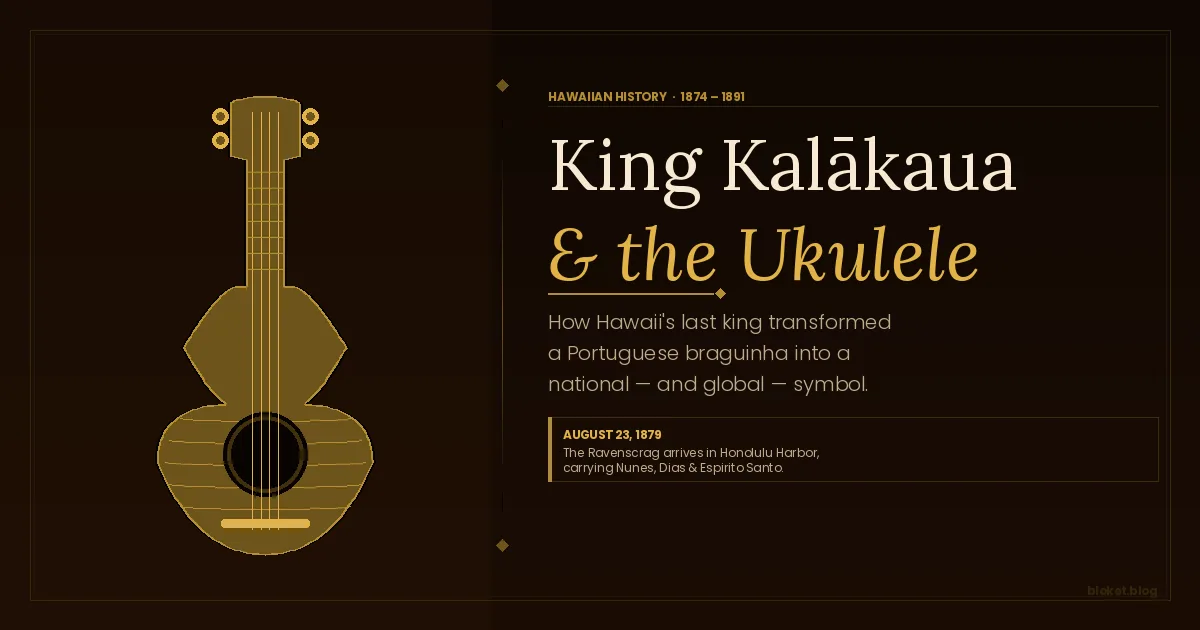
Hawaii’s introduction to the ukulele came through a specific, well-documented event. On August 23, 1879, a British merchant vessel called the Ravenscrag anchored in Honolulu Harbor after a crossing from Madeira, Portugal. Aboard were approximately 419 Portuguese immigrants recruited as contract workers for Hawaii’s sugar plantations. Among them were three cabinet-makers and instrument builders: Manuel Nunes, Augusto Dias, and Jose do Espirito Santo.
Contemporary Hawaiian newspaper accounts report that the new arrivals played music on the wharf as they disembarked, drawing onlookers from the harbor district. Their instrument was the braguinha — also called the machete de braga — a small, four-stringed instrument from the Madeiran musical tradition. That dockside performance was the ukulele’s Hawaiian debut.
From braguinha to Hawaiian instrument — the koa wood transformation
What arrived in 1879 was not identical to what would eventually become the ukulele. Built from European tonewoods and strung with gut, the braguinha was calibrated to Madeiran musical conventions. But Nunes, Dias, and Espirito Santo didn’t simply transplant a Portuguese instrument into a new geography. They adapted it.
Material was the most significant change. Hawaiian koa wood — a dense, resonant timber native to the islands’ upland forests — produces a tonal character that European alternatives don’t replicate. Its midrange is rich and slightly compressed, which gives instruments built from it a distinctive attack: a bright “pop” on the note that decays quickly and cleanly. Hawaiian musicians found this suited their playing style and the vocal textures of Hawaiian song. The acoustic marriage between Portuguese design and Hawaiian materials was the instrument’s true origin, not a continuation of the Portuguese tradition.
The second adaptation was cultural and conceptual. In Madeira, the braguinha was a vernacular community instrument — played at festivals, informal and local. In Hawaii, it would gain something it had never known at home: royal attention.
Manuel Nunes and the first ukulele workshops in Honolulu
Of the three craftsmen from the Ravenscrag, Manuel Nunes appears most consistently in historical records as a prolific and skilled maker. His Honolulu workshop produced instruments through the late 19th and early 20th centuries, and some of his instruments survive in museum collections — giving modern players a direct material link to the ukulele’s earliest phase in Hawaii.
Augusto Dias and Jose do Espirito Santo also established making traditions in Honolulu. Within a decade of the Ravenscrag’s arrival, a small but active instrument-making community was operating in the city, supplying demand that grew steadily as the ukulele spread from Hawaii’s Portuguese immigrant population into broader Hawaiian society. Kalākaua’s court would accelerate that spread dramatically.
The King Kalākaua ukulele connection — what actually happened at court
The King Kalākaua ukulele connection describes the deliberate patronage Hawaii’s last king extended to the instrument in the 1880s — a relationship that transformed a Portuguese immigrant novelty into a Hawaiian cultural symbol in roughly a decade, and laid the foundation for the ukulele’s global spread in the century that followed.
Royal patronage was what separated the ukulele from the dozens of other immigrant instruments that passed through Hawaii in the 19th century and left no lasting mark. Kalākaua’s court created the social conditions that made the instrument not merely acceptable but aspirational — and that shift changed everything about how it spread.
Music at ʻIolani Palace
ʻIolani Palace, completed in December 1882, was the formal residence of the Hawaiian monarchy and the center of the kingdom’s political and cultural life. Kalākaua hosted regular musical evenings there, drawing on Hawaiian musical traditions as well as international genres. Period accounts place the ukulele among the instruments in regular use at these gatherings.
What royal patronage actually provided:
- Social legitimacy: an instrument performed at court cannot be dismissed as low-status
- Cultural integration: palace performances embedded the ukulele in formal Hawaiian contexts before popular culture had fully adopted it
- Craftsman support: court connections elevated the profile of Honolulu’s instrument-making workshops
- Name permanence: royal association gave the word “ukulele” institutional weight, helping it appear in Hawaiian-language press by the early 1890s
The cultural logic here is worth understanding on its own terms. An instrument played at royal functions doesn’t remain a folk curiosity — it becomes, by association, a refined art form. When Kalākaua’s circle adopted the ukulele, they gave it social permission to spread through all levels of Hawaiian society without stigma attached. Within a generation, the instrument was so thoroughly integrated into Hawaiian musical life that disentangling the two would have been like removing the strings themselves.
The naming of the ukulele — and what the royal court had to do with it
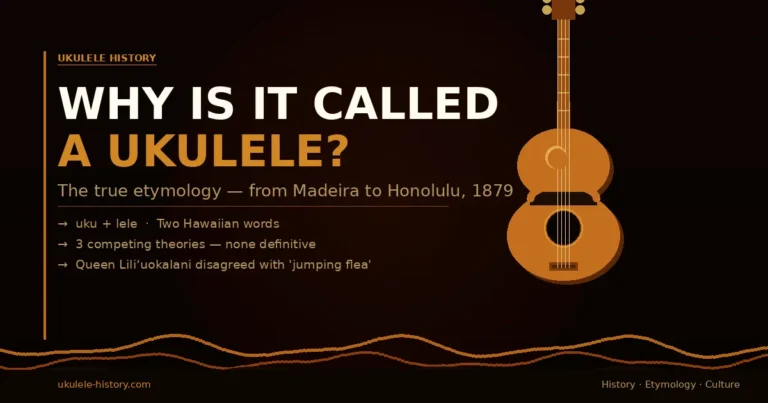
The word “ukulele” carries its own debated history, and the royal court appears in several accounts of how the name emerged. Two main etymologies have been proposed, and neither has been definitively settled by documentary evidence.
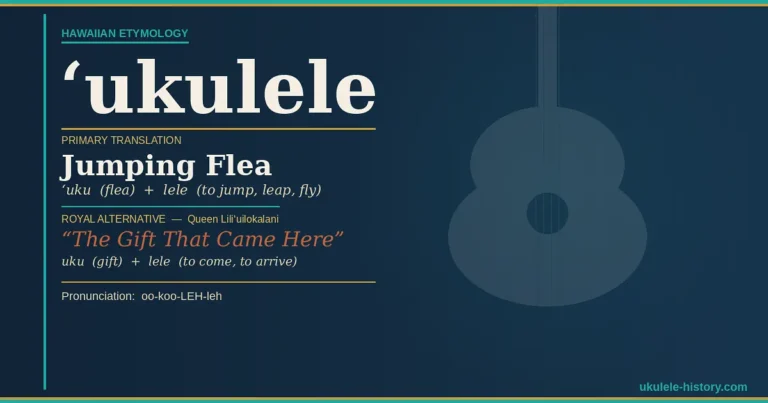
The most widely circulated interpretation translates ukulele as “jumping flea” — from the Hawaiian uku (flea) and lele (to jump) — a description of the rapid, darting finger movements of skilled players. Some accounts attach this nickname to Edward Purvis, a British officer stationed at the Hawaiian court who was reportedly known for his energetic playing style. But Purvis’s specific role in coining the name is disputed and shouldn’t be treated as established fact.
A second interpretation, favored by some Hawaiian language scholars, reads ukulele as “the gift that came here” — uku meaning gift and lele meaning to arrive or come. This reading frames the naming as an acknowledgment of the instrument’s origins: a gift the Portuguese brought, now claimed as Hawaiian. Hawaiian-language newspapers were using the word in print by the early 1890s, confirming its establishment within roughly a decade of the Ravenscrag’s arrival.
Historian’s note: Kalākaua was documented as a serious student of Hawaiian language and an active participant in questions of cultural vocabulary — his reign included efforts to compile and preserve Hawaiian history, mythology, and linguistic heritage. Given that documented engagement, it’s plausible, though not provable, that the naming of the instrument reflects sensibilities that passed through his court. What’s beyond dispute is that royal association gave the word permanence. Instruments named by kings tend to keep their names.
The Three-Stage Royal Endorsement Arc — a framework for understanding Kalākaua’s impact
Most historical accounts treat Kalākaua’s musical patronage as background color rather than structured strategy. But his relationship with the ukulele followed a traceable pattern that explains why this instrument flourished while dozens of others brought to Hawaii in the same era disappeared without trace. Call this the Royal Endorsement Arc: three stages through which royal attention converts a novelty into a national symbol.
Stage 1 — Arrival (1879–1882): Nunes, Dias, and Espirito Santo establish workshops in Honolulu. The instrument circulates within the Portuguese immigrant community and begins attracting Hawaiian listeners. At this stage, the ukulele is still foreign — admired in some quarters, unfamiliar to most.
Stage 2 — Adoption (1882–1886): The instrument reaches Kalākaua’s circle at ʻIolani Palace. The king and his court take it up. Social prestige attaches to the ukulele for the first time. Hawaiian musicians begin integrating it into existing musical forms, and makers shift toward koa wood and Hawaiian aesthetic sensibilities. The braguinha becomes, definitively, the ukulele.
Stage 3 — Codification (1886–1891): The ukulele appears in formal Hawaiian cultural contexts — royal celebrations, documented public performances, Hawaiian-language press coverage. By Kalākaua’s death in 1891, the instrument is no longer Portuguese or immigrant or novel. It is Hawaiian.
This pattern isn’t unique to the ukulele. Throughout music history, the instrument that gains royal or aristocratic endorsement at the critical moment of cultural formation tends to become permanent. What’s unusual here is the speed and precision: from dockside debut to royal cultural symbol in roughly twelve years.
| Stage | Period | Key Development | Result |
|---|---|---|---|
| Arrival | 1879–1882 | Ravenscrag landing; workshops established by Nunes, Dias, Espirito Santo | Instrument enters Hawaiian society |
| Adoption | 1882–1886 | Royal court embrace; koa wood adaptation begins | Social legitimacy; Hawaiian identity takes hold |
| Codification | 1886–1891 | Formal cultural integration; press coverage; royal performances | Instrument becomes definitively Hawaiian |
From Kalākaua to Liliʻuokalani — the continuation of royal musical patronage
Kalākaua died in San Francisco on January 20, 1891, while traveling for medical treatment. His sister Liliʻuokalani ascended to the throne as Hawaii’s final reigning monarch. She was deposed by an American-backed coup in January 1893, less than two years into her reign.
But Liliʻuokalani was herself a musician of real accomplishment. She composed over 160 songs across her lifetime, including what became “Aloha ʻOe” — now one of the most recognized Hawaiian melodies worldwide. Her musical output continued what Kalākaua had established: Hawaiian royalty as practitioners and champions of the musical arts, not merely spectators.
Together, the two monarchs created a framework in which the ukulele was celebrated at the highest level of Hawaiian society. That framework outlasted the kingdom. When Hawaii was annexed by the United States in 1898 — five years after the monarchy’s overthrow — the instrument remained. It had been woven too deeply into Hawaiian cultural identity to be extracted by political events.
The 1915 Panama-Pacific Exposition and what Kalākaua’s foundation made possible
The ukulele’s spread to the American mainland came through the 1915 Panama-Pacific International Exposition in San Francisco, where Hawaiian musicians performed for massive mainland audiences and sparked a wave of popular interest in both the instrument and Hawaiian music. Tin Pan Alley publishers picked up Hawaiian melodies. Early recordings circulated widely. A mainland boom followed.
But that boom was built on foundations Kalākaua had laid thirty years earlier. The performers who captivated Exposition audiences brought an instrument with 35 years of royal association, established craftsmanship traditions, and deep musical integration. They weren’t presenting a novelty act — they were presenting a fully formed musical culture. Kalākaua’s work made that possible.
What most histories get wrong about King Kalākaua and the ukulele
Two widespread misunderstandings shape how most people think about Kalākaua and the ukulele. The first concerns when the ukulele became Hawaiian; the second concerns why Kalākaua promoted it. Both distortions make the story smaller than it actually was.
Misconception 1: The ukulele was already Hawaiian when the Portuguese arrived
Some popular accounts present the ukulele as an ancient or indigenous Hawaiian instrument, implying it grew from the islands’ own musical soil. It didn’t. The instrument arrived in 1879 with Portuguese immigrants from Madeira. Its design, construction, and musical lineage are Portuguese. It became Hawaiian through a process of material adaptation, musical integration, and royal endorsement — a transformation that took roughly a decade.
And that distinction matters, because the real story is more compelling. Hawaii didn’t passively receive an instrument and absorb it unchanged. Hawaiian musicians, craftsmen, and a culturally strategic king actively transformed a Portuguese braguinha into something genuinely new. That’s a story of creative adoption, not passive inheritance.
Misconception 2: Kalākaua’s musical patronage was personal preference rather than policy
The “Merry Monarch” nickname has led many readers to treat Kalākaua’s love of music as a temperamental trait divorced from political strategy. His actual situation tells a different story. By 1887, the Bayonet Constitution had stripped him of executive power. American interests dominated Hawaii’s economy. Promotion of Hawaiian cultural forms — music, hula, language, ceremony — was one of the few forms of meaningful resistance still available.
He couldn’t set foreign policy or control his own cabinet. But he could fill his palace with Hawaiian music. In doing so, he ensured that Hawaiian culture — including its newest instrument — would survive him. The ukulele wasn’t just something Kalākaua enjoyed. It was something he deliberately protected.
Key dates in the King Kalākaua ukulele story
These milestones trace the full arc from the braguinha’s Honolulu debut to the ukulele’s emergence as a global instrument — a span of 36 years in which one instrument’s story and one kingdom’s political fate were inseparably intertwined. Kalākaua’s name runs through nearly every critical moment.
| Year | Event |
|---|---|
| 1874 | Kalākaua elected king by the Hawaiian legislature; a reign of cultural renewal begins |
| August 23, 1879 | Ravenscrag arrives in Honolulu; Nunes, Dias, and Espirito Santo disembark with the braguinha |
| December 1882 | ʻIolani Palace completed; royal musical evenings established |
| February 1883 | Kalākaua’s formal coronation ceremony; Hawaiian cultural forms celebrated publicly |
| 1886 | Kalākaua’s Jubilee celebration; hula restored as formal public practice; ukulele in royal performance contexts |
| July 1887 | Bayonet Constitution strips Kalākaua of executive authority |
| Early 1890s | “Ukulele” appears in Hawaiian-language press |
| January 20, 1891 | Kalākaua dies in San Francisco; Liliʻuokalani becomes Hawaii’s final monarch |
| January 1893 | Hawaiian monarchy overthrown in American-backed coup |
| 1898 | Hawaii annexed by the United States |
| 1915 | Panama-Pacific International Exposition introduces the ukulele to mainland American audiences |
FAQs
Did King Kalākaua personally play the ukulele? Historical records confirm Kalākaua was an accomplished multi-instrumentalist who composed music and played Hawaiian instruments. Period accounts document ukulele performances at ʻIolani Palace during his reign, though whether he personally played it himself or primarily championed those who did isn’t definitively settled in surviving documentation. His role as cultural patron and champion is not in dispute.
Why is the ukulele considered Hawaiian if it came from Portugal? The ukulele descended from the Portuguese braguinha, but it became Hawaiian through a combination of material adaptation — koa wood construction rather than European tonewoods — deep musical integration, and direct royal endorsement at Kalākaua’s court. Origin and cultural identity are separate questions. The instrument’s origins are Portuguese; its identity became Hawaiian through an active transformation over roughly a decade.
Who are the three craftsmen credited with bringing the ukulele to Hawaii? Manuel Nunes, Augusto Dias, and Jose do Espirito Santo arrived on the Ravenscrag on August 23, 1879. All three were cabinet-makers and instrument builders from Madeira who went on to establish ukulele-making workshops in Honolulu. Nunes appears most frequently in historical records as a prolific maker, and some of his instruments survive in museum collections today.
What does the word “ukulele” actually mean? The etymology is genuinely debated. The most popular interpretation translates it as “jumping flea” — uku (flea) and lele (jumping) — a reference to the fast finger movements of skilled players. A competing reading translates it as “the gift that came here,” with uku meaning gift and lele meaning to arrive. Both remain plausible. Hawaiian-language newspapers were using the word by the early 1890s, confirming it was established within roughly a decade of the instrument’s Hawaiian debut.
What happened to the ukulele after Kalākaua died in 1891? Queen Liliʻuokalani, a prolific composer in her own right, extended royal musical patronage until her deposition in 1893. By then the ukulele was firmly embedded in Hawaiian culture. Its global spread came later, most visibly through the 1915 Panama-Pacific International Exposition in San Francisco. But the cultural identity and prestige that made the instrument exportable were built during Kalākaua’s reign.
What other cultural contributions did Kalākaua make beyond the ukulele? Kalākaua restored the public practice of hula after decades of missionary suppression. He commissioned the compilation of Hawaiian mythology and chant in what became the Kumulipo. He wrote “Hawaiʻi Ponoʻī,” now Hawaii’s state song. His reign was a systematic effort to document, preserve, and publicly celebrate Hawaiian culture at a moment when it faced sustained external pressure. The ukulele was one part of that much larger project.
Kalākaua’s connection to the ukulele wasn’t accidental. It was the work of a king who understood that culture is a form of sovereignty — and who used every tool still available to him, including a small four-stringed instrument brought to his harbor by Portuguese craftsmen, to assert what couldn’t be surrendered by constitutional force.
Without that royal endorsement, the braguinha might have lived out its days as a community instrument among Hawaii’s Portuguese immigrant population and faded quietly. What it became instead — the defining musical emblem of an entire archipelago, capable of expressing both the deepest Hawaiian feeling and modern global pop — is partly Kalākaua’s work.
For the full arc of the ukulele’s story, from Madeiran mountain workshops to the concert stages of the world, Ukulele History has the archive you’re looking for.
The content your competitors are already reading—explore our top insight articles.