Why Is It Called a Ukulele? The True Story Behind the Name
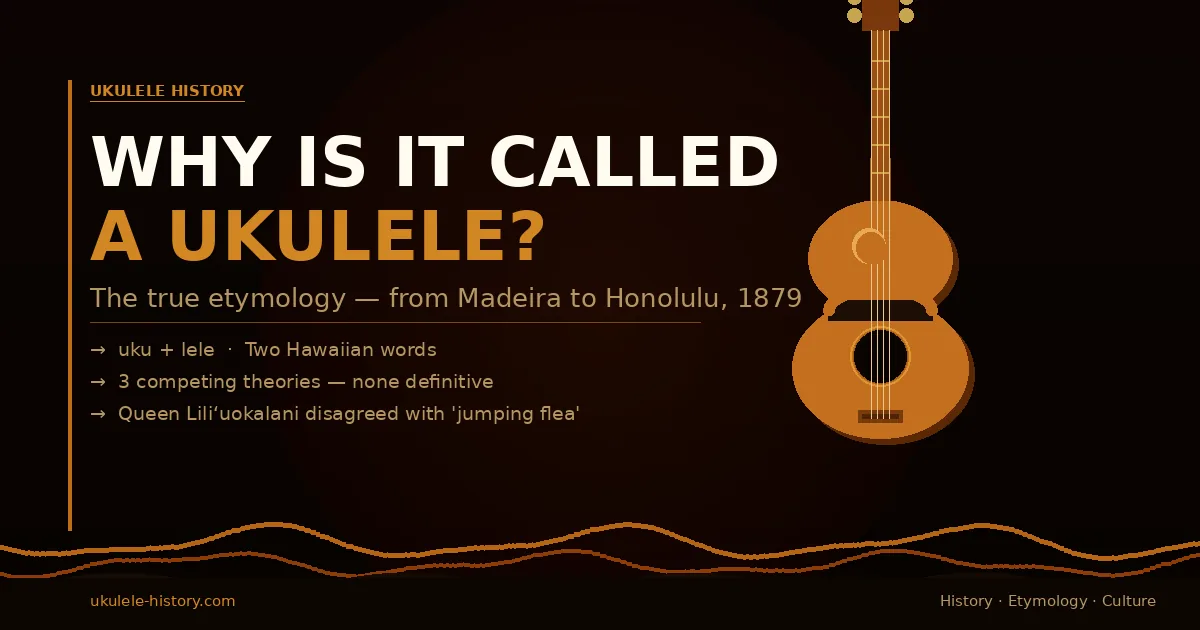
Why is it called a ukulele? The short answer: “ukulele” is a Hawaiian word, most commonly translated as “jumping flea,” applied to a Portuguese instrument after it arrived in Honolulu in August 1879. But the fuller answer is where things get genuinely interesting.
The name comes from two Hawaiian words that each carry multiple meanings, and three separate theories about who first applied it — and why — have never been resolved. One event on a Honolulu dock started it all. Most histories give it barely a sentence.
Key takeaways:
- “Ukulele” is a Hawaiian word applied to a Portuguese instrument that arrived in Honolulu on August 23, 1879.
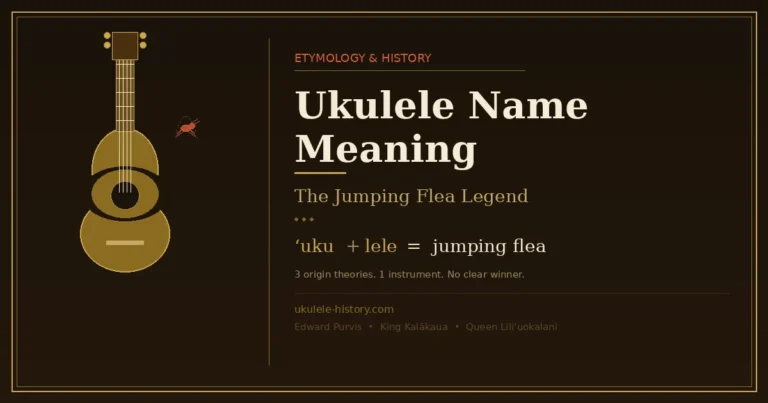
- The most common translation, “jumping flea,” combines uku (flea) and lele (to jump) — but both words carry additional meanings in Hawaiian.
- Queen Liliʻuokalani translated “ukulele” as “the gift that came here,” a linguistically valid reading that most popular sources overlook entirely.
- At least three competing theories explain who originally inspired the name, none supported by definitive primary documentation.
- The ukulele’s direct ancestor is the Portuguese machete de braga, not the guitar.
- The word appears in Hawaiian-language newspapers by the 1890s — roughly a decade after the instrument first arrived.
What “ukulele” means in Hawaiian
“Ukulele” is a compound Hawaiian word built from two roots — uku and lele — that each carry multiple meanings in the language. That built-in ambiguity is precisely why the question of the name’s true origin has never been fully settled, and why two people can give you different translations and both be right.
Breaking down uku and lele
In Hawaiian, uku means flea, but also small reward, payment, or gift. Lele means to jump or leap, but also to fly, to come, or to arrive. These aren’t obscure secondary meanings — they’re active parts of ordinary Hawaiian usage, not buried in specialist lexicons.
Combine them and you get at least two credible translations: “jumping flea,” describing the visual appearance of fast-fingered playing, or “the gift that came here,” describing the instrument’s journey across the Pacific. Both are grammatically valid in Hawaiian. Neither can be dismissed on linguistic grounds alone.
Why “jumping flea” became the dominant version
“Jumping flea” won the popular translation contest because it’s vivid and immediate. Watching a skilled player work the fretboard, audiences in late 19th-century Honolulu would have seen exactly that — fingers moving faster than the eye could easily follow, appearing to vanish and reappear at different points along the strings.
Memorable translations travel. When one reading is concrete and physical, and the competing version is more abstract, the concrete one spreads. And spread it did, moving from musician to musician and eventually into every popular history of the instrument.
Where the instrument came from before it had a name
The ukulele didn’t originate in the Pacific. It arrived from the Atlantic, carried by Portuguese immigrants recruited for the sugar industry that was reshaping Hawaiian agriculture in the second half of the 19th century. Knowing where it came from makes the naming question richer — Hawaiians were inventing a word for something they had never encountered before.
The Portuguese instruments that crossed the Pacific
The ukulele’s direct ancestor is the machete de braga, also called the braguinha — a small, four-string plucked instrument from the Braga region of northern Portugal. Gut strings, a short scale length, and a bright, carrying tone made it well-suited to vocal accompaniment. A related instrument, the rajão, a five-string Portuguese guitar, contributed tuning patterns to what eventually became the Hawaiian instrument.
Both belong to the broader family of small-bodied Portuguese plucked instruments grouped under the term cavaquinho. What made the machete particularly portable was its simplicity — a skilled cabinet-maker could build one from whatever tonewoods were locally available, including native Hawaiian koa, which produces a warmer and more complex tone than the mainland mahogany familiar to Portuguese craftsmen.
The Ravenscrag docks in Honolulu Harbor
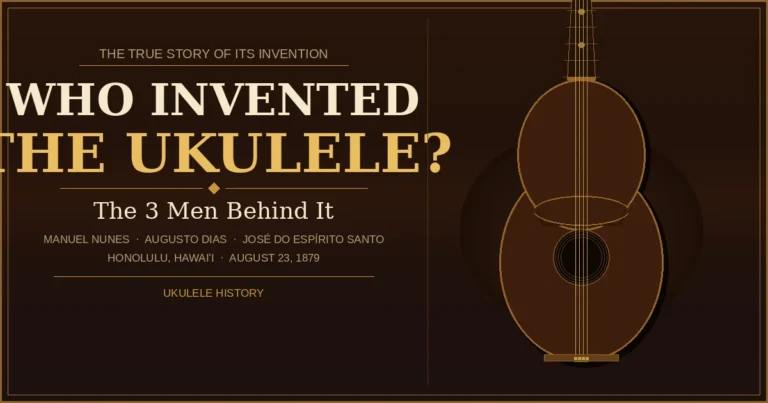
On August 23, 1879, a British barque called the Ravenscrag arrived in Honolulu after roughly four months at sea, carrying several hundred Portuguese immigrants from the island of Madeira. Most were bound for plantation labor. Among them, however, were three instrument makers who would reshape Hawaiian music: Manuel Nunes, Augusto Dias, and Jose do Espirito Santo — craftsmen who soon opened woodworking and instrument workshops in Honolulu.
Also aboard was João Fernandes. Historical accounts describe him playing the machete de braga on the dock that evening, drawing a crowd of Hawaiian onlookers who had never heard the instrument. What those watchers saw — the speed, the lightness, the movement of the fingers — gave them the material for a name.
Timeline of the ukulele’s naming:
| Year | Development |
|---|---|
| Pre-1879 | Machete de braga develops in Braga, northern Portugal, and spreads to the Madeira Islands |
| August 23, 1879 | Ravenscrag docks in Honolulu; João Fernandes performs publicly on the dock that evening |
| Early 1880s | Manuel Nunes, Augusto Dias, and Jose do Espirito Santo establish instrument-making workshops in Honolulu |
| Late 1880s | King Kalākaua incorporates the instrument into royal court performances |
| 1890s | The word “ukulele” appears in Hawaiian-language newspapers |
| 1915 | Panama-Pacific Exposition in San Francisco brings the instrument to a mainland American audience |
Why the ukulele is called a ukulele — three competing theories
This is where the history becomes genuinely complicated. At least three distinct origin stories circulate in the historical record, each with plausible supporting evidence and none with the kind of primary documentation that would settle the debate once and for all. The naming question has been open for over a century.
Theory 1 — João Fernandes and the fingers that moved like fleas
The most widely repeated version connects the name to that August 1879 dock performance. Fernandes played with enough speed and energy that Hawaiian observers compared his fingers to a jumping flea. On this account, “ukulele” began as a description of a playing style and then attached itself to the instrument — a perfectly normal trajectory for a musical nickname.
This theory has genuine appeal because it’s specific. It points to a real, documented person at a real date and place, and it offers a plausible visual trigger. The “jumping flea” translation feels exactly like what someone watching fast-fingered playing would instinctively reach for — an observation, not a metaphor coined in the abstract.
Theory 2 — Edward Purvis and the royal court nickname
A second account identifies Edward Purvis, a British army officer serving at the Hawaiian royal court under King Kalākaua, as the source. Purvis was reportedly slight in build and animated in manner — qualities that earned him the Hawaiian nickname “ukulele,” jumping flea, as a description of how he carried himself.
He played the machete de braga and helped introduce it into court circles, where Kalākaua’s patronage would soon give the instrument lasting legitimacy. On this reading, the instrument inherited his nickname through sustained association. Purvis is a real and historically documented figure at the court. But the direct evidence connecting his personal nickname to the instrument’s formal name is thin, and historians treat this account with varying degrees of confidence.
Theory 3 — Queen Liliʻuokalani’s translation
Queen Liliʻuokalani — the last reigning monarch of Hawaii, a prolific composer, and an accomplished musician — offered a different translation entirely. She read “ukulele” as “the gift that came here,” interpreting uku as gift and lele as to come or arrive.
Her credentials for this reading are hard to dismiss. Liliʻuokalani was fluent in Hawaiian, composed extensively in the language, and played the ukulele herself. She wrote “Aloha ʻOe,” still among the most recognized Hawaiian compositions globally. When someone of that linguistic and musical standing offers an etymology, it earns genuine consideration — even if it may represent a retrospective cultural interpretation rather than the original naming act.
Historian’s note: what the evidence can and can’t support
All three theories are historically plausible. The problem is that none carries what a historian would call strong primary documentation — no dated newspaper article, no court record, no letter stating explicitly why the word was applied to the instrument. What the record does support: the word emerged in late 19th-century Hawaii among speakers observing Portuguese musicians, it attached to the instrument within roughly a decade of the Ravenscrag’s arrival, and it appeared in print in Hawaiian-language newspapers by the 1890s. The precise moment of naming isn’t documented.
That’s not a failure of historical research. It’s an honest account of what the sources actually contain.
The four-root framework — a historian’s map of the naming debate
To give the competing accounts a clear structure, Ukulele History has organized them into the Four-Root Framework: four distinct origin theories, each evaluated against the historical evidence. The goal isn’t to declare a winner but to show what each claim actually rests on.
| Theory | Core claim | Evidence quality | Key weakness |
|---|---|---|---|
| Fernandes’s playing style | Fast finger movement on the 1879 dock resembled a jumping flea | Strong circumstantial; consistent with period accounts | No single dated source pins the naming to this exact moment |
| Purvis’s court nickname | A British officer’s personal nickname transferred to the instrument | Purvis is a documented figure at the royal court | Thin documentation for the actual transfer of name from person to instrument |
| Liliʻuokalani’s interpretation | uku = gift, lele = to arrive; “the gift that came here” | Direct testimony from a named, primary-source figure | More plausibly a retrospective cultural reading than the original naming intent |
| Generic playing description | Hawaiians coined the term independently to describe any energetic playing style | Linguistically consistent with Hawaiian word-formation patterns | No attribution at all; too vague to stand on its own |
The most defensible reading: “jumping flea” was the operative meaning Hawaiians had in mind when the name first attached to the instrument, with the Fernandes dock performance the most likely trigger. Liliʻuokalani’s reading isn’t wrong — it draws on genuine meanings in both Hawaiian words — but it more plausibly reflects a poetic secondary interpretation than the original act of naming.
The Fernandes vignette: On the evening of August 23, 1879, with the Ravenscrag still at dock in Honolulu Harbor, João Fernandes played his machete de braga for an audience that had never encountered the instrument. It was small. The strings were gut. But the fingers — by every account that has survived — moved at a speed that stopped people. Hawaiian witnesses on the wharf watched those fingers cross and recross the fretboard faster than they could track. They reached for a word. Within a decade, that word had become the name of the instrument itself.
What most people get wrong about the ukulele name
Two misconceptions appear consistently in popular writing about the ukulele name — one about its translation, one about the instrument’s heritage. Both are understandable given how the instrument’s history has been simplified over time, and both have clear, specific corrections.
“Ukulele definitely means jumping flea”
Most sources state this as settled fact. It’s more accurate to call it the most historically supported translation for why the name was originally applied to the instrument — but “definitely” overstates it. The Hawaiian word uku genuinely carries both “flea” and “gift” as meanings. Liliʻuokalani’s translation isn’t a modern revisionist reading; it came from someone who spoke Hawaiian fluently and composed in it throughout her life.
The correction: “jumping flea” is the right answer to why the name was first applied, but describing it as definitive erases a linguistic reality that a Hawaiian queen explicitly pointed to — and that the language itself contains.
“The ukulele is just a small guitar”
This comparison is understandable but wrong in a specific, important way. The ukulele’s lineage runs through the Portuguese machete de braga, not through any branch of the guitar family. Standard ukulele tuning — G-C-E-A — isn’t a simplified version of guitar tuning; it’s a different interval system descended from a different instrument tradition entirely.
A soprano ukulele’s scale length is roughly 13 inches (33 centimeters). Its nylon strings produce a bright, short-sustain tone that responds very differently under the fingers than steel strings on a guitar. Both instruments use frets and are held the same way — and that’s genuinely where the similarity ends.
FAQs
The questions below address the most common searches around why the ukulele has its name, where it came from, and how the history of its naming is best understood.
What does “ukulele” literally mean? “Ukulele” combines the Hawaiian words uku and lele. Uku can mean flea or gift; lele can mean to jump or to come and arrive. The most common translation is “jumping flea,” based on how early Hawaiian audiences described fast-fingered playing. Queen Liliʻuokalani’s alternative — “the gift that came here” — draws on the same two words interpreted differently and is linguistically valid.
Did Hawaiians invent the ukulele? No. The instrument arrived from Portugal, brought by immigrants who landed in Honolulu on August 23, 1879. Hawaiians gave it a name, adapted it using local woods including koa, developed distinctive playing styles, and made it central to their musical culture — but the instrument itself is Portuguese in origin, descended from the machete de braga.
Who played the ukulele first in Hawaii? João Fernandes, a Portuguese immigrant who arrived on the Ravenscrag in 1879, is credited in most historical accounts with the first public performance of the machete de braga in Honolulu — reportedly on the dock the day the ship arrived. Manuel Nunes, Augusto Dias, and Jose do Espirito Santo later established local instrument-making workshops and built instruments using Hawaiian timber.
Why is it spelled “ukulele” and not something else? The spelling comes from the Hawaiian language, which uses a Roman alphabet that doesn’t include the letter “c.” In formal Hawaiian orthography, the word may appear as “ʻukulele” with an ʻokina marking a glottal stop at the beginning. The English transliteration “ukulele” became the universal standard as the instrument spread beyond the islands.
When did the word “ukulele” first appear in print? No source has been confirmed as the definitive first use. The word appears in Hawaiian-language newspapers in the 1890s, roughly a decade after the instrument’s arrival on the islands. By the time it reached the American mainland through the 1915 Panama-Pacific Exposition in San Francisco, the name was fully established and in common international use.
Why was King Kalākaua so important to the ukulele’s early history? Kalākaua was a committed patron of Hawaiian arts who saw cultural preservation as a political act during a period of significant external pressure on Hawaiian sovereignty. Bringing the ukulele into royal court performances and celebrations gave it social legitimacy that accelerated its spread far beyond the plantation communities where it first arrived in 1879.
The name “ukulele” holds more than two syllables and one common translation. It carries the memory of a ship docking, a musician playing something Honolulu had never heard, and a watching crowd reaching for a word. Whether that word captured the speed of a player’s fingers, the energy of a court officer, or the cultural meaning of an instrument’s arrival depends on which account you find most persuasive.
What isn’t in dispute: the name is Hawaiian, the instrument is Portuguese, and what emerged from that meeting became something neither tradition had imagined on its own.
At Ukulele History, we trace these stories through the primary sources — 19th-century Hawaiian newspapers, ship manifests, royal court records, museum archives — to give you the clearest picture available of how this instrument got where it is. The naming is where it starts.
Keep the momentum going—our consistently valuable posts fuel your progress daily.