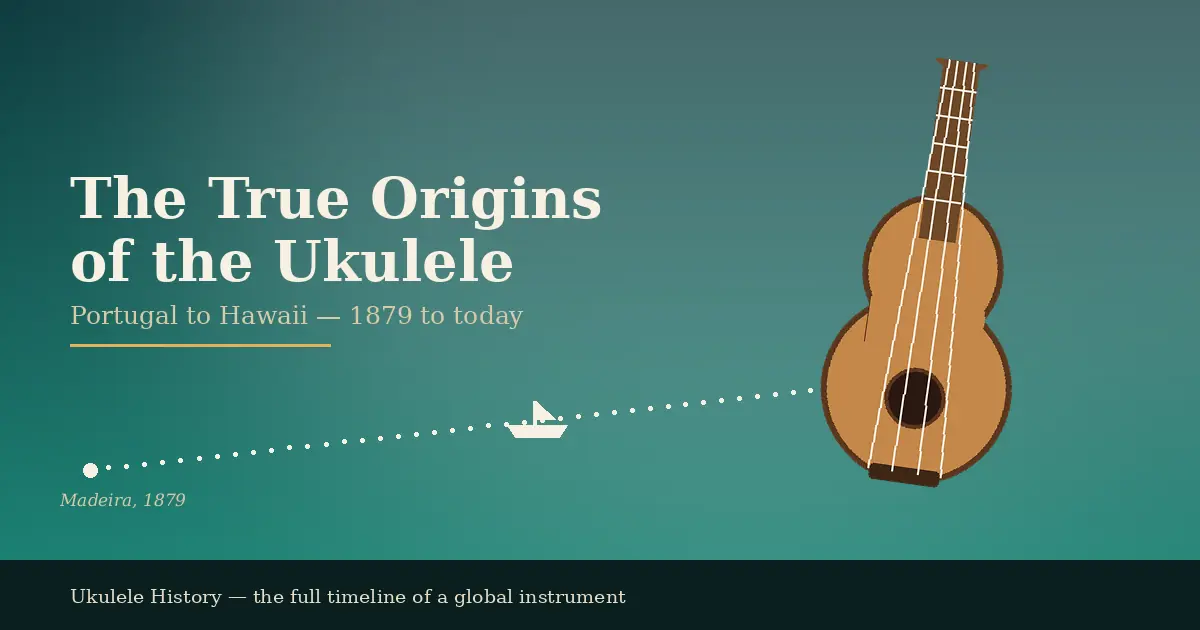
First Ukulele Ever Made: Tracing Its True Origin
No single craftsman sat down one morning and invented the ukulele. The first ukulele ever made emerged from a convergence of Portuguese craftsmanship, Hawaiian cultural hunger, and one remarkable sea voyage — and the full story is considerably more nuanced than the shorthand version most sources offer. On August 23, 1879, three Madeiran woodworkers stepped onto the docks of Honolulu Harbor with instruments and traditions that would, within a decade, become the sound of Hawaii. What they built in their workshops gave the world something genuinely new. Most histories credit the moment to a single man. But the reason a Hawaiian king took personal interest in what plantation workers were building — and what that patronage changed — is the detail most origin accounts quietly leave out.
Key takeaways:
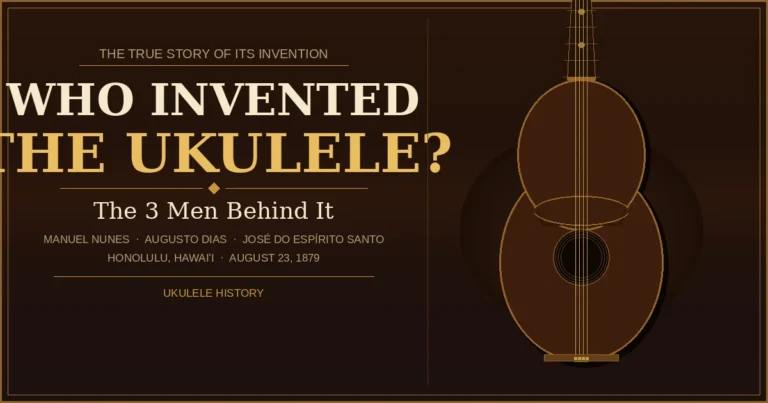
- The first ukuleles were built in Honolulu in the early 1880s by Madeiran immigrant craftsmen, primarily Manuel Nunes, Augusto Dias, and Jose do Espirito Santo.
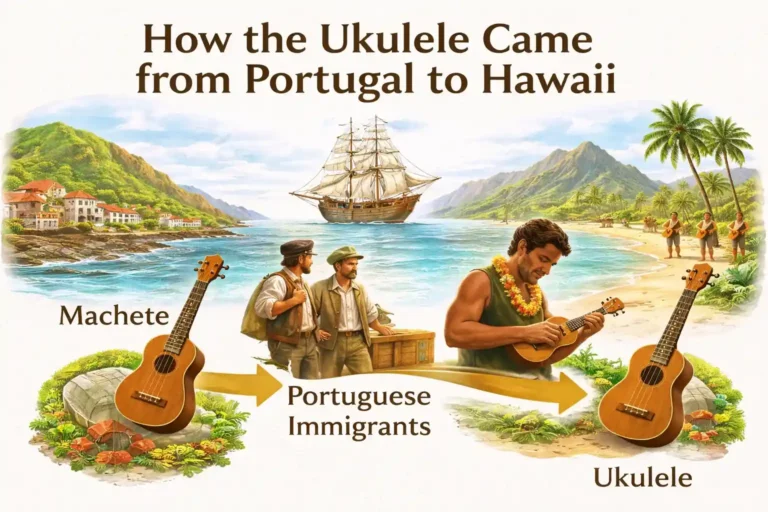
- The direct ancestor is the machete de braga (also called the braguinha), a four-stringed instrument from the Madeira Islands of Portugal.
- The British sailing ship Ravenscrag carried these craftsmen from Madeira to Honolulu, arriving on August 23, 1879 — the origin point most historians recognize.
- King Kalākaua’s active patronage elevated the instrument from an immigrant community novelty to a symbol of Hawaiian cultural identity within a decade.
- The ukulele’s re-entrant tuning — its high G string — descends not from the machete but from a second Madeiran instrument, the rajão.
- No historical record documents a single “first” ukulele. The instrument evolved gradually, making the story a process rather than a moment.
What was the first ukulele ever made?
The first ukulele was an adaptation, not an invention. Madeiran craftsmen who settled in Honolulu in the late 19th century modified the small four-stringed instruments they had brought from home, adjusting proportions, materials, and string configurations to suit Hawaiian conditions and Hawaiian tastes. The result was something that resembled its ancestors but sounded, and felt, distinctly different — different enough to need a new name.
The instruments that crossed the ocean
The machete de braga — sometimes shortened to “machete” and also known as the braguinha — is the ukulele’s closest ancestor. It originated in the Braga region of northern Portugal and spread deeply into Madeiran working-class culture. Four strings, a small resonant body, gut strings, and a bright, punchy tone: the machete provided the template that Honolulu craftsmen would refine over the following decade.
A second Madeiran instrument also shaped the ukulele’s character: the rajão. This five-stringed instrument’s most lasting contribution wasn’t its body shape. It was the re-entrant tuning principle — where the fourth string sits pitched higher than the third, rather than following a low-to-high sequence — that found its way into the ukulele’s DNA. That unconventional string relationship gives the instrument its characteristic ring, and it traces directly to how Madeiran players tuned the rajão.
Why Madeira, not mainland Portugal
Mainland Portugal had dozens of small string instruments in the 19th century. So why did Madeira, a small Atlantic archipelago roughly 900 kilometers off the coast of Morocco, produce the ukulele’s direct ancestors? Two factors converged. The machete was unusually embedded in Madeiran working-class culture — portable, inexpensive to build, and played at every level of society. And when the island’s sugar industry collapsed in the 1850s and 1860s, tens of thousands of workers emigrated. Hawaii’s plantation industry was actively recruiting laborers at exactly that moment, and the Madeiran workers who boarded those ships brought their tools and their music with them.
The Ravenscrag voyage: how the ukulele reached Hawaii
The clearest starting point in the ukulele’s Hawaiian story is the arrival of the British sailing ship Ravenscrag in Honolulu Harbor on August 23, 1879. The ship carried 419 Madeiran workers contracted as plantation laborers after a voyage of roughly four months and approximately 15,000 miles. Among the passengers were several skilled woodworkers whose trades would prove far more consequential than the sugarcane fields waiting for them.
| Year / Period | Event |
|---|---|
| 1850s–1860s | Madeiran sugar industry collapses; large-scale emigration begins |
| 1878 | Hawaii’s Board of Immigration recruits Madeiran plantation laborers |
| August 23, 1879 | Ravenscrag docks at Honolulu Harbor; Nunes, Dias, and Espirito Santo arrive |
| Early 1880s | First ukulele-style instruments appear in Honolulu workshops |
| Late 1880s | King Kalākaua incorporates the ukulele into royal court music |
| 1890s | “Ukulele” appears in Hawaiian-language newspapers |
| 1915 | Panama-Pacific International Exposition introduces the instrument to a mainland American audience |
Three craftsmen who changed music history
Manuel Nunes, Augusto Dias, and Jose do Espirito Santo all arrived on the Ravenscrag that August. All three were skilled craftsmen. All three eventually left plantation work and established instrument-making businesses in Honolulu. And all three are documented in Hawaiian historical records as makers of the instruments that would come to be called ukuleles.
Nunes is most frequently cited in historical accounts — partly because records of his workshop survive, and partly because he lived until 1922, long enough for his legacy to appear in early-20th-century newspaper accounts. Augusto Dias and Jose do Espirito Santo receive less attention in popular histories, but the most rigorous archival accounts, including those drawing on the Bishop Museum’s Hawaiian collections, acknowledge all three as contributors to the instrument’s early development.
Historian’s note: Crediting a single “inventor” flattens what was actually a collaborative, community-driven process. Nunes, Dias, and Espirito Santo worked in the same city, in the same era, building on the same Portuguese musical tradition. The ukulele wasn’t invented in a workshop — it was developed across workshops, over years.
João Fernandes and the dockside performance
Historical accounts — some drawing on contemporary Hawaiian newspaper records — describe a passenger named João Fernandes playing a machete aboard or immediately upon arrival in Honolulu, drawing a crowd to the dock. Whether this happened exactly as described or was shaped by later recounting is difficult to verify with certainty. But it captures something real: the machete’s sound was genuinely new to Hawaiian ears, and the reception it received in those early weeks helped establish the instrument as something worth building.
A new instrument takes root in Hawaiian soil
The earliest Madeiran craftsmen in Honolulu didn’t set out to build something new. They built what they knew. Over the following years, Hawaiian conditions shaped what they produced. Koa — a native Hawaiian hardwood with a warm, resonant tone and striking grain — became the preferred body material for many makers, replacing the spruce and cedar of the Madeiran originals. The result was a rounder sound with more sustain than the bright, punchy machete. By the late 1880s, what these craftsmen were producing was no longer simply a machete de braga. It was distinct enough to deserve its own name.
Who built the first true ukulele — and what sets it apart from its ancestors
The line between “the last machete” and “the first ukulele” is genuinely blurry, because the transition was gradual. But the instrument that emerged in Hawaii differed from its Portuguese ancestors in several measurable ways — in materials, in tuning philosophy, and in cultural function.
Manuel Nunes: the most documented early maker
Nunes operated an instrument-making business in Honolulu for decades. His instruments appear in Hawaiian newspaper accounts and in collectors’ records, and examples of his work survive in museum archives and private collections. He built in koa and in imported tonewoods, producing instruments across what we’d now call the soprano range. His name appears most often in the historical record, which is why he’s most frequently cited as the instrument’s “father” — though that title belongs, more accurately, to an entire generation of craftsmen working in parallel.
Augusto Dias and Jose do Espirito Santo
Both Dias and Espirito Santo are documented in Hawaiian historical records as instrument makers active in Honolulu during the 1880s and 1890s. Less documentation of their specific instruments survives compared to Nunes, but both are acknowledged in accounts drawing on archival sources from the Bishop Museum and related Hawaiian collections. Their role in those formative years was real, even when it’s less visible in popular histories.
The Hawaiian adaptation that made the ukulele distinct
The table below maps the key differences between the ukulele’s principal ancestors and the instrument that emerged in Honolulu, based on documented historical characteristics:
| Feature | Machete de braga | Rajão | Early Hawaiian ukulele |
|---|---|---|---|
| String count | 4 | 5 | 4 |
| Tuning style | Linear (ascending) | Re-entrant | Re-entrant (derived from rajão) |
| Body wood | Spruce, cedar | Spruce, cedar | Koa (native Hawaiian hardwood) |
| Approx. scale length* | ~34–38 cm | ~43–48 cm | ~33–36 cm (soprano range) |
| String material | Gut | Gut | Gut (later nylon) |
| Geographic origin | Braga / Madeira, Portugal | Madeira, Portugal | Honolulu, Hawaii |
| Cultural role | Folk and working-class music | Folk and working-class music | Royal patronage; cultural symbol |
*Measurements approximate; historical instruments varied by maker.
The re-entrant tuning — drawn from the rajão — is what most music historians consider the decisive break from the machete lineage. An instrument tuned linearly plays and sounds fundamentally different from one with an unexpected high string on the fourth course. That tuning choice, whether made by one of the Honolulu craftsmen in the early 1880s or inherited directly from Madeiran players already familiar with the rajão, is what gives the ukulele its open, modal character.
How the ukulele got its name
The word “ukulele” is Hawaiian, but its precise etymology within the language isn’t fully settled. Two competing explanations have circulated since the instrument’s early days, and neither has been definitively closed.
“Jumping flea”: the most common explanation
The prevailing origin breaks the word into “uku” (flea or small creature) and “lele” (jumping). Early observers watching fingers move rapidly across the fretboard compared the motion to a jumping flea. It’s vivid enough to stick, and it’s been repeated often enough to become the standard account you’ll find in most histories.
Queen Liliʻuokalani’s alternative interpretation
Queen Liliʻuokalani — a gifted composer and native Hawaiian speaker — offered a different reading. She parsed “ukulele” as “the gift that came here,” reading “uku” as gift and “lele” as arrived or came. Her interpretation carries genuine weight: she was a first-language speaker and a serious musician who had direct contact with the instrument’s early adoption in royal circles. Most music historians present both readings without declaring a winner. Written appearances of “ukulele” in Hawaiian-language newspapers date to the 1890s, and the Bishop Museum in Honolulu holds the most relevant primary documents for anyone pursuing the etymology further.
The Three-Stage Origin Arc: a framework for the ukulele’s true beginnings
Most origin accounts collapse a multi-decade process into a single founding moment. A more accurate framework breaks the story into three distinct stages — each one necessary, none sufficient on its own.
Stage 1 — The Madeiran seed (pre-1879): The machete de braga and rajão develop as instruments embedded in Madeiran working-class musical life. Craftsmen like Nunes, Dias, and Espirito Santo grow up building and playing these instruments. Sugar industry collapse creates the emigration pressure that will eventually carry these musicians and their knowledge across the Pacific.
Stage 2 — Hawaiian soil (1879–late 1880s): The Ravenscrag arrives. Craftsmen leave plantation work and open workshops in Honolulu. They build Portuguese instruments at first, but Hawaiian materials — especially koa — begin shaping the character of what they produce. Local communities, and eventually the royal court, take notice.
Stage 3 — Royal cultivation (late 1880s–1900): King Kalākaua becomes an active patron of the instrument. He incorporates it into royal court entertainments, transforming what had been a plantation community novelty into a marker of Hawaiian cultural identity. Within a decade, it’s no longer “the Portuguese instrument.” It’s Hawaiian.
The vignette that anchors the timeline
On August 23, 1879, the Ravenscrag docked at Honolulu Harbor after a voyage of roughly four months from Madeira. Among the 419 passengers were Manuel Nunes, Augusto Dias, and Jose do Espirito Santo — craftsmen whose plantation contracts would eventually give way to instrument-making workshops in the city. Within a decade, their work had produced an instrument distinct enough from its Portuguese ancestors to carry a new Hawaiian name. No single moment of invention was recorded. But that August docking is as close to a genesis point as the historical record allows.
What most histories get wrong about the ukulele’s origin
Misconception 1: the ukulele was invented in Hawaii
The ukulele didn’t appear from nowhere in Honolulu. Its body shape, four-string configuration, and playing technique all descend directly from the machete de braga. Its re-entrant tuning descends from the rajão. Without the Madeiran instrument-building tradition — and without the specific craftsmen who carried that tradition across the Pacific — there’s no ukulele. Hawaii gave the instrument its name, its primary tonewood, its royal endorsement, and its global identity. But the creative DNA arrived from the Atlantic.
Misconception 2: one person invented the ukulele
“Manuel Nunes invented the ukulele” appears in more casual histories than it should. Nunes was an important early maker. But Augusto Dias and Jose do Espirito Santo were working in the same tradition, in the same era, in the same city. The ukulele wasn’t the product of one workshop. It was developed across workshops, over years, by a community of Madeiran craftsmen adapting an inherited musical tradition to a new place. Crediting a single inventor is tidier for a headline. It’s not accurate.
FAQs
Who made the first ukulele ever? No single maker produced a definitive “first.” The instrument emerged from the workshops of Madeiran craftsmen in Honolulu in the 1880s — most notably Manuel Nunes, Augusto Dias, and Jose do Espirito Santo, all of whom arrived on the Ravenscrag in August 1879. All three are credited in historical records as early ukulele makers.
When was the first ukulele made? The ukulele developed gradually through the 1880s in Honolulu. The most defensible starting point is August 23, 1879 — the date the Ravenscrag arrived with the craftsmen and instruments that seeded the instrument’s development. A specific “first” ukulele with a documented creation date doesn’t exist in the historical record.
What instrument is the ukulele based on? The primary ancestor is the machete de braga (also called the braguinha), a four-stringed Portuguese instrument from Madeira. The rajão, also from Madeira, contributed the re-entrant tuning that gives the ukulele its distinctive high-G string. Both arrived in Hawaii with Madeiran immigrant workers in the late 19th century.
What does ukulele mean in Hawaiian? The most common translation is “jumping flea,” referencing rapid finger movement across the fretboard. Queen Liliʻuokalani offered an alternative: “the gift that came here.” Both readings are linguistically plausible, and neither has been definitively confirmed as the original intent.
Why did the ukulele spread so quickly in Hawaii? Two forces drove it. King Kalākaua actively promoted Hawaiian music and incorporated the ukulele into his royal court, giving the instrument a cultural legitimacy it might otherwise have taken decades to earn. And practically, it was accessible — portable, affordable to build, and playable by people across all levels of musical experience.
How is the ukulele different from a small guitar? The ukulele descends from the Portuguese machete de braga, not the guitar family. Its four strings are tuned to G-C-E-A, with the G string pitched higher than the C — a re-entrant arrangement found in its Madeiran ancestors but absent from the guitar. This structural difference produces the ukulele’s characteristic bright, modal sound, and it’s why skills learned on guitar don’t transfer automatically to ukulele playing.
Conclusion
The first ukulele ever made wasn’t born in a single moment of invention. It emerged from a convergence: Portuguese craftsmanship developed over generations in Madeira, a long ocean voyage on a ship called the Ravenscrag, the quiet work of three woodworkers adapting an inherited tradition to a new place, and the patronage of a king who understood that music could carry cultural weight.
The instrument’s true origin is a process story, not a creation myth. The most accurate answer to who built the first ukulele is several people, working in parallel, over several years, in workshops close to Honolulu Harbor.
For deeper dives into the craftsmen, the cultural arc, and the music that followed that 1879 landing, Ukulele History is where the story continues.
What top performers read—explore our success-oriented article collection.