
Jake Shimabukuro Biography: The Ukulele Virtuoso Story
Key takeaways:
- Jake Shimabukuro was born November 3, 1976, in Honolulu, Hawaii, and started playing ukulele at age four under his mother’s teaching.
- He studied for seven years under Tami Akiyami at Roy Sakuma Studios before ever performing publicly.
- His career launched with the trio Pure Heart in 1998, whose debut album won four Na Hoku Hanohano Awards.
- A 2005 performance of “While My Guitar Gently Weeps,” filmed in New York’s Central Park by a stranger, went viral on YouTube in 2006 and turned him into an international touring act.
- His solo catalog spans more than twenty albums and film scores, including the Billboard chart-topping Peace Love Ukulele and the Alan Parsons-produced Grand Ukulele.
- He’s collaborated with Bette Midler, Yo-Yo Ma, Béla Fleck, Jimmy Buffett, and Ziggy Marley, and was nominated by President Biden to the National Council on the Arts in 2021.
Who is Jake Shimabukuro?
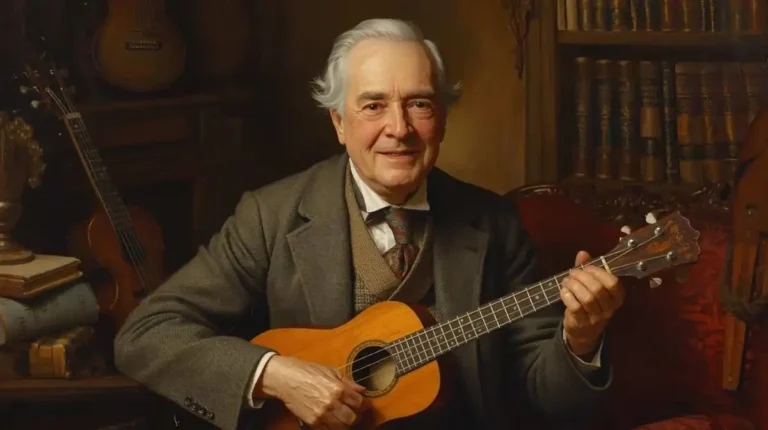
Jake Shimabukuro is an American ukulele player and composer from Honolulu, Hawaii, known for fingerpicking technique so fast and precise that fans and critics alike have nicknamed him “the Jimi Hendrix of the ukulele.” He writes original music and reworks songs across genres the instrument was never associated with before him, from Queen’s “Bohemian Rhapsody” to Schubert.
At a glance:
- Born: November 3, 1976, Honolulu, Hawaii
- Instrument: custom tenor ukulele, koa wood, built by Kamaka Ukulele
- Breakout moment: a 2005 Central Park video that went viral in 2006
- Nickname: “the Jimi Hendrix of the ukulele”
- Notable ambassador roles: Hawaii’s goodwill ambassador to Japan (2004), 160th Okinawa-Uchina Ambassador (2006)
Early life in Honolulu
Shimabukuro grew up in the Kaimuki neighborhood of Honolulu and attended Kaimuki High School. He’s a fifth-generation descendant of Japanese and Okinawan immigrants to Hawaii, and his family’s musical streak came through his mother, Carol, an accomplished ukulele player and singer who handed him his first instrument at age four. He loved it instantly and practiced for hours a day, though by his own account he was too shy to perform in front of anyone for years.
That shyness didn’t last. After his mother’s early lessons, Shimabukuro spent seven years training formally under Tami Akiyami at Roy Sakuma Studios in Honolulu. High school friends and his own music teacher eventually talked him into playing school assemblies, and he found he liked being on stage more than he expected to.
Jake Shimabukuro’s career timeline
Jake Shimabukuro’s career didn’t happen in one leap. It moved through distinct phases, each one built on the last, starting with a hometown trio and ending, so far, with collaborations that stretch from Nashville to the Grammy Museum stage.
Pure Heart and the Hawaii years (1994 to 2001)
Shimabukuro gained his first real attention in Hawaii in 1998 as the ukulele player in Pure Heart, a trio he formed with guitarist and vocalist Jon Yamasato and percussionist Lopaka Colón. He was working at a Honolulu music store at the time. Pure Heart’s self-titled debut album swept four Na Hoku Hanohano Awards, the Hawaiian equivalent of the Grammys, and was later named one of the top fifty Hawaiian albums of all time by Honolulu Magazine.
Going solo: Epic Records and early albums (2001 to 2004)
In 2001, Shimabukuro launched his solo career with his debut album, The Ehime Maru (In Memory Of), released on the independent label Surfside Records. A year later, in June 2002, he became the first ukulele player from Hawaii to sign with Epic Records International/Sony Music International, releasing the album Skyline. Around the same time, he began a multi-year run as the spokesman for Hawaii Tourism Japan, and in 2004 the State of Hawaii named him its goodwill ambassador to Japan, earning him the Japanese Foreign Minister’s Commendation for grassroots work on U.S.-Japan relations.
The Central Park video that changed everything (2005 to 2006)
In 2005, Shimabukuro released the album Dragon and, while touring, sat down near Strawberry Fields in New York’s Central Park to play through an arrangement of George Harrison’s “While My Guitar Gently Weeps” he’d just finished writing. A stranger with a camera filmed him without asking. The clip surfaced on the year-old video site YouTube and, by 2006, had become one of the platform’s first true viral hits. That same year he released the album Gently Weeps and was appointed the 160th Okinawa-Uchina Ambassador at a ceremony in the Okinawan State House.
Global collaborations and orchestral ambition (2007 to 2012)
The years after the video brought a run of high-profile work: scoring the Japanese film Hula Girls in 2007, joining Bette Midler on stage for the Royal Variety Performance in November 2009 (where the two later met Queen Elizabeth II), and scoring the Japanese remake of Sideways later that year. His 2011 album Peace Love Ukulele hit number one on Billboard’s World Albums chart the same month he married OB/GYN physician Kelly Yamasato. In 2012, he released Grand Ukulele, produced by Alan Parsons with orchestrations by Kip Winger and recorded live with no overdubs, and the documentary Jake Shimabukuro: Life on Four Strings premiered at festivals before airing repeatedly on PBS. His son, Chase, was born that August.
Genre-crossing and later career (2015 to present)
Shimabukuro kept releasing new work through the following decade: Travels in 2015, Nashville Sessions in 2016, and Trio in 2020, which reached number one on Billboard’s Contemporary Jazz Albums chart. In 2021, he released the collaborative album Jake & Friends, featuring artists including Willie Nelson, Bette Midler, and Warren Haynes, and that same year President Joe Biden nominated him to the National Council on the Arts. His 2023 album, Grateful, turned inward, focusing on partnerships with Hawaii-based musicians like Henry Kapono and Raiatea Helm.
| Year | Milestone | Why it matters |
|---|---|---|
| 1976 | Born November 3 in Honolulu, Hawaii | Start of a career now four decades long |
| 1980 | Receives his first ukulele from his mother, Carol | Marks his introduction to the instrument at age four |
| 1998 | Gains attention in Hawaii with the trio Pure Heart | Debut album wins four Na Hoku Hanohano Awards |
| 2001 | Releases solo debut, The Ehime Maru (In Memory Of) | First release under his own name |
| 2002 | Signs with Epic Records International/Sony Music International | First Hawaii ukulele player to land a major international deal |
| 2004 | Named Hawaii’s goodwill ambassador to Japan | Formal recognition of his cross-cultural reach |
| 2005 | Performs “While My Guitar Gently Weeps” in Central Park | A stranger’s unplanned recording later goes viral |
| 2006 | Central Park clip goes viral on YouTube; appointed Okinawa-Uchina Ambassador | International touring career begins |
| 2009 | Performs with Bette Midler at the Royal Variety Performance | Meets Queen Elizabeth II |
| 2011 | Peace Love Ukulele hits number one on Billboard’s World Albums chart | Commercial peak of his early solo career |
| 2012 | Releases Grand Ukulele; documentary Life on Four Strings premieres | Broadens his audience beyond ukulele enthusiasts |
| 2020 | Trio reaches number one on Billboard’s Contemporary Jazz Albums chart | Cements his standing in jazz, not just world music |
| 2021 | Nominated to the National Council on the Arts by President Biden | Recognition at the federal level |
How Jake Shimabukuro plays, and who he’s played with
Jake Shimabukuro plays fingerstyle rather than strumming, which lets him carry a melody, bassline, and rhythm part at once on an instrument most people associate with three or four simple chords. That technical range is what let him move between jazz, blues, funk, rock, bluegrass, classical, folk, and flamenco without the ukulele ever sounding out of place.
His main instrument is a custom tenor ukulele built by Kamaka Ukulele, a Honolulu maker with roots going back to the early twentieth century, strung with four nylon strings in the reentrant GCEA tuning common to soprano, concert, and tenor ukuleles. Koa wood, the material his instrument is built from, produces a warmer and more complex tone than the mahogany used on many budget models, with a brightness that carries well in large concert halls. Early in his career Shimabukuro experimented with effects pedals to expand his sound. By around 2011, he’d mostly set them aside, choosing to lean on the acoustic instrument’s natural voice instead, though he still uses a looping pedal on tour to build layered arrangements live.
His list of collaborators reads like a genre tour: bluegrass banjo player Béla Fleck, whose Flecktones he toured with in 2002, 2005, and 2006; cellist Yo-Yo Ma; singer Bette Midler; Jimmy Buffett and the Coral Reefer Band; and reggae artist Ziggy Marley, whose Grammy-winning album Love Is My Religion features Shimabukuro’s playing.
Historian’s note: Shimabukuro’s shift away from effects pedals around 2011 lines up almost exactly with the release of Peace Love Ukulele, his first album to hit number one on a Billboard chart. It’s a detail easy to miss, but it suggests his commercial breakthrough came from leaning into the ukulele’s own character rather than dressing it up to sound like something else.
| Career era | Approx. years | Core work | What it built |
|---|---|---|---|
| Bridge 1: Hawaii to Japan | 1998 to 2005 | Pure Heart, early solo albums, Hawaii Tourism Japan spokesman role | A loyal fan base in Japan years before most Americans knew his name |
| Bridge 2: Hawaii to the world | 2005 to 2012 | Central Park video, Gently Weeps, Peace Love Ukulele, Grand Ukulele | An international touring career and mainstream recognition of the ukulele as a solo lead instrument |
| Bridge 3: Ukulele to every genre | 2012 to present | Collaborations across jazz, bluegrass, classical, and pop; Trio; Jake & Friends | Proof the ukulele could carry genres it had never led before |
The Three Bridges of Jake Shimabukuro’s career
Most profiles frame Shimabukuro’s story around a single event: the Central Park video. That flattens a career that actually moved in three distinct stages, each one bridging the ukulele into a space it hadn’t occupied before. Call it the Three Bridges framework: Hawaii to Japan, Hawaii to the world, and ukulele to every genre. Each bridge built the audience the next one needed.
The clearest example of the second bridge happened on an ordinary touring afternoon. Sometime in 2005, Shimabukuro sat down near Strawberry Fields in Central Park and worked through his new arrangement of “While My Guitar Gently Weeps.” He had no plan to record it and no idea a stranger nearby had a camera running. That stranger uploaded the footage to YouTube, then barely a year old and still mostly known for home videos and skateboard falls. By 2006, the clip had spread far enough that concert promoters on multiple continents were calling his management, and Shimabukuro found himself booked to tour roughly nine months out of the year, a pace he’d later say he owed entirely to that one unplanned recording.
What the framework makes clear is that the video didn’t create Shimabukuro’s career. It connected a career that already existed in Hawaii and Japan, built over seven years of albums and an ambassador role, to an audience that had never heard of the ukulele as anything but a novelty.
Common misconceptions about Jake Shimabukuro
A few details about Shimabukuro get flattened or misremembered in casual write-ups. Two are worth untangling directly.
Is Jake Shimabukuro ethnically Native Hawaiian?
No. Shimabukuro was born and raised in Hawaii, but he’s a fifth-generation descendant of Japanese and Okinawan immigrants, not ethnically Native Hawaiian. The distinction matters because “Hawaiian” is generally reserved as an ethnonym for Native Hawaiians specifically, while “from Hawaii” describes anyone raised in the islands regardless of ancestry. Shimabukuro has spent much of his career honoring Native Hawaiian musical traditions while also representing his own Japanese-Okinawan heritage through ambassador roles in Japan and Okinawa.
Did the YouTube video make him famous overnight?
Not really. By the time the Central Park clip went viral in 2006, Shimabukuro had already spent roughly seven years building a real career: co-founding Pure Heart in 1998, signing to Epic Records International in 2002, touring internationally with Béla Fleck & the Flecktones, and being named Hawaii’s goodwill ambassador to Japan in 2004. The video accelerated an existing career and introduced it to a new, much larger audience. It didn’t invent one from nothing.
FAQs
Is Jake Shimabukuro self-taught? Not entirely. His mother, Carol, gave him his first lessons at age four, and he then studied formally for seven years under Tami Akiyami at Roy Sakuma Studios in Honolulu. His genre-crossing arrangements in jazz, rock, and classical styles, though, he largely worked out on his own by ear.
What ukulele does Jake Shimabukuro play? He plays a custom tenor ukulele built by Kamaka Ukulele, a longstanding Honolulu instrument maker. It’s made from koa wood and strung with four nylon strings in standard GCEA tuning, the same reentrant tuning used on most soprano, concert, and tenor ukuleles.
How did Jake Shimabukuro become famous internationally? A stranger filmed him playing “While My Guitar Gently Weeps” in New York’s Central Park in 2005. The clip was posted to YouTube without his knowledge and went viral in 2006, turning years of steady work in Hawaii and Japan into a global touring career almost overnight.
Is Jake Shimabukuro married? Yes. He married OB/GYN physician Kelly Yamasato in May 2011. The couple has a son, Chase, born in August 2012.
Has Jake Shimabukuro won a Grammy? Not personally, no. He’s won multiple Na Hoku Hanohano Awards, Hawaii’s equivalent of the Grammys, and he played on Ziggy Marley’s Grammy-winning album Love Is My Religion, but he hasn’t received a Grammy nomination of his own.
What genres does Jake Shimabukuro play? His music moves across jazz, rock, blues, bluegrass, classical, folk, and flamenco, along with original compositions rooted in Hawaiian music. He’s as comfortable covering Queen’s “Bohemian Rhapsody” as he is scoring a Japanese film soundtrack.
The takeaway
Jake Shimabukuro’s biography isn’t really a story about one viral video. It’s a story about seven quiet years of practice and touring that made the viral moment possible, followed by two more decades of pushing a four-string instrument into rooms it had never been invited into before, from Grammy Museum stages to orchestral halls. If you want to hear where that journey started, Dragon and Gently Weeps are the two albums that bracket the Central Park video itself. Ukulele History will keep tracking the players, like Shimabukuro, who keep redrawing what this instrument can do.
Read once, apply forever—our timeless knowledge posts never go out of style.